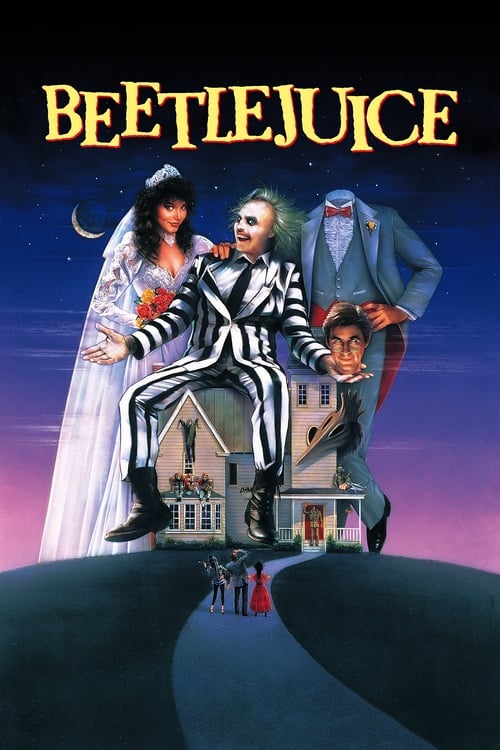
Film · 1988
Beetlejuice
Tim Burton
The afterlife as a waiting room with a sandworm problem. Gleefully unhinged.
29Mild to sit through, out of 100 — mostly how relentless it is
- PaceBuilds, then strikes56
- ThreatMostly supernatural25
- GoreHolds back30
- ToneHas a sense of humour82
- RealityPure nightmare logic92
Era bias 22 · Analog-leaning. Texture rather than fear, so it is not part of the grade. All six scores →
The most surreal horror movies ever made →
On VHSCREAM’s six-axis scale, Beetlejuice (1988) is most extreme on the reality-anchor axis: 92 out of 100, where 0 is grounded realism and 100 is dream logic. 98% of the 320 horror works we have scored come in lower on that axis. How we score →
Beetlejuice is a 1988 horror comedy directed by Tim Burton, in which a newly dead couple hire a freelance bio-exorcist to remove the living family that has moved into their house. We score it 092 on reality anchor — joint-fourth of 320 works on that axis — and 082 on tone, which is what lets it get away with being about suicide, death and child endangerment.
Scored and reviewed by VHSCREAM on · how we score
How scary is Beetlejuice, actually?
Not much, and in a specific direction.
Tone 082 is high, and the film never lets anything sit long enough to become dread. Viscera 030 is well below the index median — the horror imagery is distortion, prosthetics and stop motion rather than injury, and there is almost no blood in the film.
Where it does unsettle is reality anchor 092, joint-fourth of 320 works. The rules of the afterlife are arbitrary and explained only partially, the geography does not behave, and the film's images — the shrinking heads, the flattened faces, the man with his own head on a plate — are genuinely strange rather than frightening. Children who saw this at the wrong age tend to remember specific shots for decades.
The other genuine discomfort is Betelgeuse himself, whose aggression toward Lydia is written as aggression. The film is funny about him and never pretends he is safe.
Who should skip Beetlejuice
Skip it if you need a tight plot. The third act resolves by escalation and several threads are simply abandoned.
Skip it expecting the stage musical or the sequel's register. This is a stranger, colder and more adult film than its reputation as a Halloween staple suggests — the opening is a suicide-adjacent car accident and the climax is a forced marriage.
Skip it if 1988 practical and stop-motion effects read as cheap to you rather than as texture. At 022 on era bias it is one of the most analog-feeling films we hold.
Beetlejuice on six axes of fear
Every work in the index is scored on six continuous axes of fear. This is what Beetlejuice looks like as a vector — and what each ten-point band looks like across everything else we hold.
Where that puts it: joint #1 surreal · joint #10 funniest
Draft score — awaiting human review. About these scores
Disagree with a number? Say so on the axis itself. Nobody has confirmed this vector yet, and a score you challenge goes to the top of the queue to be re-scored by a human. Votes do not move the numbers — they decide what gets looked at first. How the scoring works →
Scored against the published rubric. This vector is a draft awaiting review — the method is public so you can argue with it.
Where to find it
Streaming on HBO Max ↗Physical copies on eBay ↗Availability from JustWatch via TMDB. We earn nothing from these links.
Nothing loads from YouTube until you press play.
Beetlejuice: the review
Beetlejuice is a film about the afterlife as an administrative failure, and it is the one Burton film where his design instincts and his sense of humour are pulling in exactly the same direction.
Adam and Barbara Maitland drive off a bridge in the first ten minutes and come back to find they are still in their house, cannot leave it, and have been issued a Handbook for the Recently Deceased written in the register of a tax document. The afterlife has waiting rooms, case workers, a number system and a caseload; the dead are processed. Juno, their case worker, smokes through a slit in her throat. This is the funniest and most original idea the film has, and it is almost incidental to the plot.
The plot concerns the Deetzes, who buy the house and begin renovating it into a sculpture gallery, and the Maitlands' increasingly desperate attempts to frighten them out. The comedy of the middle act is that the Maitlands are bad at haunting — their best effort is a bedsheet — and the only person who can see them is Lydia, the teenage daughter, who is delighted.
Then Betelgeuse. Michael Keaton is on screen for about seventeen minutes and the film is named after him, which is the correct ratio. The performance is genuinely unpleasant under the gags: a leering, sexually aggressive, enormously powerful creature who is funny for exactly as long as he is contained and frightening the moment he is not. The film is clear-eyed about this. He is not an anti-hero and he is not redeemed.
Our viscera score of 030 is low, which surprises people — the film's horror imagery is extensive but almost entirely prosthetic distortion rather than injury. Era bias 022 is where the film sits furthest from now: the stop-motion, the matte work and the Danny Elfman score make it a 1988 artefact in the best way, and the sandworms have aged into something better than modern effects would have managed.
What dates it is the plotting, which is loose, and the third act, which resolves by escalation rather than by design. The parts that endure are the production design, Keaton, and the deadpan premise that eternity has paperwork.
The ending of Beetlejuice explained
The ending, in full. Open it when you have seen it.
The short answer: Betelgeuse is released and attempts to marry Lydia in order to make his freedom permanent. Barbara interrupts the ceremony by riding a summoned sandworm through the attic, which swallows him. The Maitlands and the Deetzes then agree to share the house, and Lydia — now part of both families — is rewarded for good grades with a dance she performs in mid-air to the Banana Boat Song.
Why does Betelgeuse want to marry Lydia?
Because marriage to a living person is his route out of the afterlife's rules. He has been summoned and dismissed repeatedly through the film, and a wedding would make the arrangement permanent and unbreakable. The film does not dress this up: it is a forced marriage to a teenager, and everyone in the scene understands it as the horror it is, which is why Barbara's intervention plays as rescue rather than as spectacle.
How is Betelgeuse defeated?
Barbara rides a sandworm. Having learned earlier that the creatures inhabit the world outside the house and will eat anything, she goes out, gets one, and brings it back through the attic to swallow him mid-ceremony. It is the most Burton solution available and it works because the film established the rule an hour earlier.
What happens to Betelgeuse after the wedding?
He ends up in the afterlife's waiting room, which is the joke the film closes on: a shrunken-headed version of him sits in a queue, having been bumped down the system by a receptionist he annoyed. He is not destroyed. The film is explicit that he is simply inconvenienced, which is both funnier and more consistent with its view of death as bureaucracy.
Do the Maitlands get rid of the Deetzes?
No, and that is the resolution. Having spent the film trying to evict each other, the two families settle into cohabitation — the Maitlands get the house they could not leave, the Deetzes get the daughter they could not reach, and Lydia gets two sets of parents. The haunting ends not with an exorcism but with an arrangement.
If Beetlejuice is your kind of fear
The eight works closest to Beetlejuice in the index on the five axes that describe fear, the same medium first — not by genre label, and not by what other people watched.
Freddy's Dead: The Final Nightmare
Rachel Talalay · 1991 · Film
Shares dream logic.
84% shared signal
Gremlins
Joe Dante · 1984 · Film
Shares a threat that is not human.
77% shared signal
A Nightmare on Elm Street 4: The Dream Master
Renny Harlin · 1988 · Film
Shares dream logic.
77% shared signal
Army of Darkness
Sam Raimi · 1993 · Film
Shares gleeful black comedy.
76% shared signal
Drag Me to Hell
Sam Raimi · 2009 · Film
Shares a threat that is not human.
73% shared signal
Phantasm
Don Coscarelli · 1979 · Film
73% shared signal
Poltergeist
Tobe Hooper · 1982 · Film
71% shared signal
A Nightmare on Elm Street 3: Dream Warriors
Chuck Russell · 1987 · Film
71% shared signal
More lists like these: Movies like Poltergeist
Questions about Beetlejuice
The things people actually ask about this film, answered — including how it ends.
What happens at the end of Beetlejuice?
Betelgeuse tries to marry Lydia to escape the afterlife's rules permanently, and Barbara stops the ceremony by riding a sandworm into the attic to swallow him. He ends up in the afterlife waiting room with a shrunken head, and the Maitlands and Deetzes agree to share the house with Lydia as the link between them.
Why is the film spelled Beetlejuice but the character Betelgeuse?
The character's name is the star Betelgeuse, and the title uses the phonetic spelling because the joke of the film is that saying the name three times summons him. The handbook rules require it to be spoken, not written.
Is Beetlejuice a horror film or a comedy?
A horror comedy, and by our numbers much more comedy than horror: 082 on tone and only 030 on viscera. What keeps it in the genre is its imagery and its subject — it is a film about death, processed.
Is Beetlejuice suitable for children?
It carries a PG in the US and a 15 in the UK, which tells you how much the two certifications disagree. There is no gore, but there is a suicide-adjacent opening, a forced marriage to a teenager and a run of genuinely upsetting prosthetic imagery.
How much is Michael Keaton actually in Beetlejuice?
About seventeen minutes of a ninety-two minute film. The restraint is deliberate and it is why the performance works — he is funny while contained and frightening the moment he is loose.
These are ranked against Beetlejuice, not against you.
Build your own tape →