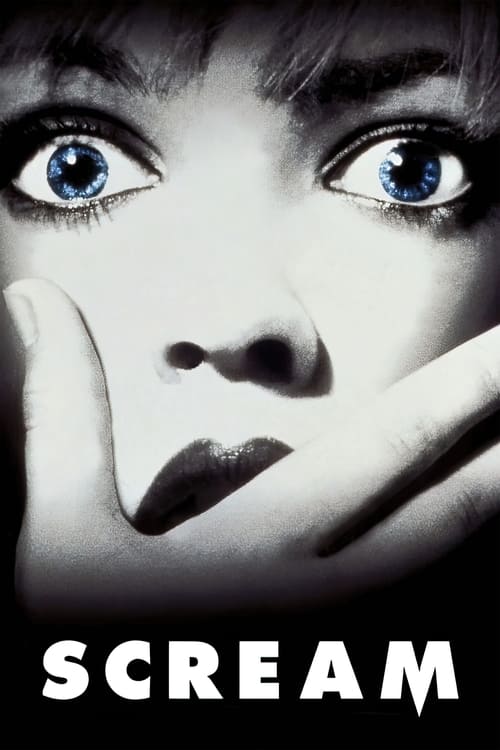
Film · 1996
Scream
Wes Craven
The slasher explains itself while committing itself. Still the sharpest of them.
Most extreme on THE THREAT — human monsters at 096
On VHSCREAM’s six-axis scale, Scream (1996) is most extreme on the threat axis: 96 out of 100, where 0 is a supernatural threat and 100 is human monsters. 96% of the 105 horror works we have scored come in lower on that axis. How we score →
Scream is a 1996 slasher directed by Wes Craven and written by Kevin Williamson. A masked killer stalks a California town where everybody has seen the films the killer is copying. We score it 096 on the threat axis — joint-second of 105 works, the human end of the scale — and 072 on tone, which makes it one of the least bleak films we hold.
Scored and reviewed by VHSCREAM on · how we score
Scream: the review
Scream is the only self-aware horror film that is also frightening, and the reason is that Craven never lets the commentary take a scene off.
The opening twelve minutes are the proof. Casey Becker answers a phone, plays along with a flirtatious stranger, and is quizzed on horror trivia with her boyfriend's life as the stake. It is funny, then it is not, and it ends with a teenager gutted and hung from a tree while her parents arrive home. Drew Barrymore was the biggest name in the cast and the film kills her before the title. Craven understood that the joke only works if the knife is real.
Williamson's script is genuinely well built. Every character is a suspect and every suspect has a reason, the exposition is delivered as teenagers showing off, and the rules-of-horror monologue works because the person delivering it is annoying rather than authoritative.
Ghostface is a bad killer and that is the point
He trips. He is winded. He gets hit with a phone, a door, a television. Every other slasher antagonist is implacable; this one is two people in a costume who are improvising badly, and the fights are scrappy rather than stately. It is the single biggest departure from the formula and almost nobody noticed because the mask is so good.
What it did to the genre
It rebuilt a market that had collapsed. The slasher was dead in 1996 — the franchises had run to parody and the audience had gone — and Scream made a hundred and seventy million dollars by treating the audience's genre literacy as the subject rather than a problem. Everything from I Know What You Did Last Summer to twenty years of meta-horror follows it.
Where it shows
The commentary occasionally stops the film to make a point. Some of the supporting performances are broad. And the film's final-act tone swings between farce and brutality in a way that works for about seventy per cent of viewers.
For the slasher it is deconstructing, Halloween; for the same meta-attitude with the volume up, Terrifier 2 is the modern end of this axis.
The ending of Scream explained
Total spoilers from here. Everything above this line is spoiler-free.
The short answer: there are two killers. Billy Loomis, Sidney's boyfriend, and Stu Macher, his friend. Billy's motive is that Sidney's mother had an affair with his father and broke up his family, so he killed her a year earlier and framed an innocent man. Stu's stated motive is peer pressure. Sidney kills both — Stu with a television, Billy with an umbrella and then a gunshot from Gale — and Randy survives being shot.
Who is Ghostface in Scream?
Billy Loomis and Stu Macher, working together, which is how the film sustains alibis that would otherwise collapse. One is on the phone while the other is in the room; both take genuine injuries to appear to be victims. The two-killer structure is also what lets the film play fair — every clue points at one or the other.
Why does Billy kill Sidney's mother?
Because Maureen Prescott had an affair with Billy's father, which caused Billy's mother to leave. He killed Maureen a year before the film begins, and Cotton Weary was convicted of it on Sidney's own testimony. The whole plot is a year-old murder being finished, and Sidney's role in convicting the wrong man is the reason the killer is interested in her.
What is Stu's motive?
He does not have one, and the film makes a joke of it — asked why, he says peer pressure. That is a real answer within the film's logic: Stu is a follower who found something to follow. It also lets the film decline the thing it has been mocking, which is the slasher's habit of supplying a tidy psychological reason.
Do the rules work in Scream?
They are stated and then selectively broken, which is the design. Randy's rules — never say "I'll be right back", virgins survive, never assume the killer is dead — mostly hold, and the film enjoys honouring them. The one it breaks hardest is the opening: the famous actress dies first, which is the rule nobody had thought to state.
How scary is Scream, actually?
Scored against the published rubric, here is what the numbers mean.
The threat at 096 is the highest in the index. Only 1 work scores higher. There is nothing supernatural anywhere in Scream — two teenagers in a costume with a knife and a mobile phone — and the film is explicit that this is the point.
Tone 072 is remarkably high — 103 works score lower, which makes this one of the least bleak films we hold. It is a comedy for long stretches, the hero wins, the killers are humiliated before they die, and the film is having fun.
Viscera 052 is just above the median film — 59 works score lower. The gutting in the opening and the garage-door death are both explicit; most of the rest is quick.
Pace 072 is fast — 95 works are slower. The film opens with a twelve-minute set piece and does not slow down.
Era bias 026 reads analog — 39 works score lower. 1996 film stock, a Panavision look, and a plot that depends entirely on landline and early mobile technology.
Reality anchor 016 is grounded — only 4 works score lower. Everything in it is possible and most of it is mundane.
On jump scares: many, and they are well made. The closet, the cat flap, the garage.
Scream on six axes of fear
Every work in the index is scored on six continuous axes of fear. This is what Scream looks like as a vector.
Where that puts it: #2 human monsters · #4 grounded · #7 relentless
Disagree with a number? Say so on the axis itself. Nobody has confirmed this vector yet, and a score you challenge goes to the top of the queue to be re-scored by a human. Votes do not move the numbers — they decide what gets looked at first. How the scoring works →
Scored against the published rubric. This vector is a draft awaiting review — the method is public so you can argue with it.
Who should skip Scream
Skip it if the meta commentary will irritate you. Characters discuss horror films throughout, and viewers who want the genre played straight find it smug.
Skip it if teen sexual content and violence together is a hard limit. The film's treatment of Sidney's mother's affair is a plot engine, and the killer's interest in her is framed sexually at points.
Skip it if you want the implacable killer. Ghostface loses fights, trips over furniture and gets hit with household objects, which some viewers find deflating.
Content notes: a graphic disembowelling, a throat-cutting, a death by garage door, a shooting, the sustained terrorising of a teenage girl, and a murdered mother's sexual history used as motive.
Watch it if you want the smartest slasher ever made, you can take jokes in the same scene as a knife, and you want to see a dead subgenre brought back by one film.
Where to find it
Streaming on Netflix · fuboTV · Paramount Plus Premium +3 ↗Physical copies on eBay ↗Availability from JustWatch via TMDB. We earn nothing from these links.
Nothing loads from YouTube until you press play.
If Scream is your kind of fear
The eight works closest to Scream in the index, ranked by distance across all six axes — not by genre label, and not by what other people watched.
Dawn of the Dead
George A. Romero · 1978 · Film
Shares grounded realism.
72% shared signal
The Texas Chain Saw Massacre
Tobe Hooper · 1974 · Film
Shares human monsters.
68% shared signal
28 Days Later
Danny Boyle · 2002 · Film
Shares relentless shock.
64% shared signal
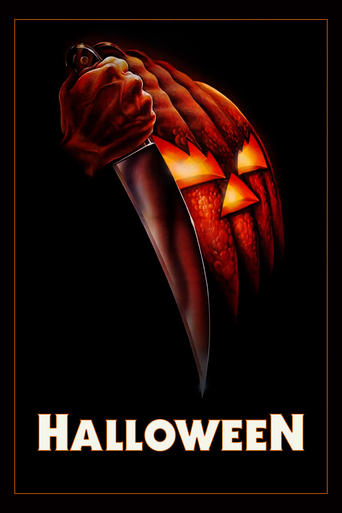
Halloween
John Carpenter · 1978 · Film
Shares analog-era texture.
63% shared signal
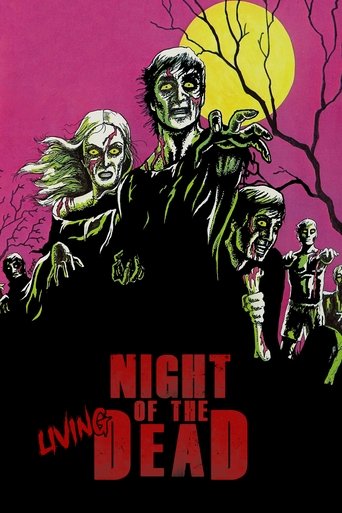
Night of the Living Dead
George A. Romero · 1968 · Film
Shares grounded realism.
63% shared signal

Halloween (OST)
John Carpenter · 1978 · Record
Shares analog-era texture.
62% shared signal
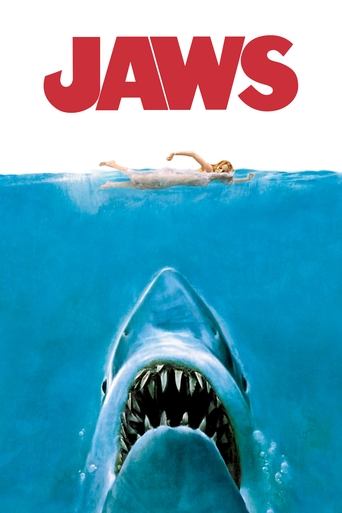
Jaws
Steven Spielberg · 1975 · Film
62% shared signal
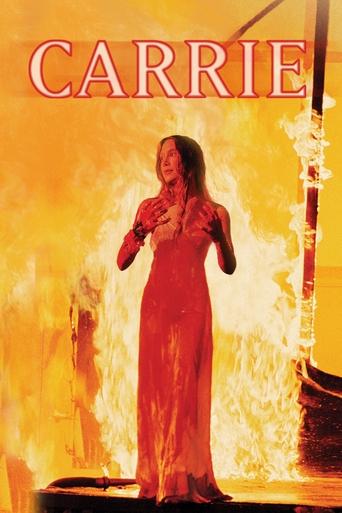
Carrie
Brian De Palma · 1976 · Film
61% shared signal
See the full list of movies like Scream →
Questions about Scream
The things people actually ask about this film, answered.
Who is the killer in Scream?
Two people — Billy Loomis, Sidney's boyfriend, and his friend Stu Macher, sharing the Ghostface costume. The pairing is how the film sustains alibis: one can be on the phone while the other is in the room, and both take real injuries to appear to be victims.
Why does Billy Loomis kill Sidney's mother?
Because Maureen Prescott had an affair with Billy's father, which caused his mother to leave. He murdered Maureen a year before the film, and Cotton Weary was convicted on Sidney's testimony. The plot is that year-old murder being completed.
What is Stu's motive in Scream?
He does not really have one. Asked directly, he says peer pressure, and the film plays it as a joke that is also sincere — Stu is a follower who found something to follow. It lets the film refuse the tidy psychological explanation it has spent ninety minutes mocking.
What are the rules of horror in Scream?
Randy states several: never say "I'll be right back", virgins survive, and never assume the killer is dead. The film mostly honours them. The one it breaks hardest is unstated — killing the biggest name in the cast in the opening twelve minutes.
Is Scream actually scary or is it a comedy?
Both, and the scoring shows the balance. At 072 on tone it is one of the least bleak films in our index, and at 096 on the threat axis it holds the highest human-threat score we have. The jokes are real and so is the knife.
How gory is Scream?
Moderately. We score it 052 on viscera, just above the median film in our index. The opening disembowelling and the garage-door death are explicit; most other kills are fast, and the film spends more time on chase than on injury.
These are ranked against Scream, not against you.
Build your own tape →