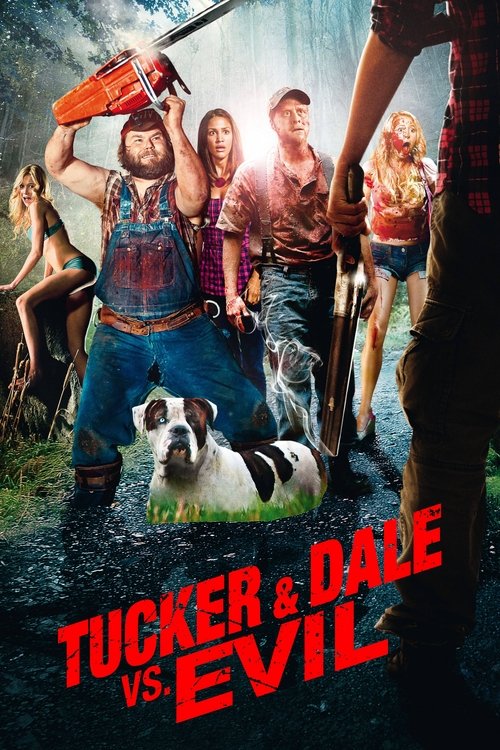
Film · 2010
Tucker and Dale vs Evil
Eli Craig
A slasher in which nobody is the killer. Every death is a misunderstanding.
45Strong to sit through, out of 100 — mostly how much it shows
- PaceJolts you often66
- ThreatPeople, entirely92
- GoreExplicit78
- ToneHas a sense of humour84
- RealityGrounded22
Era bias 70 · Modern. Texture rather than fear, so it is not part of the grade. All six scores →
Horror movies where the monster is a person →
On VHSCREAM’s six-axis scale, Tucker and Dale vs Evil (2010) is most extreme on the threat axis: 92 out of 100, where 0 is a threat that is not human and 100 is human monsters. 89% of the 320 horror works we have scored come in lower on that axis. How we score →
Tucker and Dale vs Evil is a 2010 horror comedy directed by Eli Craig, in which two amiable hillbillies on a fishing holiday are mistaken for murderers by a group of college students who then kill themselves trying to escape. We score it 092 on the threat axis — almost purely human — and 084 on tone, because the joke is that there is no monster at all.
Scored and reviewed by VHSCREAM on · how we score
How scary is Tucker and Dale vs Evil, actually?
Not very, with one caveat that matters.
Tone 084 sits near the gleeful end of our scale and the film never spends long in a frightening register. Reality anchor 022 means nothing supernatural ever threatens anybody, and pace 066 keeps it moving.
The caveat is viscera 078, which is well above the index median. The deaths are explicit, practical and often sudden, and the wood chipper sequence in particular is a genuinely nasty piece of effects work played for a laugh. Viewers who find practical gore difficult should treat the comedy as no protection whatever.
There is also an undertow the film is deliberate about. The students die because they are afraid of the wrong people, and the film's funniest scenes are also a reasonably bleak account of how that happens. Nobody in it is punished for cruelty; they are punished for assumption.
Who should skip Tucker and Dale vs Evil
Skip it if you dislike gore. At 078 on viscera this is more explicit than most straight slashers in this index, and the comic framing does not change the images.
Skip it if the one-joke structure will not hold you. The inversion is excellent and the film is built entirely on it; once Chad takes over as a conventional antagonist, roughly twenty minutes remain and they are the weakest part.
Skip it if broad accents and class comedy sit badly with you, even when the film is on the right side of the argument.
Tucker and Dale vs Evil on six axes of fear
Every work in the index is scored on six continuous axes of fear. This is what Tucker and Dale vs Evil looks like as a vector — and what each ten-point band looks like across everything else we hold.
Where that puts it: joint #8 funniest
Draft score — awaiting human review. About these scores
Disagree with a number? Say so on the axis itself. Nobody has confirmed this vector yet, and a score you challenge goes to the top of the queue to be re-scored by a human. Votes do not move the numbers — they decide what gets looked at first. How the scoring works →
Scored against the published rubric. This vector is a draft awaiting review — the method is public so you can argue with it.
Where to find it
Streaming on Philo · Magnolia Selects · Monsters and Nightmares +1 ↗Physical copies on eBay ↗Availability from JustWatch via TMDB. We earn nothing from these links.
Nothing loads from YouTube until you press play.
Tucker and Dale vs Evil: the review
The premise is a single inversion executed with real discipline. Every slasher convention is present — the woods, the derelict cabin, the locals with bad teeth, the group of students who split up — and the film simply moves the point of view. Tucker and Dale are the protagonists, they are kind, and they spend the film trying to help.
What makes it work rather than a sketch is that the script never cheats. Each death is a genuine accident caused by a student's own panic, and each is set up so the misunderstanding is legible to the audience and invisible to everybody in it. A boy dives into a wood chipper to escape men he thinks are murderers. Another impales himself on a branch. Dale, holding a chainsaw for entirely innocent reasons, runs screaming into a cabin because he has just disturbed a wasps' nest, and arrives looking exactly like the thing the students believe him to be. The gag is constructed, not asserted.
Alan Tudyk and Tyler Labine are the reason it lands. Both play the roles completely straight and with affection, and Labine in particular gives Dale a bruised self-consciousness about how people read him that turns the film's joke into its subject. The class politics are not subtle and are not meant to be: the students arrive at the lake assuming the men who live there are dangerous, the film kills nine of them to prove them wrong, and the one actual murderer in the cast is the privileged one.
Our viscera score of 078 is the thing people forget. This is explicit — the wood chipper is shown, the dismemberments are practical and wet, and the film is not interested in cutting away. Its reality anchor of 022 is near the grounded floor: nothing supernatural happens, no rules break, and every event has a mundane physical cause. That combination is unusual. Most films this comic are also more fantastical.
The weakness is the last twenty minutes, where the misunderstanding has run out and the film has to produce an actual antagonist. It is competent and it is less interesting than everything before it.
The ending of Tucker and Dale vs Evil explained
The ending, in full. Open it when you have seen it.
The short answer: Chad is the real killer. He is revealed to be the son of a woman who survived a massacre at the same lake in 1978 — the product of a rape by one of the killers — and he has inherited both the trauma and the violence. He abducts Allison, admits what he is, and dies when a shed explodes. Tucker and Dale survive, injured, and Dale and Allison end up together.
Who is the actual villain in Tucker and Dale vs Evil?
Chad, the group's self-appointed leader. The film seeds him carefully: he is the most hostile toward Tucker and Dale from the first scene, he escalates every misunderstanding deliberately, and he is the only student who kills on purpose. His hatred of hillbillies is revealed to be inherited — his mother survived the 1978 Memorial Day massacre at the lake, and Chad is the child of one of the men who attacked her.
Does anybody survive Tucker and Dale vs Evil?
Tucker, Dale and Allison. Every other student dies, almost all of them accidentally, and Chad dies in the shed explosion after Allison fights him off. The epilogue finds Dale and Allison together and Tucker recovering, which is the only sentimental note the film allows itself.
What was the 1978 massacre?
A backstory the film uses to give Chad a motive and to close its own argument. Students were murdered at the lake decades earlier by local men; Chad's mother survived. The film declines to make the original killers sympathetic — it is not arguing that no hillbilly was ever dangerous, only that these two are not, and that assuming otherwise is what killed nine people.
Is every death in the film genuinely an accident?
Almost. The students' deaths are self-inflicted panics — the wood chipper, the branch, the fire — and the film is rigorous about showing the chain of causation each time. The exceptions are Chad's own killings late in the film, which are deliberate, and which is how you know the register has changed.
If Tucker and Dale vs Evil is your kind of fear
The eight works closest to Tucker and Dale vs Evil in the index on the five axes that describe fear, the same medium first — not by genre label, and not by what other people watched.
Ready or Not
Matt Bettinelli-Olpin · 2019 · Film
Shares human monsters.
90% shared signal
The Texas Chainsaw Massacre 2
Tobe Hooper · 1986 · Film
Shares explicit viscera.
86% shared signal
You're Next
Adam Wingard · 2011 · Film
Shares grounded realism.
85% shared signal
Scream 4
Wes Craven · 2011 · Film
Shares human monsters.
84% shared signal
Scream VI
Matt Bettinelli-Olpin and Tyler Gillett · 2023 · Film
Shares explicit viscera.
83% shared signal
Scream
Wes Craven · 1996 · Film
Shares gleeful black comedy.
82% shared signal
Scream 2
Wes Craven · 1997 · Film
Shares grounded realism.
81% shared signal
Scream
Matt Bettinelli-Olpin and Tyler Gillett · 2022 · Film
80% shared signal
More lists like these: Movies like Scream
Questions about Tucker and Dale vs Evil
The things people actually ask about this film, answered — including how it ends.
What happens at the end of Tucker and Dale vs Evil?
Chad is revealed as the real killer — the son of a survivor of a 1978 massacre at the same lake, fathered by one of the attackers. He abducts Allison, confesses, and dies in a shed explosion. Tucker, Dale and Allison survive, and Dale and Allison end up together.
Why do the students keep dying in Tucker and Dale vs Evil?
Because they are panicking. Every student death is a self-inflicted accident caused by fleeing two men they wrongly believe are murderers — a dive into a wood chipper, an impalement, a fire. The film sets up each chain of causation so the audience sees the misunderstanding that nobody inside it can.
Is Tucker and Dale vs Evil a parody?
No. It uses every slasher convention and takes all of them seriously; what it changes is the point of view. Nothing in the film undercuts the danger — people really die, and the gore is real at 078 on our viscera axis.
Is Tucker and Dale vs Evil gory?
Yes, more than its reputation suggests. We score it 078 on viscera, above the index median and above several straight slashers we hold, and the practical effects are shown rather than implied.
Is there a monster in Tucker and Dale vs Evil?
No, and that is the point. At 092 on our threat axis it is almost purely human — nothing supernatural occurs, and the only deliberate violence in the film comes from a college student.
These are ranked against Tucker and Dale vs Evil, not against you.
Build your own tape →