Film · 2008
Saw V
David Hackl
Five strangers, four rooms, one lesson learned too late. Hoffman takes the chair.
80Punishing to sit through, out of 100 — mostly how bleak it is
- PaceBuilds, then strikes64
- ThreatPeople, entirely92
- GoreExplicit84
- ToneBleak16
- RealityGrounded28
Era bias 74 · Modern. Texture rather than fear, so it is not part of the grade. All six scores →
Horror movies where the monster is a person →
Part of a series: Saw movies in order →
On VHSCREAM’s six-axis scale, Saw V (2008) is most extreme on the threat axis: 92 out of 100, where 0 is a threat that is not human and 100 is human monsters. 89% of the 320 horror works we have scored come in lower on that axis. How we score →
Saw V is a 2008 American trap-horror film directed by David Hackl, written by Patrick Melton and Marcus Dunstan. Detective Hoffman is hailed as the hero of the Jigsaw case while an FBI agent hunts him, and five strangers wake collared in a sewer. We score it 092 on the threat axis and 084 on viscera.
Scored and reviewed by VHSCREAM on · how we score
How scary is Saw V, actually?
Scored against the published rubric, here is what the numbers mean.
The threat at 092 is near the human end — 284 works score lower. Every death is engineered by people — Kramer, from beyond the grave, and Hoffman, who has his own reasons.
Viscera 084 is high — 277 works score lower. A man cut in half by a pendulum after crushing his own hands, a decapitation by collar, an explosion, a corpse wired into an electrical circuit and two arms fed into saws.
Tone 016 is bleak — 103 works score lower. The investigator who is right dies, the killer is promoted, and the survivors are maimed.
Pace 064 is on the shock side, with 228 works slower. The sewer game is propulsive; the investigation is not.
Era bias 074 reads modern — 176 works score lower. The series' digital grading, sickly colour and late-2000s procedural look.
Reality anchor 028 is grounded — 63 works score lower. Everything is mechanical and buildable, and nothing in it bends physics.
On jump scares: a few, used as punctuation in the investigation rather than as the film's method.
Who should skip Saw V
Skip it if you have not seen Saw IV. The film assumes you know who Hoffman and Strahm are and what happened in the factory.
Skip it if police procedurals bore you. More than half of the film is an investigator reading files and making calls.
Skip it if you need the right person to win. The man who solves the case dies, and the killer is promoted.
Content notes: a man bisected by a pendulum after crushing his own hands, a decapitation, a death by explosion, a murdered woman's body used to complete an electrical circuit, self-inflicted wounds from saws, a man's head sealed in a box filling with water, an emergency tracheotomy, and a man crushed to death.
Watch it if you are following the series in order, you want Hoffman's origin, and you want the sewer game, which is one of the purest statements of what the traps were supposed to mean.
Saw V on six axes of fear
Every work in the index is scored on six continuous axes of fear. This is what Saw V looks like as a vector — and what each ten-point band looks like across everything else we hold.
Draft score — awaiting human review. About these scores
Disagree with a number? Say so on the axis itself. Nobody has confirmed this vector yet, and a score you challenge goes to the top of the queue to be re-scored by a human. Votes do not move the numbers — they decide what gets looked at first. How the scoring works →
Scored against the published rubric. This vector is a draft awaiting review — the method is public so you can argue with it.
Saw V: the review
Saw V has one very good idea, and it hides it inside a film that is mostly about a police officer filling in forms.
The good idea is the sewer game. Five strangers wake up with collars around their necks, each wired by a cable to a blade on the wall behind them, and a tape tells them they are all connected and must do the opposite of their instincts if they want to survive. They do not. They do exactly what people in these films always do — grab, shove, sacrifice the weakest — and they lose people at every stage. Then, in the last room, the two who are left work it out: every test could have been passed without a single death if they had cooperated. The keys in the first room would open any collar. The bomb shelters in the second held two people each. The circuit in the third only needed everyone to take a small, harmless shock together. The blood in the last room would only have cost two pints a head.
That is the cleanest statement of Kramer's philosophy in any of the sequels, and it is genuinely chilling, because the audience has been making the same assumptions as the people on screen. You watched them turn on each other and assumed it was the only move. It was not.
The game is staged as a descent through four rooms, and each one strips another layer of civility off the group. In the first, Ashley cannot reach her key in time and loses her head to the blade behind her. In the second, with explosives ticking down, Charles attacks Mallick and then Luba, and is left to die when the bombs go off while the other three shelter. In the third, Brit kills Luba and the survivors put her body in a bathtub to complete the circuit that unlocks the door. By the fourth, Brit and Mallick are the only two left, and only then do they read the rules properly. The structure is mechanical, but it works like a slow reveal: every room makes the final realisation crueller, because you have watched exactly what each death cost and how little it bought.
The other film is a procedural about Hoffman
The rest is a cat-and-mouse story between Detective Mark Hoffman, now revealed as Kramer's second apprentice, and FBI Agent Peter Strahm, who gets out of the previous film's factory only to wake with his head sealed in a box filling with water, and survives by giving himself a tracheotomy with a pen. Hoffman has been promoted and credited with closing the case. Strahm, put on medical leave, takes the case files of past victims and starts working backwards through Jigsaw's victims until he finds the one that does not fit.
That one is Seth Baxter, the convicted murderer in the opening scene, cut in half by a pendulum after he has crushed his own hands to escape it. Seth had killed Hoffman's sister, and it was Hoffman, not Kramer, who killed him; Kramer found out, abducted him, and blackmailed him into helping with future games. It is an origin story for a villain the series would lean on for the rest of its original run, and Costas Mandylor plays him as a man who has stopped being frightened of being caught.
Hackl's debut is tidier than the films around it
David Hackl had been production designer on the second, third and fourth films and second-unit director on two of them, and he brings a designer's orderliness. The sewer rooms are clearly laid out, the rules of each are legible, and the film is far easier to follow than Saw IV. Hackl said he wanted to give the audience an emotional investment in the people in the traps so they would not feel like any other gory horror film, and in the sewer story he largely manages it. Julie Benz, as Brit, is the standout; she said the shoot gave her nightmares, and her performance has a ragged, cornered quality the rest of the film lacks.
Tobin Bell, whose character died two films ago, shot new flashback scenes, and they are mostly Kramer explaining things to Hoffman. They are useful and lifeless. The film never finds a reason for him to be there beyond the series' need for him to be.
Where it falls down
The Strahm and Hoffman story is dull. It is a sequence of men looking at files, making phone calls and walking into rooms, and it takes up more than half the running time. Reviews at the time compared it to a basic-cable procedural, and that is not unfair.
The traps outside the sewer are punishments rather than tests. The pendulum is a striking image, but it is staged as an execution with a fig leaf of choice, which is exactly what the film later tells you it was.
And the ending, for all its neatness, depends on a hero who refuses to listen to a tape to the end. It is a strong final image built on a weak decision.
Audiences polled by CinemaScore gave it a C, the lowest grade of the franchise. It deserves better than that for the sewer alone, but not much better. See the Saw movies in order for where it fits; for the series at its sharpest, go back to Saw, and for another film about strangers who cannot stop turning on one another, The Platform.
The ending of Saw V explained
The ending, in full. Open it when you have seen it.
The short answer: two games end at once. In the sewer, Brit and Mallick reach the last room, realise that all five of them could have survived if they had worked together, and work out what connects them: all five were involved in a building fire that killed eight people. They each put an arm into the saws to fill the beaker with blood, Mallick taking the worst of it, and they survive — Agent Erickson finds them still alive and calls for medical help. Meanwhile Agent Strahm follows Hoffman to the nerve gas house, where a tape tells him to get into a glass-filled box. He stops the tape early, overpowers Hoffman and seals him in the box instead. The door locks, the walls begin closing in, and the box — with Hoffman safe inside it — is lowered beneath the floor. The rest of the tape says that if Strahm does not get into the box, he will die and be framed as Jigsaw's apprentice. He is crushed to death while Hoffman watches.
Who survives Saw V?
Brit and Mallick, the last two players in the sewer game, are found still alive by Agent Erickson after they each sacrifice an arm to the saws. Hoffman survives, safe in the box. Strahm does not: he is crushed between the closing walls. Corbett, Jeff's daughter, survived the previous film's events and is delivered to the police by Hoffman early on.
How does Strahm die in Saw V?
He ignores the instructions. A tape in the nerve gas house tells Strahm to get into a box filled with broken glass. He stops listening, ambushes Hoffman and puts him in the box instead. The box sinks below the floor, the room seals, the walls close in, and Strahm is crushed. The unheard end of the tape warned him exactly that.
What connects the five people in the sewer?
A building fire that killed eight people. Brit and Mallick work it out in the last room. Each of the five played a part in it, which is why the tape tells them they are connected. The game was designed so that all five could survive by cooperating, and the film makes that the point of the story.
Why did Hoffman kill Seth Baxter?
Seth had murdered Hoffman's sister, and Hoffman killed him — Seth is the man cut in half by the pendulum in the opening scene. John Kramer found out, abducted Hoffman and blackmailed him into helping set up future games. That is how Hoffman became the second apprentice revealed at the end of Saw IV.
If Saw V is your kind of fear
The eight works closest to Saw V in the index on the five axes that describe fear, the same medium first — not by genre label, and not by what other people watched.
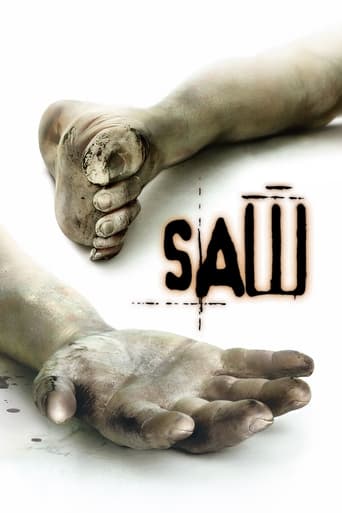
Saw
James Wan · 2004 · Film
Shares human monsters.
97% shared signal
Saw II
Darren Lynn Bousman · 2005 · Film
Shares a bleak, unforgiving tone.
96% shared signal
Saw IV
Darren Lynn Bousman · 2007 · Film
Shares explicit viscera.
95% shared signal
Saw III
Darren Lynn Bousman · 2006 · Film
Shares grounded realism.
95% shared signal
Saw X
Kevin Greutert · 2023 · Film
Shares human monsters.
95% shared signal
Spiral: From the Book of Saw
Darren Lynn Bousman · 2021 · Film
Shares a bleak, unforgiving tone.
94% shared signal
Saw VI
Kevin Greutert · 2009 · Film
Shares explicit viscera.
94% shared signal
Leatherface
Julien Maury and Alexandre Bustillo · 2017 · Film
Shares grounded realism.
93% shared signal
More lists like these: Movies like Saw
Questions about Saw V
The things people actually ask about this film, answered — including how it ends.
What happens at the end of Saw V?
Brit and Mallick survive the sewer game by each sacrificing an arm to the saws, and Agent Erickson finds them alive. Agent Strahm traps Hoffman in a glass-filled box instead of getting into it himself, but the box sinks to safety and the room's walls close in. Strahm is crushed to death while Hoffman watches.
Who is the killer in Saw V?
Detective Mark Hoffman, John Kramer's second apprentice, runs the games, using instructions Kramer left behind. The film reveals that Hoffman killed Seth Baxter, the man who murdered his sister, in the pendulum trap that opens the film. Kramer found out and blackmailed him into helping.
Could everyone have survived the sewer game in Saw V?
Yes. In the last room Brit and Mallick realise each test could have been passed by all five if they had cooperated: the keys fitted any collar, the bomb shelters held two each, the circuit needed only a small shared shock, and the last room needed two pints of blood from each person.
Does Agent Strahm die in Saw V?
Yes. He survives the water-box trap at the start by giving himself a tracheotomy with a pen, but at the end he ignores the tape's instruction to get into a box, puts Hoffman in it instead, and is crushed when the walls of the room close in.
Is Saw V worth watching?
Mostly for the sewer game, which is one of the clearest expressions of what Kramer's traps were supposed to teach. The investigation plot around it is slow, reviews were very negative, and audiences gave it a C on CinemaScore, the lowest grade of the series. We score it 084 on viscera.
These are ranked against Saw V, not against you.
Build your own tape →