Film · 2011
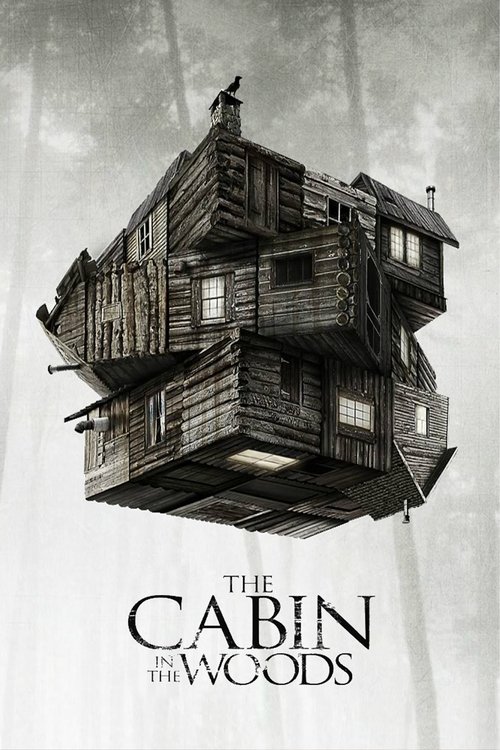
The Cabin in the Woods
Drew Goddard
The machine that makes horror films, shown working. Then the lift doors open.
51Strong to sit through, out of 100 — mostly how much it shows
- PaceBuilds, then strikes64
- ThreatHuman and not55
- GoreExplicit80
- ToneHas a sense of humour72
- RealityDream logic70
Era bias 74 · Modern. Texture rather than fear, so it is not part of the grade. All six scores →
The goriest horror movies ever made →
On VHSCREAM’s six-axis scale, The Cabin in the Woods (2011) is most extreme on the viscera axis: 80 out of 100, where 0 is restraint over gore and 100 is explicit viscera. 83% of the 320 horror works we have scored come in lower on that axis. How we score →
The Cabin in the Woods is a 2011 horror comedy directed by Drew Goddard and written with Joss Whedon, in which five students at a remote cabin are being manipulated by a subterranean agency running a ritual sacrifice. We score it 080 on viscera and 072 on tone — a film that explains the machinery of horror and then turns it on.
Scored and reviewed by VHSCREAM on · how we score
How scary is The Cabin in the Woods, actually?
Not very, and deliberately so after the first act.
Tone 072 and pace 064 combine into a film that is having a good time, and the characters are too thin by design for their deaths to land. The one properly frightening stretch is the merman gag and the elevator reveal, which are frightening because they are funny.
Viscera 080 is the number that matters. The last half hour is among the most explicit sustained sequences in this index — the monster release is a massacre, shown in detail, and the practical and digital gore is relentless. Several of the kills are nastier than anything in the straight slashers this film is about.
Its threat 055 sitting almost exactly at the midpoint is unusual and worth reading as a finding rather than a fudge. Most films fall clearly on one side. This one is structurally about the boundary: supernatural monsters operated by salaried humans.
Who should skip The Cabin in the Woods
Skip it if you want to be frightened. The film's project requires it to be clever rather than scary, and it chooses clever every time.
Skip it if a deliberately generic first act will lose you. Eighty minutes of competent formula precede the payoff, and knowing it is intentional does not make it more gripping.
Skip it if you dislike heavy gore. At 080 on viscera the final act is explicit and extended.
The Cabin in the Woods on six axes of fear
Every work in the index is scored on six continuous axes of fear. This is what The Cabin in the Woods looks like as a vector — and what each ten-point band looks like across everything else we hold.
Draft score — awaiting human review. About these scores
Disagree with a number? Say so on the axis itself. Nobody has confirmed this vector yet, and a score you challenge goes to the top of the queue to be re-scored by a human. Votes do not move the numbers — they decide what gets looked at first. How the scoring works →
Scored against the published rubric. This vector is a draft awaiting review — the method is public so you can argue with it.
Where to find it
Streaming on HBO Max · Philo · AMC Plus +2 ↗Physical copies on eBay ↗Availability from JustWatch via TMDB. We earn nothing from these links.
Nothing loads from YouTube until you press play.
The Cabin in the Woods: the review
The conceit is announced immediately, which is the film's first good decision: before any student appears, two technicians in short sleeves discuss childproofing over coffee in a strip-lit office. We know there is an apparatus. We do not know what it is for, and the film withholds that for an hour while running a competent, deliberately generic cabin slasher on the surface.
The surface layer is the weakest part and is meant to be. The five archetypes — athlete, scholar, whore, fool, virgin — are named as archetypes, chemically nudged into behaving like them, and dispatched by a family of pain-worshipping redneck zombies the group selects by accident. Everything that reads as lazy is being engineered by somebody on screen, and the film's running joke is a betting pool among departments on which monster the sacrifices will choose.
Then the lift. The last half hour is one of the most purely enjoyable sequences in modern horror: Dana and Marty reach the Facility, release every containment cell at once, and the film pays off every monster it has shown you on a whiteboard. It is gleeful, extremely violent, and formally interesting — a horror film arguing that the genre is an ancient appeasement mechanism and that the audience is the party being appeased.
What it gives up for that is any possibility of dread. Our pace score of 064 and tone of 072 describe a film moving too fast and enjoying itself too much to accumulate anything, and the characters are deliberately thin, which blunts the deaths. Its threat of 055 is almost exactly at the midpoint, and uniquely so: the monsters are supernatural, the people operating them are human, and the film is precisely about that division.
The argument is also where the criticism lands. If the thesis is that formulaic horror is a ritual the audience demands, the film still has to deliver eighty minutes of formulaic horror to make the point, and a thesis is not an excuse for the first act being the least interesting thing in it.
The ending of The Cabin in the Woods explained
The ending, in full. Open it when you have seen it.
The short answer: the Facility exists to sacrifice five archetypal young people each year to the Ancient Ones sleeping beneath it, and the ritual requires the whore to die first and the virgin last, by their own kind of monster. Dana and Marty survive long enough to reach the control room and release every captive monster, destroying the Facility. The Director explains the stakes directly; Dana nearly shoots Marty to complete the ritual and does not. The sun rises, the ritual fails, and an enormous hand erupts from the ground as the Ancient Ones wake and end the world.
What are the Ancient Ones in The Cabin in the Woods?
Gods that predate humanity and sleep underground, and whose continued sleep is purchased annually with the ritual. The film shows almost nothing of them — a hand, at the very end, large enough to flatten the cabin — which is the right choice, because the idea is more frightening than any design could be. The entire global apparatus of cabins, offices and betting pools exists to keep them unconscious.
Why does Marty have to die at the end?
The ritual requires the fool to die before the virgin, and both to die at all. Marty — the stoner, whose marijuana use has accidentally shielded him from the chemical manipulation all film — is the fool, and he is the one variable the Facility never controlled. Dana is given a gun and the choice, and she lowers it. The world ends because two people decline to be archetypes.
Does the world actually end in The Cabin in the Woods?
Yes, unambiguously. The sun comes up, the sacrifice is incomplete, the ground splits and a vast hand rises. Dana and Marty sit and share a joint while it happens. The film declines any last-minute reversal and ends on an extinction event played as a shrug.
What is the Facility and who works there?
A branch of a worldwide organisation running the same ritual simultaneously in several countries — the film shows failures in Sweden and Japan on monitors. Sitterson and Hadley are mid-level technicians who treat an annual human sacrifice as a job with a sweepstake attached, and that banality is the film's sharpest joke about the industry it is describing.
If The Cabin in the Woods is your kind of fear
The eight works closest to The Cabin in the Woods in the index on the five axes that describe fear, the same medium first — not by genre label, and not by what other people watched.
Seed of Chucky
Don Mancini · 2004 · Film
Shares explicit viscera.
90% shared signal
Bride of Chucky
Ronny Yu · 1998 · Film
Shares gleeful black comedy.
89% shared signal
Hellraiser III: Hell on Earth
Anthony Hickox · 1992 · Film
Shares dream logic.
82% shared signal
Sinners
Ryan Coogler · 2025 · Film
Shares explicit viscera.
81% shared signal
Jason X
James Isaac · 2002 · Film
Shares gleeful black comedy.
80% shared signal
Hellraiser
Clive Barker · 1987 · Film
Shares dream logic.
79% shared signal
Freddy vs. Jason
Ronny Yu · 2003 · Film
77% shared signal

Dangerous Days
Perturbator · 2014 · Record
77% shared signal
More lists like these: Movies like Sinners
Questions about The Cabin in the Woods
The things people actually ask about this film, answered — including how it ends.
What happens at the end of The Cabin in the Woods?
Dana and Marty reach the control room and release every captive monster, destroying the Facility. Dana refuses to shoot Marty to complete the ritual, so the sacrifice fails, the sun rises, and an enormous hand erupts from the ground as the Ancient Ones wake. The world ends.
What are the Ancient Ones?
Gods older than humanity, sleeping beneath the Facility, kept asleep by an annual sacrifice of five archetypal young people. The film shows only a hand at the very end, which is more effective than any full reveal would have been.
Why does the stoner survive longest in The Cabin in the Woods?
Because his marijuana use has accidentally made him immune to the chemicals the Facility uses to push the group into archetypal behaviour. Marty is the one variable they never control, which is why he is the one who works out that the cabin is a stage.
Is The Cabin in the Woods a horror film or a comedy about horror films?
Both, and the numbers show the balance: 072 on tone and 080 on viscera. It is genuinely funny and genuinely explicit, and its argument about the genre requires it to deliver the genre straight for most of its length.
Is The Cabin in the Woods connected to any other film?
No. It is a standalone, though its monster whiteboard references a great many other films and its Facility is implied to be one branch of a worldwide operation, with failed rituals in Sweden and Japan shown on monitors.
These are ranked against The Cabin in the Woods, not against you.
Build your own tape →