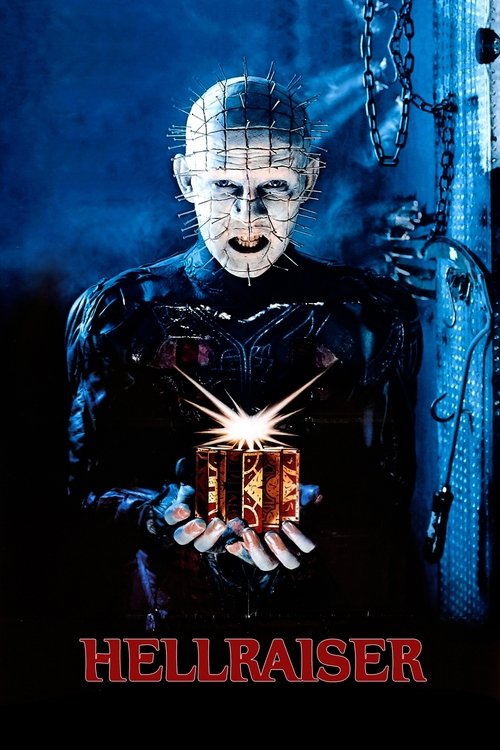
Film · 1987
Hellraiser
Desire and agony filed under the same heading.
Most extreme on VISCERA — explicit viscera at 090
On VHSCREAM’s six-axis scale, Hellraiser (1987) is most extreme on the viscera axis: 90 out of 100, where 0 is restraint over gore and 100 is explicit viscera. 92% of the 105 horror works we have scored come in lower on that axis. How we score →
Hellraiser is a 1987 horror film written and directed by Clive Barker, adapting his own novella The Hellbound Heart. A man solves a puzzle box and is taken apart by beings who do not distinguish pleasure from pain. We score it 090 on viscera — joint-seventh of 105 works — and 074 on reality anchor.
Scored and reviewed by VHSCREAM on · how we score
Hellraiser: the review
Hellraiser is a domestic melodrama with an abattoir in the spare room, and the melodrama is the better half.
The plot everyone remembers is the Cenobites. The plot that actually runs the film is Julia: a bored second wife who was having an affair with her husband's brother, and who, when his skinless remains reassemble in the attic, starts picking men up in pubs and bringing them home to be consumed so he can finish regrowing. Clare Higgins plays her with complete seriousness and it is the best performance in the film. Her arc is not corruption — she is relieved. She has finally been given something she wants to do.
Barker was a playwright and novelist directing his first feature on a small British budget, and it shows in both directions. The staging is sometimes flat and the suburban interiors are cheap. The ideas are unlike anything else in the genre.
The Cenobites are a theology, not a monster squad
They appear for perhaps six minutes. They are not demons and the film never calls them evil; they are an order, they were human, they were summoned by somebody who wanted the limits of sensation removed, and they deliver exactly that. The phrase the film gives them — explorers in the further regions of experience — is the whole design. The leather, the pins and the hooks are vestments.
Doug Bradley's Pinhead has eight lines and became an icon because the performance is courteous. He does not threaten Kirsty. He negotiates.
The effects and the score
Bob Keen's work on Frank's reassembly is the film's showpiece and still extraordinary — a body rebuilding itself out of floorboards in stop-motion and latex. Christopher Young's score is lush, orchestral and romantic, scored as though this were a tragedy rather than a horror film, which is a large part of why it does not feel like its imitators.
Where it is weak
The English cast dubbed to American accents is distracting. The engineer creature at the end is a cheap effect and lands badly. And the film's internal rules are explained in a hurry.
For the same flesh-as-sacrament in prose, Books of Blood is Barker's own; for the same practical-effects body work, The Fly.
The ending of Hellraiser explained
Total spoilers from here. Everything above this line is spoiler-free.
The short answer: Kirsty exposes Frank, who has killed Julia and is wearing his brother Larry's skin. The Cenobites arrive to reclaim him — he escaped them, which is the only crime they recognise — and tear him apart with hooks. Kirsty has to trick and banish them in turn by solving the box's configurations. She and Steve burn the house; a vagrant who has been watching all film transforms into a winged creature and flies off with the box, which reappears being sold in a market.
What are the Cenobites?
An order of beings summoned by the Lament Configuration. They were human and gave themselves to the limits of sensation, and they no longer distinguish pleasure from pain. The film is specific that they are not demons and not evil in their own terms — they answer a request. Whoever opens the box is understood to have asked.
How does the puzzle box work?
Solving the Lament Configuration opens a passage and summons the Cenobites to whoever solved it. Different configurations do different things — opening, closing, and banishing — which is how Kirsty survives: she reconfigures it rather than fighting. The box also appears to choose its owners, moving through hands and markets, always finding somebody who wants more than they have.
Why do the Cenobites want Frank back?
Because he escaped, and escape is the one thing their order does not permit. They have no interest in punishing him morally — Frank's murders are irrelevant to them. He left before the arrangement was complete, and the film's clearest line of theology is that the Cenobites do not care what you have done, only whether you are still theirs.
What is the deal Kirsty makes?
She offers them Frank in exchange for her own release, and they accept — then renege, because the deal was never binding on them. She survives only by working out the box's banishing configuration. The lesson the film teaches is the opposite of most horror: bargaining works right up until it doesn't, and the rules are not symmetrical.
Why is Julia the real villain?
Because every murder in the house is hers. Frank is a skeleton in an attic who can do nothing; Julia finds the men, brings them home and kills them with a hammer, and does it four times. The film understands that the horror is not the thing in the attic but the woman who decides to feed it.
How scary is Hellraiser, actually?
Scored against the published rubric, here is what the numbers mean.
Viscera 090 is near the ceiling — only 6 works score higher. Flaying, hooks, hammer murders, a body rebuilding itself, and a skinned man in a suit of someone else's skin.
Reality anchor 074 is on the dream-logic side — 83 works score lower. The Cenobites' corridor obeys no geography, and the film moves between a terraced house and somewhere else without explanation.
Era bias 012 is deep analog — only 21 works score lower. 1987 British film stock, latex, stop-motion, an orchestral score on tape.
Tone 040 is less bleak than the content suggests — 88 works score lower. Kirsty survives, Steve survives, and the film has a romantic streak that its reputation hides.
Pace 058 is on the shock side, with 77 works slower.
The threat at 045 is near the midpoint, which is correct: the Cenobites are supernatural and every murder in the film is committed by a human with a hammer.
On jump scares: a few, mostly the chattering teeth creature.
Hellraiser on six axes of fear
Every work in the index is scored on six continuous axes of fear. This is what Hellraiser looks like as a vector.
Where that puts it: #5 goriest · #7 surreal · #13 analog era
Disagree with a number? Say so on the axis itself. Nobody has confirmed this vector yet, and a score you challenge goes to the top of the queue to be re-scored by a human. Votes do not move the numbers — they decide what gets looked at first. How the scoring works →
Scored against the published rubric. This vector is a draft awaiting review — the method is public so you can argue with it.
Who should skip Hellraiser
Skip it if flaying or hooks are a hard limit. At 090 on viscera this is one of the most explicit films in the index, and the imagery is specifically about skin.
Skip it if sexual violence is a hard limit. The film's logic connects sensation and injury throughout, and the opening scene and Frank's history both rest on it.
Skip it if cheap 1987 effects break the spell. The final creature is poor and the dubbing is noticeable.
Content notes: flaying, four hammer murders, a body skinned and worn, implied sexual violence, incest-adjacent betrayal, and a sustained association of sex with injury.
Watch it if you want the most original mythology in horror, you can take the viscera, and you want to watch a domestic melodrama where the adulterous wife is the most compelling person on screen.
Where to find it
Streaming on Amazon Prime Video · fuboTV ↗Physical copies on eBay ↗Availability from JustWatch via TMDB. We earn nothing from these links.
Nothing loads from YouTube until you press play.
If Hellraiser is your kind of fear
The eight works closest to Hellraiser in the index, ranked by distance across all six axes — not by genre label, and not by what other people watched.

Books of Blood
Clive Barker · 1984 · Book
Shares explicit viscera.
87% shared signal
Videodrome
David Cronenberg · 1983 · Film
Shares analog-era texture.
87% shared signal

Profondo Rosso
Goblin · 1975 · Record
Shares dream logic.
80% shared signal
Suspiria
Dario Argento · 1977 · Film
Shares analog-era texture.
76% shared signal
The Fly
David Cronenberg · 1986 · Film
Shares explicit viscera.
75% shared signal
The Thing
John Carpenter · 1982 · Film
75% shared signal

Suspiria (OST)
Goblin · 1977 · Record
Shares dream logic.
75% shared signal

Candyman
Bernard Rose · 1992 · Film
74% shared signal
Questions about Hellraiser
The things people actually ask about this film, answered.
What happens at the end of Hellraiser?
Kirsty exposes Frank, who has killed Julia and is wearing his brother's skin. The Cenobites reclaim him with hooks for having escaped them, and Kirsty banishes them by reconfiguring the box. She and Steve burn the house, and the box is carried off and reappears for sale in a market.
What are the Cenobites in Hellraiser?
An order of formerly human beings summoned by the Lament Configuration, who no longer distinguish pleasure from pain. The film is explicit that they are not demons and not evil in their own terms — they answer a request, and opening the box counts as making one.
How does the puzzle box in Hellraiser work?
Solving the Lament Configuration opens a passage and summons the Cenobites to whoever solved it. Different configurations open, close and banish, which is how Kirsty survives — she reconfigures it rather than fighting. The box also seems to find owners who want more than they have.
Why do the Cenobites want Frank?
Because he escaped them, which is the only offence their order recognises. His murders are irrelevant to them. The film's clearest piece of theology is that the Cenobites do not care what you have done, only whether you still belong to them.
Is Julia the villain of Hellraiser?
Effectively, yes. Frank is a skeleton who can do nothing on his own; Julia finds the men, brings them to the attic and kills them with a hammer, four times over. Clare Higgins plays her as relieved rather than corrupted, and it is the best performance in the film.
How gory is Hellraiser?
Extremely. We score it 090 on viscera, with only a handful of works in our index above it. The imagery is specifically about skin — flaying, a reassembling body, and a man wearing his brother's — and it is all practical.
These are ranked against Hellraiser, not against you.
Build your own tape →