Film · 2022
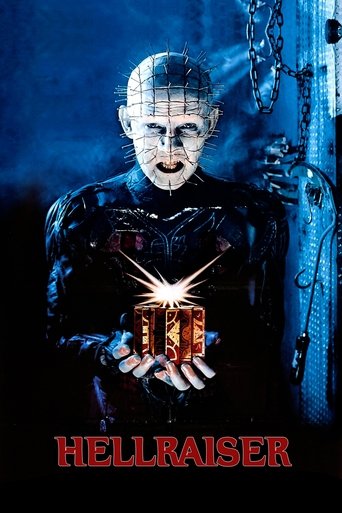
Hellraiser (2022)
A recovering addict, a box with six configurations, a Priest who keeps the accounts.
74Hard going to sit through, out of 100 — mostly how bleak it is
- PaceBuilds, then strikes48
- ThreatHuman and not38
- GoreExplicit78
- ToneBleak18
- RealityDream logic72
Era bias 88 · Thoroughly modern. Texture rather than fear, so it is not part of the grade. All six scores →
The bleakest horror movies ever made →
Part of a series: Hellraiser movies in order →
On VHSCREAM’s six-axis scale, Hellraiser (2022) is most extreme on the tone axis: 18 out of 100, where 0 is a bleak, unforgiving tone and 100 is gleeful black comedy. 37% of the 320 horror works we have scored come in lower on that axis. How we score →
Hellraiser is a 2022 American-Serbian supernatural body horror film directed by David Bruckner. A recovering addict, Riley, finds a puzzle box that takes her brother, and learns it needs six people marked by its blade before it will give anything back. We score it 078 on viscera and 088 on era bias.
Scored and reviewed by VHSCREAM on · how we score
How scary is Hellraiser, actually?
Scored against the published rubric, here is what the numbers mean.
The threat at 038 is on the supernatural side — 151 works score lower. The Cenobites take the victims, but a human collector and his recruit choose who gets cut.
Viscera 078 is high — 256 works score lower. A man torn apart by chains, a woman flayed in a hallway, a flayed brother and a Cenobite ripped apart, with heavy make-up effects throughout.
Tone 018 is bleak — 119 works score lower. The heroine loses her brother, kills her boyfriend and ends the film unsure she chose right.
Pace 048 sits near the middle, with 142 works slower. Long stretches of investigation, broken by the Cenobites' visits.
Era bias 088 reads modern — 267 works score lower. Clean digital photography, sleek production design and a streaming-era finish.
Reality anchor 072 leans surreal — 256 works score lower. A box that rewrites space, a decaying corridor out of Hell and a god who answers requests.
On jump scares: few. It is a slow, deliberate film that prefers ceremony to stings.
Who should skip Hellraiser
Skip it if you want the 1987 film's erotic charge. This version is sober, and keeps its distance from pleasure.
Skip it if a slow middle tests you. It spends a good deal of time on research and driving.
Skip it if addiction and relapse are hard subjects for you. Riley's recovery is central, and the film keeps testing it.
Content notes: flaying, a man torn apart by chains, impalement, stabbings, the death of a sibling, drug addiction and relapse, a betrayal by a partner, and sustained body horror.
Watch it if you want a serious reboot that treats the box as a moral trap, you want to see Jamie Clayton's Priest, and you prefer a slow, careful film to a loud one.
Hellraiser on six axes of fear
Every work in the index is scored on six continuous axes of fear. This is what Hellraiser looks like as a vector — and what each ten-point band looks like across everything else we hold.
Draft score — awaiting human review. About these scores
Disagree with a number? Say so on the axis itself. Nobody has confirmed this vector yet, and a score you challenge goes to the top of the queue to be re-scored by a human. Votes do not move the numbers — they decide what gets looked at first. How the scoring works →
Scored against the published rubric. This vector is a draft awaiting review — the method is public so you can argue with it.
Hellraiser: the review
Hellraiser (2022) takes the puzzle box seriously, and that seriousness is both its achievement and its limit.
The reboot had been in development since 2006, when Clive Barker announced he would write it. It passed through several sets of hands, among them Julien Maury and Alexandre Bustillo, Pascal Laugier, and Patrick Lussier with Todd Farmer, before Barker regained the US rights in 2020 and the version David Bruckner made was developed with David S. Goyer. Barker is a producer. The film was shot in Belgrade in the autumn of 2021 and went straight to Hulu in the United States in October 2022.
A box with rules
Bruckner's main contribution is mechanical. In Hellraiser the box was a door. Here it is a contract. It has six configurations; each one requires a person to be cut by a blade that springs out of it, and that person is taken; and the one who completes all six receives a gift from Leviathan, the ruler of Hell. That structure turns the film into something close to a moral thriller. Riley McKendry, a recovering addict living with her brother Matt, his boyfriend Colin and their roommate Nora, solves the first configuration in a park and dodges the blade. Matt, trying to wake her, is cut instead, and disappears. Everything Riley does after that is an attempt to bring him back by feeding the box other people, and the film does not let her off for it.
The prologue sets the stakes: six years earlier, a wealthy, hedonistic collector, Roland Voight, had a sex worker, Joey Coscuna, try to solve the box at an orgy in his mansion, and chains tore him apart. Voight's journals, found in his abandoned mansion, are how Riley learns the rules, and Voight himself turns out to be very much still in the house.
The Cenobites look superb
Jamie Clayton's Priest, the film's Pinhead, is quiet, precise and genuinely unsettling, a figure who speaks like a judge rather than a showman, and the redesigned Cenobites, the Chatterer, the Weeper, the Gasp, the Asphyx, the Masque and the Mother, are skinned, pinned and pared back to wet anatomy. Critics who disliked the film still praised their design and Clayton's performance, and the scene in which the Priest tortures and flays Nora in a decaying hallway is the film at its strongest: slow, ceremonial and horrible.
Doug Bradley, the original Pinhead, declined a cameo, citing the pandemic and a wish to preserve the legacy of his performance, and the film is better for the clean break. Clayton's Priest owes Bradley's nothing but the pins; she plays the role as a cold, almost courteous official of pain, and the Fangoria Chainsaw Awards nominated her for it, alongside the film's make-up effects.
Odessa A'zion is a committed lead, and Bruckner's interest in Riley's addiction gives the film a real subject. She is someone who has already learned what it costs to want something too much, and the box is a temptation she understands.
Addiction as the film's subject
The decision to make Riley a recovering addict is the film's best idea, and it gives the old Hellraiser bargain a new shape. Riley does not go looking for the box. She finds it with her boyfriend in an abandoned warehouse, opens it almost by accident, and keeps going because she wants something back. The film is clear that this is the impulse of an addict, the desire that will trade anything, and the fight in which her brother accuses her of relapsing lands harder once you see where the box takes her. Riley's final choice, to refuse the gift and accept the loss, reads as recovery in the only form the film allows.
Bruckner is an exacting stylist, and the production design, for a film shot in Belgrade on a $14 million budget, is lavish. Voight's mansion, with steel doors that close against the Cenobites, is a strong set, and the box itself, with its six configurations and its hidden blade, becomes a genuinely threatening object rather than a key. Ben Lovett's score is restrained and droning, and Eli Born's photography is cold and clean. The screenplay, by Ben Collins and Luke Piotrowski from a story they wrote with Goyer, is very literal-minded about the box's rules, which helps the plot and costs it mystery.
Where it falls down
It is too long and too careful. The middle hour is a good deal of driving, research and explaining, and Riley's friends are written so thinly that the film's sacrifices register as plot rather than loss. The redesigned Cenobites are magnificent but underused; they arrive, pronounce, and vanish. Where the 1987 film was erotic and grubby and frightening about desire, this one is clean and sober, a film about grief and addiction that keeps its distance from pleasure entirely, which is a strange choice for a story about beings who make no distinction between pleasure and pain. Slant Magazine called it "a toothlessly retrograde enterprise," and that goes too far, but the film is more admirable than alive. It is still the version to show someone who has never seen a Hellraiser film and wants to know what the fuss is about: a coherent story, a frightening design, and a heroine whose choice at the end means something. The original remains the one to love; this is the one to respect.
For the original that still defines the series, Hellraiser; for the novella both films are drawn from, The Hellbound Heart; and for the man behind all of it, Clive Barker.
The ending of Hellraiser explained
The ending, in full. Open it when you have seen it.
The short answer: Voight, the collector who first gave the box away, reveals that he hired Riley's boyfriend Trevor to find victims, and that the gift he received for completing it is a device that randomly twists his nerves. He stabs Colin with the box and solves the final configuration himself, trapping the Cenobites and demanding they ask Leviathan to free him. Riley takes the box back, reopens the mansion's doors and stabs Trevor, making him the final sacrifice. Voight asks for "power" as his new gift; he is freed and healed, and then a huge chain impales him and Leviathan lifts him away. The Cenobites offer to resurrect Matt as Riley's reward. Riley refuses, accepting that their gifts bring pain and that Matt is dead, and chooses the Lament Configuration, which the film frames as a life of regret. The box closes and the Cenobites vanish. As Riley and Colin leave, Colin asks whether she made the right choice and she says nothing. In Leviathan's realm, Voight is violently remade as a new Cenobite.
What happens at the end of Hellraiser (2022)?
Riley completes the box's sacrifices by stabbing Trevor, who had been working for Voight. Voight's request for power is granted and he is taken by Leviathan and turned into a Cenobite. Offered her brother back, Riley refuses and chooses the Lament Configuration instead. She walks away with Colin, and the box returns to a plain cube.
What does Riley choose at the end of Hellraiser (2022)?
She chooses the Lament Configuration, turning down the Cenobites' offer to resurrect her brother Matt. Having seen what Leviathan's gifts did to Voight, she understands that anything the box gives brings pain, and she accepts her brother's death and a life of regret instead. When Colin asks if it was the right choice, she does not answer.
What happens to Voight in Hellraiser (2022)?
He is the reason the box is loose. He solved it years before and was given a device that randomly twists his nerves rather than the sensation he wanted. He hires Trevor to find victims, completes the box again, and asks for power. He is freed and healed, then impaled by a chain and lifted away by Leviathan, and finally remade as a Cenobite.
Was Trevor working with Voight?
Yes. Voight admits he hired Trevor, Riley's boyfriend, to find victims for the box. He and Riley had found the box together in an abandoned warehouse, which reads very differently once you know who was paying him. Riley stabs him with the box to save Colin, which makes Trevor the final sacrifice.
If Hellraiser is your kind of fear
The eight works closest to Hellraiser in the index on the five axes that describe fear, the same medium first — not by genre label, and not by what other people watched.
Late Night with the Devil
C. & C. Cairnes · 2024 · Film
Shares a bleak, unforgiving tone.
88% shared signal
Prometheus
Ridley Scott · 2012 · Film
Shares a bleak, unforgiving tone.
86% shared signal

Candyman
Bernard Rose · 1992 · Film
86% shared signal
In the Tall Grass
Vincenzo Natali · 2019 · Film
Shares dream logic.
85% shared signal
Hellbound: Hellraiser II
Tony Randel · 1988 · Film
Shares explicit viscera.
85% shared signal

The Hellbound Heart
Clive Barker · 1986 · Book
Shares explicit viscera.
90% shared signal
Penny Dreadful
John Logan · 2014 · Television
89% shared signal

The Only Good Indians
Stephen Graham Jones · 2020 · Book
86% shared signal
Hellraiser in another form
The index links works across media, so an adaptation sits beside its source and a score beside the film it haunts.
Questions about Hellraiser
The things people actually ask about this film, answered — including how it ends.
What happens at the end of Hellraiser (2022)?
Riley stabs Trevor, completing the box's sacrifices. Voight asks Leviathan for power and is taken and remade as a Cenobite. The Cenobites offer to resurrect Riley's brother Matt, but she refuses and chooses the Lament Configuration, a life of regret. She leaves with Colin, who asks if she chose right, and she says nothing.
Is Hellraiser (2022) a remake?
It is a reboot rather than a scene-by-scene remake. It keeps the puzzle box, the Cenobites and Leviathan from Clive Barker's work but tells a new story about a recovering addict, Riley, and a box with six configurations that each demand a sacrifice. Barker is one of its producers.
Who plays Pinhead in Hellraiser (2022)?
Jamie Clayton plays the Cenobite leader, credited as the Priest. Doug Bradley, who played Pinhead in the original films, declined a cameo, citing the COVID-19 pandemic and a wish to protect his performance's legacy. Clayton was nominated for a Fangoria Chainsaw Award for the role.
What are the rules of the box in Hellraiser (2022)?
The box has six configurations. Each needs a person marked by its blade, and that person is taken by the Cenobites. Whoever completes all six receives a gift from Leviathan, the ruler of Hell, such as power or sensation. The gifts bring pain, and cannot be revoked.
Where can you watch Hellraiser (2022)?
In the United States it was released on 7 October 2022 as a Hulu Original, after premiering at Fantastic Fest in Austin on 28 September. Internationally it was handled by Spyglass and Paramount, reaching UK streaming first and DVD in March 2023.
How gory is Hellraiser (2022)?
Very, though slower and more deliberate than the original. We score it 078 on viscera. It shows a man torn apart by chains, a woman tortured and flayed by the Cenobites, a flayed body and a Cenobite ripped apart, with heavy make-up effects for the Cenobites throughout.
These are ranked against Hellraiser, not against you.
Build your own tape →