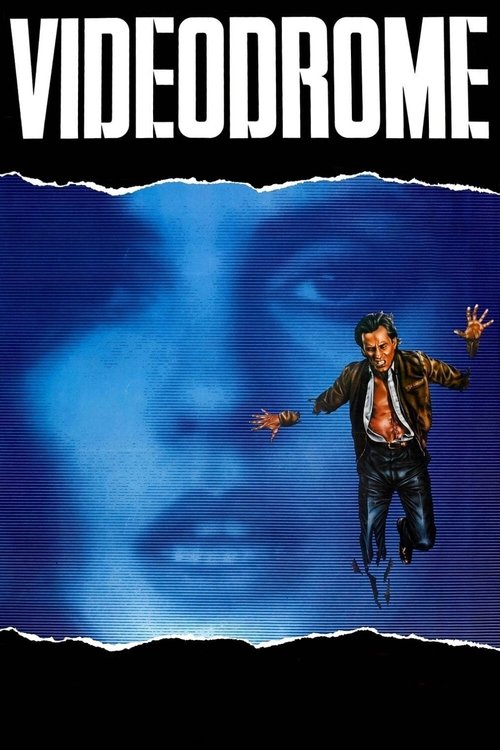
Film · 1983
Videodrome
Long live the new flesh. Analog horror's founding document.
Most extreme on REALITY ANCHOR — dream logic at 090
On VHSCREAM’s six-axis scale, Videodrome (1983) is most extreme on the reality-anchor axis: 90 out of 100, where 0 is grounded realism and 100 is dream logic. 92% of the 105 horror works we have scored come in lower on that axis. How we score →
Videodrome is a 1983 body horror film written and directed by David Cronenberg. A sleazy television executive finds a broadcast of apparently real torture and the signal begins to alter him. We score it 090 on reality anchor — joint-sixth of 105 works — and 076 on viscera.
Scored and reviewed by VHSCREAM on · how we score
Videodrome: the review
Videodrome is the film that guessed the shape of the next forty years, and it did it by being a very grubby thriller about a man who programmes soft pornography for a UHF station.
James Woods is perfectly cast as Max Renn — not a hero, barely a protagonist, a man whose entire professional judgement is about what an audience will tolerate. His business is finding things that are slightly too much. When he pirates a signal called Videodrome, which is a static-lit room where people are tortured without plot, his first response is not horror. It is acquisition.
Cronenberg's idea, stated flat out by the film's prophet figure, is that the screen is part of the nervous system — the television screen is the retina of the mind's eye, therefore it is physically real, therefore what happens on it happens to you. The film then builds that out literally: a signal that produces a brain tumour that produces hallucinations that produce a new organ.
It is about tapes and it knows what tapes are
Everything in the film's texture is analog: cassettes, static, a tube television that breathes, a videodrome that is only reachable as a broadcast. The slit that opens in Max's abdomen is a cassette slot. Rick Baker's effects are wet, latex, pulsing and dated in exactly the way that makes them more disturbing rather than less.
And Brian O'Blivion — a media theorist who refuses to appear in person and exists only as thousands of tapes, played by Jack Creley and visibly built out of Marshall McLuhan — is the most prescient character in horror. He is dead for most of the film and still broadcasting. His daughter keeps the library and plays him on request.
Where it gets away from itself
The last twenty minutes are close to incoherent and the film stops distinguishing hallucination from event, which is deliberate and also a loss of traction. The conspiracy's mechanics are explained twice and clear neither time. And Max is unpleasant enough that the film has no emotional centre — you watch what happens to him rather than fear it.
For the same prophecy about screens, nothing in the index comes close; for the same flesh-as-frontier, The Fly is Cronenberg doing it with a character you like.
The ending of Videodrome explained
Total spoilers from here. Everything above this line is spoiler-free.
The short answer: Max is told by Nicki, on a television screen, that he must leave his old body and become "the new flesh" — and that to do so he must kill himself. He raises the pistol grafted to his hand, watches a television show him his own suicide, says "long live the new flesh", and shoots himself. The film cuts to black immediately. Whether anything in the last reel happened is not established.
What does "long live the new flesh" mean?
It is the Videodrome conspiracy's goal and the film's most-quoted line. The new flesh is a body remade by the signal — one that has incorporated the screen rather than merely watching it. O'Blivion presents it as evolution; Barry Convex's faction wants to use it as a weapon. By the end Max has been told that his current body is an obsolete stage and that killing it is how he advances.
Is Max hallucinating the whole film?
Partly, and the film deliberately refuses to say where it starts. The tumour is established as the cause of the hallucinations, and the tumour is caused by the signal, which Max really watched. So the hallucinations are real in their cause and false in their content, and the film stops marking the boundary after the midpoint. The abdominal slit, the breathing television and the flesh pistol are all presented identically to things nobody disputes.
Who is Brian O'Blivion?
A media prophet who died before the film begins and exists as a library of thousands of videotapes, played on request by his daughter Bianca. He invented Videodrome as a benign evolutionary tool, was killed by the faction that took it over, and continues to appear and give instructions. He will not speak to anyone except on television, on principle.
Does Max actually kill himself?
He fires, and the film cuts to black on the shot. What it does not do is show a body. Given that the preceding five minutes include him watching a television set perform his suicide before he performs it, the ending supports reading the gunshot as an actual death, as a transition into the new flesh, or as another broadcast. Cronenberg has been content to leave it there.
How scary is Videodrome, actually?
Scored against the published rubric, here is what the numbers mean.
Reality anchor 090 is near the ceiling — only 5 works score higher. The film abandons any stable account of what is happening at roughly the midpoint and never restores one.
Viscera 076 is high — 89 works score lower. The effects are wet and frequent: the abdominal slit, the pulsing cassette, the hand-pistol, a chest that opens.
Era bias 014 is deep analog — only 25 works score lower, which is almost funny for a film about media technology. It is entirely a film of tape, static and tube screens, and could not be remade in any other format.
Tone 038 is less bleak than you would expect — 87 works score lower. Cronenberg is dry rather than despairing, and there are jokes.
The threat at 050 is exactly the midpoint, which is the right score for a conspiracy run by people using a signal nobody fully controls.
Pace 048 is close to the middle. It plays as a thriller until the hallucinations take over.
On jump scares: none. Nothing in the film is interested in startling you.
Videodrome on six axes of fear
Every work in the index is scored on six continuous axes of fear. This is what Videodrome looks like as a vector.
Where that puts it: #2 surreal · #13 goriest
Disagree with a number? Say so on the axis itself. Nobody has confirmed this vector yet, and a score you challenge goes to the top of the queue to be re-scored by a human. Votes do not move the numbers — they decide what gets looked at first. How the scoring works →
Scored against the published rubric. This vector is a draft awaiting review — the method is public so you can argue with it.
Who should skip Videodrome
Skip it if incoherence frustrates you. The last act genuinely does not hold together and is not meant to. Viewers who need to know what happened leave annoyed.
Skip it if sexual violence is a hard limit. The Videodrome broadcasts are depicted as torture with a sexual charge, and a consensual relationship in the film involves injury.
Skip it if wet practical effects are a problem. At 076 on viscera the body material is frequent and lingering.
Content notes: depictions of torture presented as broadcast entertainment, sexual content involving injury, a graphic abdominal wound used repeatedly, a gun fused to a hand, a suicide, and a character who dies on camera.
Watch it if you want the single most prescient horror film ever made, you can take an ending that dissolves, and you want to see a 1983 film about screens becoming part of the body get almost everything right.
Where to find it
Rent or buy from Amazon Video · Apple TV Store · Google Play Movies +2 ↗Physical copies on eBay ↗Availability from JustWatch via TMDB. We earn nothing from these links.
Nothing loads from YouTube until you press play.
If Videodrome is your kind of fear
The eight works closest to Videodrome in the index, ranked by distance across all six axes — not by genre label, and not by what other people watched.
Hellraiser
Clive Barker · 1987 · Film
Shares analog-era texture.
87% shared signal

Profondo Rosso
Goblin · 1975 · Record
Shares dream logic.
83% shared signal

Suspiria
Dario Argento · 1977 · Film
Shares explicit viscera.
79% shared signal

Books of Blood
Clive Barker · 1984 · Book
Shares analog-era texture.
78% shared signal
Possession
Andrzej Zulawski · 1981 · Film
Shares dream logic.
78% shared signal

Suspiria (OST)
Goblin · 1977 · Record
78% shared signal

The Cipher
Kathe Koja · 1991 · Book
Shares explicit viscera.
76% shared signal

Candyman
Bernard Rose · 1992 · Film
76% shared signal
See the full list of movies like Videodrome →
Questions about Videodrome
The things people actually ask about this film, answered.
What happens at the end of Videodrome?
Nicki appears on a television and tells Max that to become the new flesh he must leave his old body — meaning kill himself. He watches a television screen show him his own suicide, says "long live the new flesh", and shoots himself. The film cuts to black without showing a body.
What does "long live the new flesh" mean?
It is the Videodrome project's goal: a body remade by the signal, one that has absorbed the screen rather than watching it. O'Blivion presents it as the next evolutionary stage and Convex's faction wants it as a weapon. Max is told his current body is obsolete.
Is Videodrome all a hallucination?
Partly, and the film refuses to mark where it begins. The signal causes a tumour and the tumour causes hallucinations, so the visions are real in their cause and false in their content. After the midpoint the film presents hallucination and event identically.
Who is Brian O'Blivion in Videodrome?
A media theorist, modelled on Marshall McLuhan, who died before the film starts and exists only as a library of thousands of videotapes played on request by his daughter. He created Videodrome as a benign tool, was killed by the faction that seized it, and still issues instructions.
Is Videodrome about the internet?
It predates it, but the film's central claim — that the screen is part of the nervous system, so what happens on it happens to you — describes the following forty years more accurately than almost anything written since. Cronenberg got there in 1983 using videocassettes.
How gory is Videodrome?
Quite. We score it 076 on viscera, higher than most of our index. Rick Baker's effects are wet and recurring rather than concentrated in one scene — the abdominal slit, the breathing television and the hand-gun fusion are all shown repeatedly.
These are ranked against Videodrome, not against you.
Build your own tape →