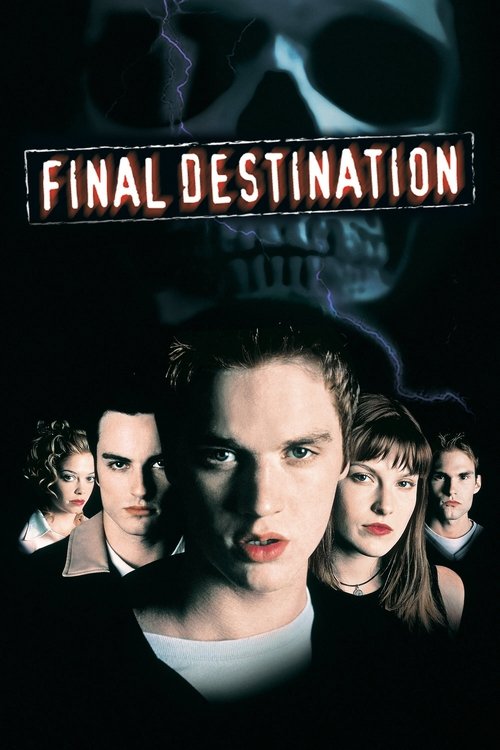
Film · 2000
Final Destination
James Wong
Death as a Rube Goldberg machine. Cheerfully, elaborately explicit.
Most extreme on VISCERA — explicit viscera at 076
On VHSCREAM’s six-axis scale, Final Destination (2000) is most extreme on the viscera axis: 76 out of 100, where 0 is restraint over gore and 100 is explicit viscera. 85% of the 105 horror works we have scored come in lower on that axis. How we score →
Final Destination is a 2000 horror film directed by James Wong, from a script originally written for The X-Files. A teenager has a premonition of his plane exploding, gets six people off it, and Death comes back for them in order. We score it 076 on viscera — 89 works score lower — and 074 on pace.
Scored and reviewed by VHSCREAM on · how we score
Final Destination: the review
Final Destination invented a genre out of a single idea and the idea is better than any of the eleven films that have used it.
There is no killer. That is the whole thing. The antagonist is causality: a loose screw, a leaking pipe, a frayed cable, a trail of spilled vodka, a shard of glass in a pool of water, and a sequence of entirely plausible events that arrive in the correct order. Wong stages each death as a Rube Goldberg machine that the audience is invited to solve ahead of the characters, which converts dread into something closer to a puzzle — you are scanning the frame for the thing that will do it, and the film keeps putting the real mechanism out of focus behind the decoy.
The opening is excellent. Flight 180 is a genuinely upsetting sequence because it is built out of airline mundanity — a seatbelt sign, a vibration, a child kicking a seat — and because Wong holds the premonition long enough that you stop knowing which layer you are in. Devon Sawa plays Alex as frightened and socially ruined rather than heroic, and the film is clear-eyed that a boy who screams on a plane about an explosion that then happens will be treated as a suspect.
The rules are the pleasure
Death has a design; the design has an order; interfering with the order creates a gap and the gap must be closed. Tony Todd's mortician delivers the cosmology in one scene and it is the right amount — cryptic, unhelpful and tonally perfect. Everything after it is the characters doing inference under time pressure, which is a far more interesting activity than running.
Where it has dated and where it has not
The 2000 teen-horror register is strong on the screen — the post-Scream cast, the needle-drop soundtrack, the WB-adjacent line readings — and some of it plays as camp now. The digital compositing in the plane sequence shows. Clear Rivers survives for structural reasons rather than character ones.
What has not dated is the mechanism. Nothing in the film is supernatural in appearance: every death is an accident report, which is why the film makes aeroplanes, buses and kitchens worse for about a week afterwards.
Where it is weak
The cast outside Sawa and Ali Larter is thin. The film's one bad death is the bus, which is a shock rather than a design. And the ending is a gag rather than a resolution, which the sequels then had to treat as doctrine.
For the same engineered-death architecture given a moral framework, Saw; for the same 2000s teen-slasher register done better, Scream; for the same curse-with-rules structure, The Ring.
The ending of Final Destination explained
Total spoilers from here. Everything above this line is spoiler-free.
The short answer: Alex works out the order and believes he has broken the chain by saving Clear from an electrocution in her car, taking her place in the design and surviving it. Six months later the three survivors — Alex, Clear and Carter — are in Paris. Alex explains that by taking Clear's death he moved himself out of sequence. Then a bus's rear-view fitting swings loose; Alex pushes Clear clear of it; and the film cuts away as Carter, who has just said he intends to live forever, is struck. The last lines confirm Alex is next in the new order. The design was not broken, only reordered.
How does Death's design work in Final Destination?
Everybody has an appointed moment. The premonition lets Alex pull seven people out of theirs, which leaves a gap in an otherwise closed sequence, and Death closes the gap by killing them in the exact order they would have died on the plane. The mechanism is always ordinary: the film never shows a force, only consequences. Tony Todd's mortician states the two operating rules — you cannot cheat death, and only new life defeats it — and the film tests both.
Can you cheat death in Final Destination?
Not in this film. The two apparent escapes both turn out to be substitutions. Alex saves Clear and inherits her slot; Carter survives the bus and is moved to the end of the queue. The design tolerates reordering and not removal. Later entries in the series introduce the "new life" clause and the idea of taking someone else's remaining lifespan; the first film keeps it to one rule and is stronger for it.
What is the significance of the order of deaths?
It is the film's only investigative tool. Alex reconstructs the seating plan and the sequence of the explosion from memory, which gives him a list, and the list is what lets him predict. When Tod dies out of turn the list appears to break — until Alex realises he has the order reversed for the people who were standing. Getting the sequence right is the difference between the characters being prey and being able to act.
Why does Alex survive the ending?
Because he traded places. By pulling Clear out of her death he moved into her position in the design, and then survived it when Carter's intervention broke the circuit, which left the sequence with nowhere to go but forward. The Paris coda confirms he is no longer last but next, and the film ends before collecting.
Does the premonition cause the crash?
No, and the film is careful about it. Alex's vision is of something that is going to happen; his reaction gets people off the plane; the plane explodes anyway, killing everybody still on it. The film is not a time-loop story and nothing Alex does creates the disaster. What his actions create is the anomaly, which is the problem the rest of the film is about.
How scary is Final Destination, actually?
Scored against the published rubric, here is what the numbers mean.
Viscera 076 is high — 89 works score lower. A decapitation, an impalement, a hanging, a bus impact and an explosion, most of it staged as spectacle rather than suffering.
Pace 074 is fast — 98 works are slower. The film averages a set piece every ten minutes and the set pieces are built in advance.
Era bias 068 leans modern — 60 works score lower. 2000 digital compositing, a soundtrack-driven mix and a post-Scream teen register.
Tone 048 is near the middle — 98 works score lower, which is high for a film in which everybody dies. The deaths are engineered for an audience's enjoyment and the film knows it.
The threat at 030 is on the supernatural side — 35 works score lower. Death is never shown, never embodied and has no human agent, but every individual death is mechanically ordinary.
Reality anchor 044 is just under the midpoint. One metaphysical premise, then physics.
On jump scares: many, and about half are deliberate fake-outs built from the decoy hazard.
Final Destination on six axes of fear
Every work in the index is scored on six continuous axes of fear. This is what Final Destination looks like as a vector.
Where that puts it: #4 relentless · #12 goriest
Disagree with a number? Say so on the axis itself. Nobody has confirmed this vector yet, and a score you challenge goes to the top of the queue to be re-scored by a human. Votes do not move the numbers — they decide what gets looked at first. How the scoring works →
Scored against the published rubric. This vector is a draft awaiting review — the method is public so you can argue with it.
Who should skip Final Destination
Skip it if aviation is a fear of yours. The Flight 180 sequence is detailed, plausible and seven minutes long.
Skip it if elaborate accident deaths will stay with you. The film's design makes kitchens, buses, overhead wires and bathtubs briefly intolerable, which is the intended effect.
Skip it if you need characters to be worth losing. Most of the cast exists to be a mechanism, and the film's interest is in the apparatus.
Content notes: a mass-casualty plane explosion, a decapitation, a hanging shown at length, a death by impalement, a pedestrian struck by a bus, a child's death implied, and a sustained sequence in which a teenager is treated as a terror suspect.
Watch it if you want the cleverest premise in 2000s horror, you enjoy solving a death before the film commits it, and you want to see a film that works entirely without a villain.
Where to find it
Streaming on Howdy ↗Physical copies on eBay ↗Availability from JustWatch via TMDB. We earn nothing from these links.
Nothing loads from YouTube until you press play.
If Final Destination is your kind of fear
The eight works closest to Final Destination in the index, ranked by distance across all six axes — not by genre label, and not by what other people watched.
Evil Dead
Fede Alvarez · 2013 · Film
Shares explicit viscera.
81% shared signal
Talk to Me
Danny & Michael Philippou · 2022 · Film
Shares a supernatural threat.
80% shared signal
It
Andy Muschietti · 2017 · Film
Shares modern craft.
79% shared signal
Between Two Fires
Christopher Buehlman · 2012 · Book
Shares explicit viscera.
79% shared signal
The Descent
Neil Marshall · 2005 · Film
Shares relentless shock.
77% shared signal

The Only Good Indians
Stephen Graham Jones · 2020 · Book
Shares modern craft.
74% shared signal
Smile
Parker Finn · 2022 · Film
Shares relentless shock.
73% shared signal

Books of Blood
Clive Barker · 1984 · Book
Shares a supernatural threat.
71% shared signal
See the full list of movies like Final Destination →
Questions about Final Destination
The things people actually ask about this film, answered.
What happens at the end of Final Destination?
Alex saves Clear from her death and inherits her place in the design, which appears to break the chain. Six months later in Paris he explains the reordering, a bus fitting swings loose, and Carter is struck instead. The design was never broken, only reshuffled, and Alex is next.
How does Death's design work in Final Destination?
Everyone has an appointed moment. Alex's premonition removes seven people from theirs, leaving a gap in a closed sequence, and Death closes it by killing them in the order they would have died on the plane. No force is ever shown — only ordinary accidents arriving in the right order.
Can you cheat death in Final Destination?
Not in the first film. Both apparent escapes are substitutions rather than exits: Alex takes Clear's place and Carter is moved to the back of the queue. The design tolerates reordering, not removal. The later films add the "new life" clause and the idea of inheriting someone's remaining time.
Why does the order of deaths matter?
Because it is the only thing the characters can use. Alex reconstructs the plane's seating and the explosion's sequence to build a list, and the list is what lets him predict and intervene. When one death comes out of turn he has to work out that the standing passengers are reversed.
How gory is Final Destination?
Quite. We score it 076 on viscera, high for our index. There is a decapitation, an impalement, a hanging and a bus impact, though the film is staging each one as a spectacle to be admired rather than lingering on injury.
Is Final Destination connected to The X-Files?
By origin. Jeffrey Reddick wrote the premise as a spec script for the series, and James Wong and Glen Morgan — both X-Files writers and producers — developed it into a feature instead. The procedural-investigation structure and the unseen antagonist are inherited from that.
These are ranked against Final Destination, not against you.
Build your own tape →