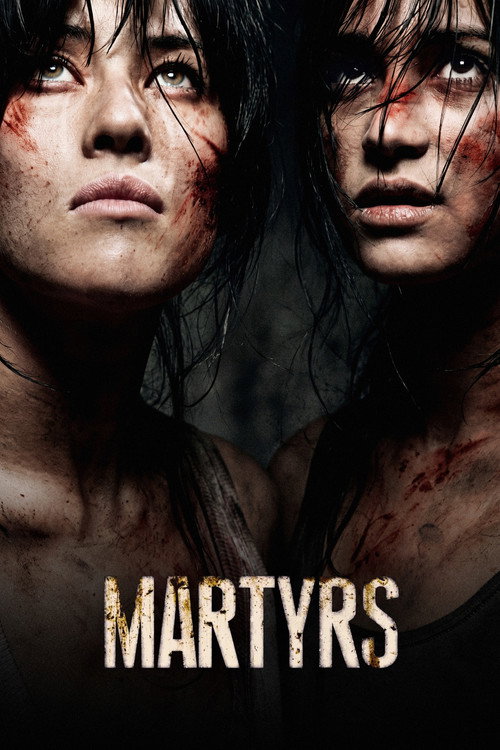
Film · 2008
Martyrs
Pascal Laugier
New French Extremity at its most punishing. There is no relief anywhere in it.
Most extreme on TONE — a bleak, unforgiving tone at 003
On VHSCREAM’s six-axis scale, Martyrs (2008) is most extreme on the tone axis: 3 out of 100, where 0 is a bleak, unforgiving tone and 100 is gleeful black comedy. 2% of the 105 horror works we have scored come in lower on that axis. How we score →
Martyrs is a 2008 French horror film written and directed by Pascal Laugier, the most extreme entry in the New French Extremity. We score it 003 on tone — only 2 works in an index of 105 are bleaker — and 096 on viscera, with only 1 work scoring higher. Nothing else we have scored is simultaneously this explicit and this hopeless.
Scored and reviewed by VHSCREAM on · how we score
Martyrs: the review
Martyrs is two films bolted together, and the join is the most violent thing about it.
The first is a revenge film that curdles. Lucie, who escaped an unexplained captivity as a child, walks into a suburban house fifteen years later and kills the family she believes were her captors, with her friend Anna cleaning up behind her. It is shot like a home invasion and it is genuinely shocking, partly because the film declines to confirm she has the right house. Lucie is also being hunted by something that is not there, and the film's handling of that figure — self-harming, silent, relentless — is the best work in it.
Then, around forty minutes, the film kills its protagonist and starts again. What follows is an hour of systematic, procedural torture in a basement, administered by a secret society in pursuit of a theological outcome.
It is not a torture film, which is why it is worse
The crucial thing about the second half is that nobody enjoys it. There is no sadist. Mademoiselle, played with appalling calm by Catherine Bégin, is an administrator running a research programme: she believes that sustained suffering can push a young woman past a threshold into transfiguration, at which point she will be able to report what is on the other side of death. The violence is scheduled. There is a technician. Meals are provided.
That is the film's argument and it is the only reason the second half functions as anything but endurance. Laugier is not asking whether you can stand it. He is asking what you would do with an afterlife you could confirm, and answering: this.
Whether it is worth it
I think so, narrowly, and I would not recommend it to most people. The craft is real — the structure is audacious, Morjana Alaoui's performance in the back half is extraordinary and almost entirely physical, and the final ten minutes are among the most formally beautiful in the genre. It also has nothing resembling a reason to be watched twice.
The 2015 American remake removes the theology and is therefore pointless. If you want the register without the basement, Possession is bleaker in a way that does not require a stomach, and Tender Is the Flesh does something comparable in prose.
The ending of Martyrs explained
Total spoilers from here. Everything above this line is spoiler-free.
The short answer: Anna is flayed alive and survives into a transfigured state. Mademoiselle arrives, Anna whispers something to her, and Mademoiselle writes it down. Before the society's assembled members can hear the report, Mademoiselle shoots herself. Her last instruction to her second is a single word: doubt. The film ends without ever telling you what Anna saw.
What does Anna whisper?
The film does not say and this is not an oversight. We see the whisper and we see its effect, and the effect is suicide. Laugier has been explicit in interviews that the content is deliberately withheld, and the structure makes the reason clear: any specific revelation would be smaller than the question.
What does "keep doubting" mean?
Mademoiselle's last words to Étienne are an instruction to the whole society. Three readings hold.
Anna described nothing. There is no afterlife, the programme has murdered dozens of girls for nothing, and Mademoiselle cannot live with having been wrong — so she tells the others to doubt because doubt is the only honest position left.
Anna described something unbearable. Not absence but a worse presence. On this reading "doubt" is mercy: she is sparing them a certainty she cannot survive.
Anna described paradise. Mademoiselle kills herself to get there immediately, and tells the others to doubt so that they do not all follow and so the work continues.
The film supports all three equally, which is the point of ending on a word rather than a sentence.
What is the creature haunting Lucie?
The emaciated, self-harming figure that attacks Lucie is the girl she abandoned when she escaped — the one she left chained. It is guilt with a body. The film makes this explicit when Anna finds that girl's remains, and the figure stops appearing once Lucie is dead, which is the only mercy anybody in this film receives.
Did Lucie kill the right family?
The film says yes, and makes you wait an hour to be sure. Anna discovers the basement, the equipment and the surviving captive in the house Lucie chose. The revenge was accurate. It was also, in the film's accounting, completely irrelevant — the family were employees.
How scary is Martyrs, actually?
Scored against the published rubric, here is what the numbers mean. This is the hardest-scoring film in the index and the numbers are the warning.
On tone, Martyrs ranks first among our films. Only 2 works in the whole index score lower and neither is a film — one is a novel, The Girl Next Door, and one is a record, Penderecki's Threnody for the Victims of Hiroshima. There is no relief, no humour, no survivor, and no consolation of any kind. This is the floor of what we score.
Viscera 096 is second only to one work in the entire index — 1 scores higher. The violence is extended, procedural and almost entirely practical, including a sustained flaying.
Threat 078 is the human end. 90 works score lower. Nothing supernatural causes any of the harm in this film. Every injury is inflicted by a person with a job.
Pace 062 puts it on the shock side, with 83 works slower — but note how that number conceals the structure. The first forty minutes are fast and the last hour is a slow, static grind.
Reality anchor 025 keeps it grounded — only 12 works score lower. Everything in it could happen, and that is the problem.
On jump scares: a few in the first act and none at all in the second. Nothing in the back half needs one.
Martyrs on six axes of fear
Every work in the index is scored on six continuous axes of fear. This is what Martyrs looks like as a vector.
Where that puts it: #1 bleakest · #2 goriest · #10 human monsters · #11 grounded
Disagree with a number? Say so on the axis itself. Nobody has confirmed this vector yet, and a score you challenge goes to the top of the queue to be re-scored by a human. Votes do not move the numbers — they decide what gets looked at first. How the scoring works →
Scored against the published rubric. This vector is a draft awaiting review — the method is public so you can argue with it.
Who should skip Martyrs
This is the one film in the index I would actively discourage most people from watching, and the scores are why: the lowest tone we hold and viscera that ranks second of everything we score. If you are unsure, that is your answer.
Skip it if you have any history with self-harm, captivity, or sustained abuse. The second half is an hour of a restrained woman being systematically injured, filmed without stylisation.
Skip it if you need the violence to mean something in the moment. It does mean something, and the meaning only arrives in the final five minutes. Until then it is simply happening.
Skip it if you want to be entertained. It is not trying.
Content notes: child captivity and abuse, extended torture, force-feeding, a flaying shown at length, self-harm, suicide, the murder of children, and the on-screen killing of an entire family including two teenagers.
Watch it if you have a high tolerance, you are interested in what the genre can do at its limit, and you want a film whose final image genuinely justifies what preceded it. Once.
Where to find it
Rent or buy from Apple TV Store · Google Play Movies · YouTube +1 ↗Physical copies on eBay ↗Availability from JustWatch via TMDB. We earn nothing from these links.
Nothing loads from YouTube until you press play.
If Martyrs is your kind of fear
The eight works closest to Martyrs in the index, ranked by distance across all six axes — not by genre label, and not by what other people watched.
Saw
James Wan · 2004 · Film
Shares explicit viscera.
86% shared signal
Kill List
Ben Wheatley · 2011 · Film
Shares a bleak, unforgiving tone.
78% shared signal
28 Days Later
Danny Boyle · 2002 · Film
Shares grounded realism.
77% shared signal
Terrifier 2
Damien Leone · 2022 · Film
Shares human monsters.
76% shared signal
Tender Is the Flesh
Agustina Bazterrica · 2017 · Book
Shares modern craft.
75% shared signal
Audition
Takashi Miike · 1999 · Film
Shares explicit viscera.
72% shared signal
The Only Good Indians
Stephen Graham Jones · 2020 · Book
Shares a bleak, unforgiving tone.
70% shared signal
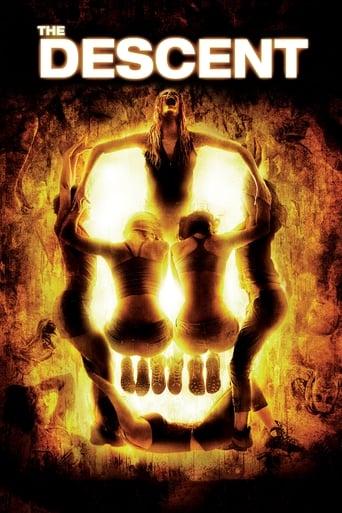
The Descent
Neil Marshall · 2005 · Film
Shares grounded realism.
69% shared signal
See the full list of movies like Martyrs →
Questions about Martyrs
The things people actually ask about this film, answered.
What happens at the end of Martyrs?
Anna is flayed alive and reaches a transfigured state. She whispers something to Mademoiselle, who writes it down and then shoots herself before the society can hear it. Her final word to her second is "doubt". The film never reveals what Anna described.
What does Anna say to Mademoiselle?
The film deliberately withholds it. Laugier has confirmed the omission is intentional, and the structure explains why — any specific answer would be smaller than the question the whole film has been building. What we see is the effect: immediate suicide.
What does "keep doubting" mean in Martyrs?
It is Mademoiselle's last instruction to the society. It works equally well as an admission that there is nothing after death, as mercy to spare them a worse certainty, or as a way to stop the others following her if what Anna described was paradise. The film supports all three.
How violent is Martyrs?
It ranks second of the 105 works in our index at 096 on viscera, with only 1 scoring higher. The second half is an hour of sustained, procedural torture including a flaying, shot with practical effects and almost no stylisation.
Is Martyrs worth watching?
For a small number of viewers, once. It is genuinely accomplished — the structure, Morjana Alaoui's performance and the final sequence are all exceptional — and it scores 003 on tone, the bleakest film in our index. Most people should not watch it, and that is a reasonable conclusion rather than squeamishness.
Is the 2015 Martyrs remake any good?
No. The American version removes the secret society's theology, which is the only thing that gives the original's violence a purpose. Without the argument it is an endurance exercise.
These are ranked against Martyrs, not against you.
Build your own tape →