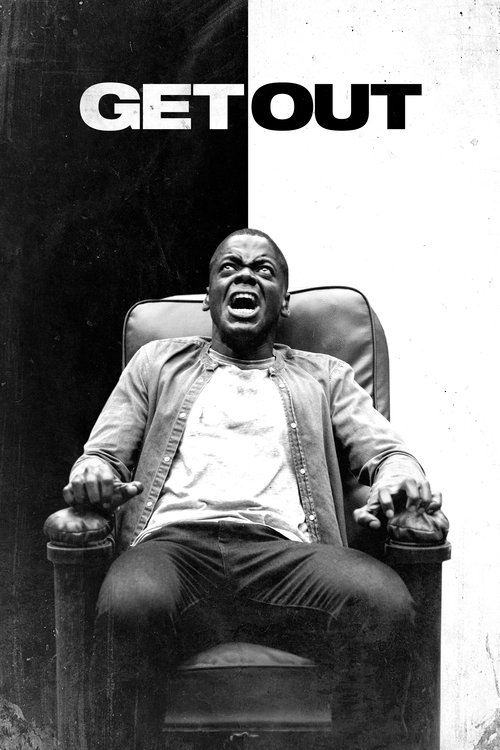
Film · 2017
Get Out
Jordan Peele
The most frightening thing in it is a polite conversation.
Most extreme on THE THREAT — human monsters at 088
On VHSCREAM’s six-axis scale, Get Out (2017) is most extreme on the threat axis: 88 out of 100, where 0 is a supernatural threat and 100 is human monsters. 89% of the 105 horror works we have scored come in lower on that axis. How we score →
Get Out is a 2017 horror film written and directed by Jordan Peele, his debut, which won the Academy Award for Original Screenplay. A Black photographer visits his white girlfriend's family and finds they are harvesting Black bodies. We score it 088 on the threat axis — only 8 works in an index of 105 score higher — because nothing supernatural happens in it at all.
Scored and reviewed by VHSCREAM on · how we score
Get Out: the review
The thing that still astonishes about Get Out is how early it tells you. The opening scene is a man lost in a white suburb at night, saying out loud that this is the kind of place where he gets killed, before a car pulls up and he is taken. By the time Chris and Rose are driving to her parents' house, the film has already named its subject and dared you to pretend it hasn't.
Peele's craft is in the texture after that. The horror is almost entirely social for an hour: the father's performed liberalism — I would have voted for Obama a third time — the brother's physical aggression dressed as banter, the groundskeeper and housekeeper whose warmth is pitched slightly wrong, the party guests complimenting Chris's build. Every scene is a situation anybody who has been the only Black person in a room would recognise, and the film's bet is that recognising it is the scare.
The hypnosis sequence is the best single idea in modern horror
The teacup and the spoon, the slow sink, and the Sunken Place — a black void where you are conscious and watching your own life through a small window, unable to act. It functions as a plot device, as an image of dissociation under trauma, and as a precise metaphor for a specific political condition, without the film ever stopping to explain which.
Daniel Kaluuya does the heaviest lifting in the film with his face in that scene, and the single tear with his eyes blown wide became the shorthand for the whole thing for a reason.
What keeps it from being perfect
The third act is a conventional escape thriller, and after an hour of social dread the shift to violence is a release the film arguably did not need. The Order of the Coagula's mechanics get a long exposition video that explains more than the film requires. And Rod is a genuinely funny character doing structural work — he is the audience's relief valve — which makes the tonal join visible in a couple of places.
None of that matters much against what it achieved. For the same satire pushed further, Peele's Us is the obvious follow-on; for the same paranoia without the politics, Rosemary's Baby is the ancestor it is openly quoting.
The ending of Get Out explained
Total spoilers from here. Everything above this line is spoiler-free.
The short answer: Chris escapes. He blocks the hypnotic trigger by stuffing cotton from the chair's upholstery into his ears, kills Jeremy, Dean and Missy, is shot at by Rose and strangles her after she is gored by the hypnotised Walter — who takes the gun, shoots Rose and then himself. As Chris stands over her, a police car arrives. It is Rod, in a TSA vehicle, and he drives Chris away.
What is the Coagula procedure?
The Armitage family's business: a partial brain transplant that puts a white buyer's consciousness into a Black host body. Dean is the neurosurgeon, Missy supplies the hypnosis that makes the host compliant, Rose procures, and Jeremy handles the physical side. The host's original consciousness is not destroyed — it is pushed into a passenger position, which is the detail that makes it horror rather than science fiction.
What is the Sunken Place?
The state Missy's hypnosis induces: a lightless void in which the host remains conscious and can see out through a small aperture, aware of everything their body is doing and unable to intervene. Peele has described it as being about the silencing of Black voices, and it also works exactly as a description of dissociation. It is why Walter and Georgina behave as they do, and why a flash of light can briefly surface the original person.
Why does the cotton work?
Because Missy's trigger is auditory — the spoon against the teacup — so blocking his ears blocks the mechanism. The choice of cotton, picked out of the armchair he has been strapped into, is the film's sharpest single gesture, and the film does not underline it.
Why does Rod arrive in a TSA car?
Because the original ending was different, and this one is deliberate. Peele's first version had the arriving police arrest Chris, with Rod visiting him in prison — Chris having saved himself and lost anyway. Peele cut it after the political mood shifted during production, judging that audiences needed to see Chris get out. The TSA car is the compromise: an authority figure arrives, and it is the one Chris can trust.
Is anything supernatural in Get Out?
No, and that is why we score the threat axis at 088. There is no ghost, no demon and no curse. There is surgery, hypnosis and a family with a business.
How scary is Get Out, actually?
Scored against the published rubric, here is what the numbers mean.
Threat 088 is the signature and it is near the ceiling. Only 8 works in the index score higher, which makes this among the most purely human threats we hold. Everything that happens is done by people, deliberately, with equipment.
Tone 044 is the surprise. 93 works score lower, which puts Get Out among the least bleak films in the index — and that is correct. It is frequently funny, the protagonist wins, and his friend arrives to collect him. For a film about a body-harvesting conspiracy, it is remarkably un-despairing.
Era bias 086 is modern craft, with 87 works lower. Clean contemporary photography, a Michael Abels score built on Swahili vocals and nothing analog anywhere.
Viscera 042 is just below the median film — 49 works score lower. The third act has several hard moments including a deer antler and a bocce ball, but the first hour is bloodless.
Pace 044 is close to the middle, with 61 works slower. The first hour is dread and the last half hour is a chase, and the average lands in between.
On jump scares: a few, and the running man in the driveway is the best of them — a scare built entirely from a man approaching at speed and then stopping to apologise.
Get Out on six axes of fear
Every work in the index is scored on six continuous axes of fear. This is what Get Out looks like as a vector.
Where that puts it: #6 human monsters · #8 modern
Disagree with a number? Say so on the axis itself. Nobody has confirmed this vector yet, and a score you challenge goes to the top of the queue to be re-scored by a human. Votes do not move the numbers — they decide what gets looked at first. How the scoring works →
Scored against the published rubric. This vector is a draft awaiting review — the method is public so you can argue with it.
Who should skip Get Out
Skip it if you want to be frightened rather than implicated. The first hour's horror is a series of conversations. Viewers expecting a conventional scare picture often report being more impressed than scared, which is a fair reaction.
Skip it if racial violence is something you need to avoid. The film is explicitly about the appropriation of Black bodies and it does not soften it, including an abduction, a lynching-adjacent image and a sustained sequence of a restrained man being told what will be done to him.
Content notes: abduction, non-consensual surgery, hypnosis used to incapacitate, a death by deer antler, a strangling, suicide by gunshot, and a vehicle striking a person.
Watch it if you want the most influential horror debut of the century, you appreciate a film that explains its own metaphor by refusing to, and you can take an hour of discomfort before anything bleeds.
Where to find it
Streaming on YouTube TV ↗Physical copies on eBay ↗Availability from JustWatch via TMDB. We earn nothing from these links.
Nothing loads from YouTube until you press play.
If Get Out is your kind of fear
The eight works closest to Get Out in the index, ranked by distance across all six axes — not by genre label, and not by what other people watched.

Midsommar
Ari Aster · 2019 · Film
Shares modern craft.
80% shared signal
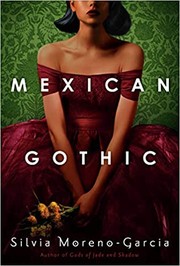
Mexican Gothic
Silvia Moreno-Garcia · 2020 · Book
Shares modern craft.
76% shared signal
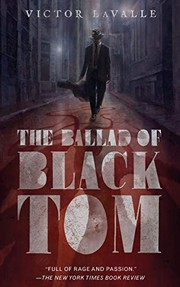
The Ballad of Black Tom
Victor Lavalle · 2016 · Book
75% shared signal
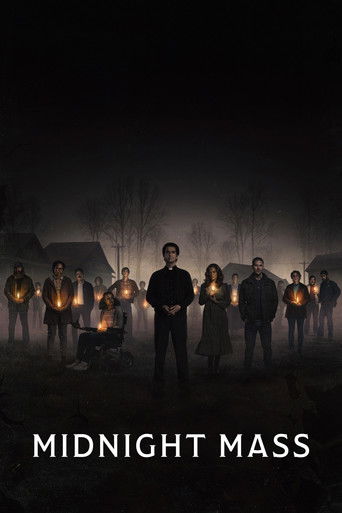
Midnight Mass
Mike Flanagan · 2021 · Television
73% shared signal

It Follows (OST)
Disasterpeace · 2014 · Record
71% shared signal
Kill List
Ben Wheatley · 2011 · Film
Shares human monsters.
70% shared signal

The Lighthouse
Robert Eggers · 2019 · Film
70% shared signal

Dangerous Days
Perturbator · 2014 · Record
Shares human monsters.
69% shared signal
See the full list of movies like Get Out →
Questions about Get Out
The things people actually ask about this film, answered.
What happens at the end of Get Out?
Chris blocks Missy's hypnotic trigger with cotton from the chair, kills Jeremy, Dean and Missy, and is strangling Rose when Walter — briefly surfaced from the Sunken Place — shoots her and then himself. A police car arrives, but it is Rod in a TSA vehicle, and he drives Chris away.
What is the Sunken Place in Get Out?
The state Missy's hypnosis produces: a lightless void where the host stays conscious, watching their own body act through a small aperture and unable to intervene. Peele has described it as being about the silencing of Black voices, and it doubles as an accurate description of dissociation.
What is the Coagula procedure?
A partial brain transplant that places a white buyer's consciousness into a Black host body. Crucially the host's own mind is not destroyed — it is demoted to a passenger in the Sunken Place, which is what makes it a horror premise rather than a science-fiction one.
What was the original ending of Get Out?
The arriving police arrested Chris, and Rod visited him in prison — Chris having saved himself and lost regardless. Peele cut it during production as the political mood shifted, deciding audiences needed to see Chris escape. The TSA car is what replaced it.
Why does Chris use cotton in his ears?
Because Missy's hypnotic trigger is a sound — a spoon stirred against a teacup — so blocking his hearing blocks it. He pulls the cotton out of the armchair he has been strapped into, and the film pointedly does not comment on it.
Is Get Out a horror film or a thriller?
Horror, and our scoring shows why it reads as something else to some viewers. At 088 on the threat axis nothing supernatural happens, and at 044 on tone it is among the least bleak films in our index — funny, and with a protagonist who wins. The dread is social rather than spectral.
These are ranked against Get Out, not against you.
Build your own tape →