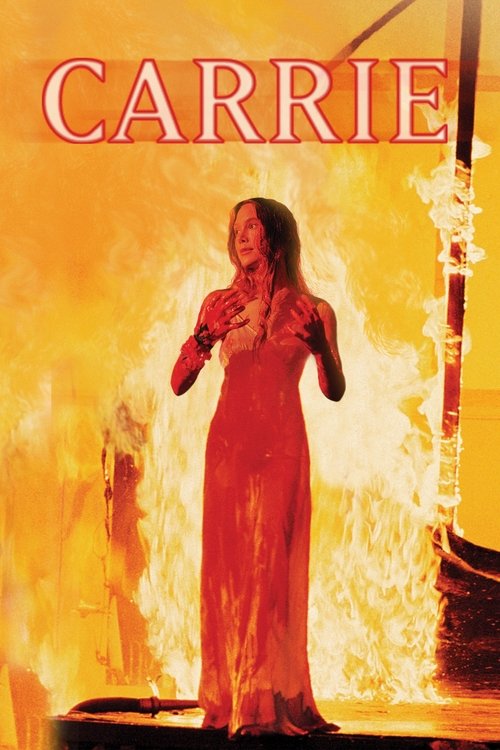
Film · 1976
Carrie
Brian De Palma
Cruelty at school compounding until physics gives up.
Most extreme on ERA BIAS — analog-era texture at 010
The most analog-era horror movies ever made →
On VHSCREAM’s six-axis scale, Carrie (1976) is most extreme on the era-bias axis: 10 out of 100, where 0 is analog-era texture and 100 is modern craft. 16% of the 105 horror works we have scored come in lower on that axis. How we score →
Carrie is a 1976 horror film directed by Brian De Palma, adapting Stephen King's first novel. A bullied teenager with a fanatically religious mother discovers she can move things with her mind, and is then invited to the prom. We score it 068 on the threat axis — 84 works score lower, the human end of the scale — and 010 on era bias.
Scored and reviewed by VHSCREAM on · how we score
Carrie: the review
Carrie is a film about cruelty in which the telekinesis is almost beside the point, and De Palma knew it.
The structure is a trap built in full view. Carrie White is humiliated in a shower in the first five minutes, in front of a camera that is leering at her classmates and then suddenly not; from there the film spends ninety minutes assembling a kindness — a good teacher, a decent boy, a girl with a guilty conscience, a dress, a crown — and the audience spends all of it knowing what the bucket above the stage is for. The dread is not that something will go wrong. It is that something is going right.
Sissy Spacek plays Carrie with her shoulders up around her ears for an hour and then, for about four minutes at the prom, as a happy seventeen-year-old, and those four minutes are the most upsetting thing in the film. Piper Laurie's Margaret White is the other half: not a caricature but a woman in genuine religious terror, who believes her daughter's body is evidence of sin and who says so in language the film takes from scripture and from nowhere else.
De Palma is showing off and it works
Split screen, extreme slow motion, a 360-degree dolly around the dance floor, a split-diopter shot that holds the bucket and the couple in focus at once, Pino Donaggio's shrieking string cue borrowed openly from Psycho. The prom sequence is about fifteen minutes of pure technique and it is one of the great set pieces in American film, because every formal choice is doing narrative work: the slow motion is Carrie's perception, the split screen is the massacre becoming simultaneous, and the dolly is a girl who thinks the world has turned towards her.
The telekinesis is a symptom
King's novel and De Palma's film agree that the power arrives with menarche and is governed by shame. Carrie cannot use it deliberately until the end, and when she does she cannot stop. The film is explicit that nothing she does at the prom is aimed — she locks the doors and kills indiscriminately, including the one teacher who was kind to her, which is the detail that makes the sequence tragedy rather than revenge.
Where it has dated
The high-school scenes are shot and scored as period teen comedy and the tonal gear change is abrupt. The locker-room opening is leering in a way that is hard to defend as purely perspectival. And John Travolta's Billy is broad.
For King's other great adaptation of the period, The Shining; for the novel King wrote next about a town that will not help, Pet Sematary; for the modern King adaptation that gets the bullying right, It.
The ending of Carrie explained
Total spoilers from here. Everything above this line is spoiler-free.
The short answer: Chris Hargensen and Billy Nolan rig the prom ballot so Carrie is crowned, and tip a bucket of pig's blood over her on the stage. Carrie locks the doors with her mind and kills almost everyone in the hall — fire hoses, electrocution, fire — including Miss Collins, the teacher who defended her, and Tommy Ross, killed by the falling bucket itself. She walks home through the burning town and destroys Chris and Billy's car on the way. At home Margaret bathes her, tells her she should have killed her at birth, and stabs her in the back with a kitchen knife. Carrie pins her mother to the doorframe with flying kitchen implements, in the posture of the St Sebastian figure Margaret kept in the prayer closet, and then brings the house down on both of them. The last scene is Sue Snell's dream: she lays flowers on the lot where the house stood, and Carrie's hand bursts out of the gravel and seizes her wrist. Sue wakes screaming, sedated, with her mother holding her.
What happens at the prom in Carrie?
Chris and Billy stuff the ballot so that Carrie and Tommy win king and queen, having already killed a pig and hung a bucket of its blood in the rigging above the stage. Carrie is crowned, the bucket is tipped, and the hall laughs — or Carrie believes it does; the film shows her hearing laughter that is partly in her head. She seals the doors, and the gymnasium becomes a closed room with a fire in it.
Does Carrie die at the end?
Yes. She is stabbed by her mother, and after killing her she loses control completely and collapses the house with both of them inside; the final shots show it burning and sinking. The only ambiguity the film offers is Sue's nightmare, which is explicitly a dream — the preceding dialogue and the sedation after it establish that Carrie is dead and that Sue is not recovering.
Why does Margaret White stab her own daughter?
Because she has concluded that Carrie is the product of sin and the vessel of the Devil, and that killing her is a duty she failed at once already. The film gives her a long, strange, almost erotic monologue about the night Carrie was conceived, in which she describes being aroused and therefore damned. Her last act is to tell Carrie she loves her and then put a knife in her back, and Piper Laurie plays it as relief.
What is the hand at the end of Carrie?
A dream, and the first use of the device in modern horror. Sue Snell, the only survivor of the prom who tried to help, walks to the vacant lot with flowers and Carrie's hand erupts from the ground and grabs her. De Palma shot it in reverse to get the uncanny movement. It is not a resurrection or a sequel hook; it is the film saying that the one decent person in it will not get to put this down.
Is Carrie's power telekinesis or something else?
Telekinesis, and the film roots it in the body. It first appears in childhood, in a story about a rain of stones, and returns with her first period in the opening scene. She can move objects, close doors, start fires and stop a heart; she cannot control it under stress and cannot aim it at all. Both the novel and the film treat it as an involuntary physical fact rather than a gift or a curse.
Who kills Carrie's bullies?
Carrie, but indiscriminately. Chris and Billy die when she throws their car off the road and it explodes as they try to run her down. Everyone else in the gymnasium — the people who laughed, the people who did not, Tommy, Miss Collins, the band — dies in the same event, because she is not making distinctions. The film refuses to let the massacre be satisfying.
How scary is Carrie, actually?
Scored against the published rubric, here is what the numbers mean.
The threat at 068 leans human — 84 works score lower, which is the correct reading: every cruelty in the film is committed by people, and the supernatural element belongs to the victim.
Era bias 010 is deep analog — only 17 works score lower. 1976 film stock, in-camera split screen, optical slow motion and a string score cut on tape.
Viscera 054 is just above the median film — 65 works score lower. A stabbing, an electrocution, a burning, an impalement by kitchen knives and a great deal of pig's blood.
Tone 026 is bleak — 70 works score lower. Everybody dies, the kind teacher dies with the cruel students, and the survivor is left sedated.
Pace 038 is on the dread side — 54 works are slower. The first hour is deliberate and almost all of the incident is in fifteen minutes.
Reality anchor 044 is just under the midpoint. The town, the school and the house are entirely ordinary; only Carrie's perception at the prom bends.
On jump scares: one, and it is the most copied in horror.
Carrie on six axes of fear
Every work in the index is scored on six continuous axes of fear. This is what Carrie looks like as a vector.
Where that puts it: #10 analog era · #14 human monsters
Disagree with a number? Say so on the axis itself. Nobody has confirmed this vector yet, and a score you challenge goes to the top of the queue to be re-scored by a human. Votes do not move the numbers — they decide what gets looked at first. How the scoring works →
Scored against the published rubric. This vector is a draft awaiting review — the method is public so you can argue with it.
Who should skip Carrie
Skip it if the locker-room opening will be unbearable. It is five minutes of a naked, frightened girl being pelted by classmates, shot in soft focus, and its defenders and detractors are both right.
Skip it if religious abuse of a child is a hard limit. Margaret locks Carrie in a prayer closet, calls her body sinful and ends the film trying to kill her.
Skip it if school bullying is a hard limit. The film is relentless about it and offers no reprieve.
Content notes: the sustained bullying and public humiliation of a teenager, menarche used as the occasion for assault, religious abuse including confinement, a mother's attempted filicide, an extended mass-casualty fire, animal slaughter described and implied, and a parent stabbed to death by her child.
Watch it if you want the best Stephen King adaptation of the seventies, you can take fifteen minutes of pure De Palma technique, and you want a horror film in which the monster is the only sympathetic person on screen.
Where to find it
Streaming on fuboTV · MGM+ · Philo +3 ↗Physical copies on eBay ↗Availability from JustWatch via TMDB. We earn nothing from these links.
Nothing loads from YouTube until you press play.
If Carrie is your kind of fear
The eight works closest to Carrie in the index, ranked by distance across all six axes — not by genre label, and not by what other people watched.
The Shining
Stephen King · 1977 · Book
Shares analog-era texture.
85% shared signal
The Shining
Stanley Kubrick · 1980 · Film
Shares a bleak, unforgiving tone.
81% shared signal
Candyman
Bernard Rose · 1992 · Film
Shares a bleak, unforgiving tone.
80% shared signal

Frankenstein
Mary Shelley · 1818 · Book
Shares analog-era texture.
80% shared signal
Ghost Story
Peter Straub · 1979 · Book
79% shared signal
Night of the Living Dead
George A. Romero · 1968 · Film
78% shared signal

Halloween (OST)
John Carpenter · 1978 · Record
76% shared signal
Halloween
John Carpenter · 1978 · Film
76% shared signal
See the full list of movies like Carrie →
Questions about Carrie
The things people actually ask about this film, answered.
What happens at the end of Carrie?
Carrie is doused in pig's blood at the prom, seals the hall and kills almost everyone in it, including the teacher who helped her. She walks home, kills Chris and Billy in their car, is stabbed by her mother, pins her mother to a doorframe with kitchen knives and brings the burning house down on them both.
Does Carrie die in Carrie?
Yes. She is stabbed by Margaret and then collapses the house on both of them. The hand reaching out of the grave in the last scene is explicitly Sue Snell's nightmare, not a survival — Sue wakes from it under sedation.
Why does Carrie's mother try to kill her?
Because Margaret believes Carrie was conceived in sin and is a vessel for the Devil, and that she should have killed her at birth. The film gives her a long monologue about her own arousal on the night Carrie was conceived, and she stabs her daughter immediately after saying she loves her.
What is the hand at the end of Carrie?
A dream. Sue Snell lays flowers on the lot where the White house stood and Carrie's hand comes out of the gravel. De Palma shot it in reverse for the unnatural movement. It is the first use of the final-jump-scare device that horror has used ever since.
Is Carrie a villain?
The film declines to say. She kills dozens of people, most of whom did nothing to her, and the film has spent an hour establishing that she has been tormented since childhood by her classmates and her mother. We score the threat axis at 068, towards the human end, because every cruelty that causes the massacre is a human choice.
How gory is Carrie?
Moderately. We score it 054 on viscera, just above the median film in our index. The pig's blood is the defining image rather than the most violent one; the stabbing, the electrocution and the kitchen-knife impalement are the explicit moments.
These are ranked against Carrie, not against you.
Build your own tape →