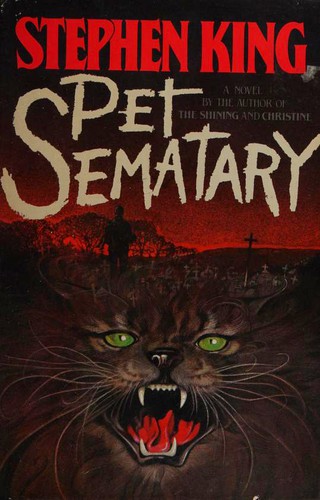
Book · 1983
Pet Sematary
King's bleakest. He sat on it for years because it upset him.
Most extreme on TONE — a bleak, unforgiving tone at 004
On VHSCREAM’s six-axis scale, Pet Sematary (1983) is most extreme on the tone axis: 4 out of 100, where 0 is a bleak, unforgiving tone and 100 is gleeful black comedy. 3% of the 105 horror works we have scored come in lower on that axis. How we score →
Pet Sematary is a 1983 novel by Stephen King, which he has said he considered too bleak to publish. A doctor moves his family to rural Maine and learns that there is ground behind his house that gives things back. We score it 004 on tone — the joint-fourth-bleakest work we hold — and 066 on viscera.
Scored and reviewed by VHSCREAM on · how we score
Pet Sematary: the review
Pet Sematary is the most upsetting book Stephen King has written and it is upsetting for a reason that has nothing to do with the monster.
The novel's engine is a disagreement about death inside a marriage. Louis Creed is a doctor and a rationalist who thinks children should be told the truth; Rachel watched her sister Zelda die of spinal meningitis in a back bedroom when she was eight, and cannot hear the word. Their daughter Ellie is five and has worked out that her cat will die. The first two hundred pages are a family having that argument badly, in a house on a road where logging trucks come through at seventy miles an hour.
King wrote it after his own daughter's cat was killed on the road outside a rented house in Orrington, and after nearly losing his toddler son to the same traffic. The book knows exactly what it is about, and its most frightening passages are not supernatural at all: they are Louis performing CPR on a child in a hospital corridor, or the long chapter in which a two-year-old runs toward a road.
Jud Crandall is the best character and the reason it happens
The elderly neighbour across the road is warm, generous, lonely and the agent of every disaster in the book. He takes Louis up past the pet cemetery to the old burying ground because he is fond of a little girl and cannot bear to see her unhappy, and he spends the rest of the novel knowing he has done it. His long account of Timmy Baterman — a young man killed in France in 1943 and brought back by his father, who sat in the house with him until the town's men came to burn them both — is the novel's clearest statement of the stakes, delivered too late.
Church is the horror
The cat comes back. King's refusal to make him dramatic is what makes the sequence work: Church stinks, he is clumsy, he walks into things, he kills birds and mice slowly and leaves them where they will be found, and he sits in the room looking at the family. Something is wearing the shape of a cat and not bothering to do it well.
Where it is weaker
The Wendigo material is thin and the novel's mythology is at its least convincing when it tries to be specific. The last act accelerates into something closer to a slasher sequence than the preceding four hundred pages deserve. And Rachel's phobia is explained slightly too thoroughly.
For King's other great novel about a family destroyed by a place, The Shining; for the bleakest book in our index on any other measure, Tender Is the Flesh; for the Maine town that will not help its children, It.
The ending of Pet Sematary explained
Total spoilers from here. Everything above this line is spoiler-free.
The short answer: Gage, two years old, is killed by a truck on Route 15. Louis exhumes his son's body from the cemetery, carries it up past the pet cemetery to the burying ground, and buries him there. Gage comes back wrong, takes Louis's scalpel, and kills Jud Crandall — from under the bed, with the voice of Jud's dead wife — and then Rachel in the house. Louis finds what is left of his wife, finally does the thing he should have done to the cat, and kills the Gage-thing with morphine. He burns the house down. Then he carries Rachel's body up the path and buries her, because he has convinced himself that she has not been dead as long as Gage was and that this time it will work. The novel's last page is Louis sitting at the kitchen table playing solitaire, hearing the back door, hearing slow footsteps. A hand falls on his shoulder. A voice says his name — one word, spoken in a tone the book describes as cold and full of earth. That is the end.
What is the burying ground in Pet Sematary?
Ground beyond the deadfall past the children's pet cemetery, which King's novel attributes to the Micmac — now written Mi'kmaq — and which the Micmac are said to have abandoned when it "went sour". Anything buried there walks again. Jud's position is that it was a place of power that something else moved into, and that the thing now in residence is a Wendigo. The novel is deliberately unclear about whether the returning dead are the dead at all, or something using the body.
Who is Timmy Baterman?
A young man from Ludlow killed in action in France in 1943, whose father Bill took the delivered coffin up to the burying ground. Timmy came back and walked up and down the road at dusk; he knew everyone's secrets and said them out loud. Four men from the town, Jud among them, went to the house to deal with it, and Bill Baterman shot himself and burned the house with his son inside it. Jud tells Louis the story as a warning — specifically, as the reason not to do it with a person — and tells it after Gage is already in the ground.
Why does Louis bury Rachel at the end?
Because the novel has spent five hundred pages establishing that grief does not reason. Louis's own stated justification is a technicality: Gage had been dead and embalmed for days, where Rachel has only just died, so the body is fresher and the result will be better. It is the same logic Jud used about the cat and the same logic Bill Baterman used about his son, and King's point is that every one of them knew better and did it anyway. Jud's line — that the soil of a man's heart is stonier, and a man grows what he can and tends it — is the book's thesis.
Who is Victor Pascow?
A student killed by a car on Louis's first day at the university infirmary, who dies on the floor of Louis's surgery after speaking to him and then returns repeatedly as a warning. He takes Louis to the deadfall in a dream, tells him the barrier was not made to be broken, and appears to Ellie and to Rachel to try to get them home in time. He is the only benign supernatural element in the novel and he fails completely.
Does anyone survive Pet Sematary?
Ellie, who is in Chicago with her grandparents for most of the final act, and Rachel's parents. Gage, Jud, Rachel and Church all die; Louis is alive on the last page and is about to be killed by whatever he has brought back. The 1989 film ends in the same place; the book's version is bleaker because King gives Louis the full chapter of deliberate, lucid planning first.
How scary is Pet Sematary, actually?
Scored against the published rubric, here is what the numbers mean.
Tone 004 is the joint-fourth-bleakest score in our index — only 3 works score lower. A toddler dies, is brought back as a murder weapon, and the book ends with the protagonist doing it again on purpose.
Viscera 066 is above the median — 81 works score lower. A child's body described after a traffic collision, an exhumation, two scalpel murders, a mutilated corpse found in a hall, and an animal killing things slowly.
The threat at 030 is on the supernatural side — 35 works score lower. Every killing in the present is done by something that was once a person, and the novel declines to say what is operating it.
Pace 026 is slow — 35 works are slower. More than half the novel is a family arguing about mortality before anything is buried.
Era bias 020 is deep analog — only 34 works score lower. A 1983 novel of landlines, logging trucks, a rural road and a hospital with no scanners in it.
Reality anchor 038 is grounded — 24 works score lower. One rule, applied consistently, in a Maine town with a road through it.
On shocks: a handful. Nothing in the book startles as badly as the cat simply being in the room.
Pet Sematary on six axes of fear
Every work in the index is scored on six continuous axes of fear. This is what Pet Sematary looks like as a vector.
Where that puts it: #2 bleakest · #7 goriest · #8 supernatural
Disagree with a number? Say so on the axis itself. Nobody has confirmed this vector yet, and a score you challenge goes to the top of the queue to be re-scored by a human. Votes do not move the numbers — they decide what gets looked at first. How the scoring works →
Scored against the published rubric. This vector is a draft awaiting review — the method is public so you can argue with it.
Who should skip Pet Sematary
Skip it if the death of a child is a hard limit. This is the subject of the novel, it happens on the page, and the aftermath runs for two hundred pages.
Skip it if you have young children near traffic. King wrote it out of that exact fear and the book is extremely precise about it.
Skip it if animal death is a hard limit. The cat is killed, buried, returns, and spends the second half of the book killing small animals badly.
Content notes: the death of a two-year-old in a road accident described in detail, the exhumation of a child's body, a child's corpse reanimated and used to kill, two murders with a scalpel, a sibling's death from illness recounted at length, animal death and cruelty, suicide in a recounted history, and a protagonist's deliberate, lucid repetition of a known catastrophe.
Read it if you want the bleakest thing King has published, you can take a child's death handled without any mercy at all, and you want a horror novel whose monster is a father's refusal to accept an outcome.
Where to start with horror books →
Where to find it
Buy from an indie bookshop ↗Out-of-print copies on eBay ↗We earn nothing from these links.
If Pet Sematary is your kind of fear
The eight works closest to Pet Sematary in the index, ranked by distance across all six axes — not by genre label, and not by what other people watched.
Alien
Ridley Scott · 1979 · Film
Shares analog-era texture.
84% shared signal
Candyman
Bernard Rose · 1992 · Film
Shares a bleak, unforgiving tone.
84% shared signal
The Exorcist
William Friedkin · 1973 · Film
Shares a supernatural threat.
82% shared signal
The Omen
Richard Donner · 1976 · Film
Shares a bleak, unforgiving tone.
81% shared signal
Ghost Story
Peter Straub · 1979 · Book
Shares slow-burn dread.
81% shared signal
The Fly
David Cronenberg · 1986 · Film
Shares analog-era texture.
80% shared signal
The Shining
Stephen King · 1977 · Book
Shares slow-burn dread.
79% shared signal
Ring
Koji Suzuki · 1991 · Book
Shares a supernatural threat.
77% shared signal
Questions about Pet Sematary
The things people actually ask about this book, answered.
What happens at the end of Pet Sematary?
Gage is killed by a truck, buried in the old ground, and returns to kill Jud and Rachel with a scalpel. Louis destroys the Gage-thing and burns the house, then buries Rachel in the same ground. The last page has him at the kitchen table hearing footsteps, and a cold hand on his shoulder.
What is the burying ground in Pet Sematary?
Ground beyond the deadfall past the pet cemetery, which King attributes to the Micmac — now Mi'kmaq — and which they are said to have abandoned when it went sour. Anything buried there comes back. Jud believes something else has taken up residence there, and names it a Wendigo.
Who is Timmy Baterman in Pet Sematary?
A Ludlow man killed in France in 1943, whose father buried him in the old ground. He came back knowing everyone's secrets and saying them aloud, and his father shot himself and burned the house with him in it. Jud tells Louis the story as a warning, too late.
Why does Louis bury Rachel at the end of Pet Sematary?
Because his grief has produced a technicality he can believe: Rachel has only just died, where Gage had been dead and embalmed for days, so this time it will work. It is the same reasoning Jud used about the cat and Bill Baterman used about his son.
Is Pet Sematary Stephen King's scariest book?
It is his bleakest. We score it 004 on tone, among the lowest in our whole index, and King has said he found it too dark and put the manuscript away. Whether it is the most frightening depends on whether a child's death frightens you more than a hotel does.
How gory is Pet Sematary?
Quite. We score it 066 on viscera, above the median for our index. The road accident, the exhumation, the two scalpel murders and the state of Rachel's body are all described directly, and the cat's killings are described slowly.
These are ranked against Pet Sematary, not against you.
Build your own tape →