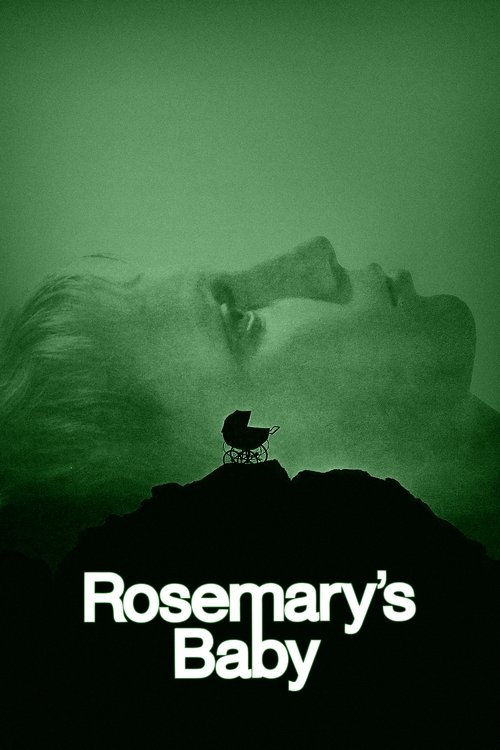
Film · 1968
Rosemary's Baby
Roman Polanski
Nobody believes her, and everybody is in on it. Paranoia as pregnancy.
Most extreme on ERA BIAS — analog-era texture at 006
On VHSCREAM’s six-axis scale, Rosemary's Baby (1968) is most extreme on the era-bias axis: 6 out of 100, where 0 is analog-era texture and 100 is modern craft. 6% of the 105 horror works we have scored come in lower on that axis. How we score →
Rosemary's Baby is a 1968 horror film written and directed by Roman Polanski, adapted from Ira Levin's novel. A young woman in a Manhattan apartment building becomes pregnant and slowly works out what her neighbours have arranged. We score it 006 on era bias — joint-seventh of 105 works — and 010 on viscera, among the least explicit things we hold.
Scored and reviewed by VHSCREAM on · how we score
Rosemary's Baby: the review
The horror in Rosemary's Baby is that everybody is so helpful.
Polanski's method is to make every single sinister act also a plausible kindness. The neighbours bring food. The famous obstetrician takes her on as a favour. Her husband handles the arrangements. The herbal drink is for her health. The pain is normal, the doctor says so, and the doctor was recommended. For ninety minutes Rosemary is given no evidence that would survive being repeated to anybody, and the film understands exactly how that feels — which is why it has outlived every film about a satanic cult that chose to show the cult.
Mia Farrow is extraordinary and the performance is mostly physical: she loses weight across the film, her hair is cut short at the midpoint, and she gets visibly smaller while everybody around her gets more solicitous. The Bramford's rooms are large and she is always at the edge of them.
It is a film about not being believed
Every supernatural element is deniable until the last two minutes. What is not deniable is the social mechanism — a husband who trades his wife for a career, an obstetrician who will not refer her, neighbours who intercept her post, a friend who dies before he can explain. When Rosemary finally reaches a doctor she chose herself, he calls the men she is fleeing. That scene has nothing supernatural in it and it is the most frightening in the film.
What Polanski does with an apartment
The film is almost entirely interiors and the geography is doing work: the sealed closet between the flats, the wall thin enough to carry chanting, a dumbwaiter, a party held in one room while something happens in the next. It is a haunted house film in which the house is a lease.
Where it is difficult now
It is slow by design and almost nothing happens for long stretches. And it is impossible to watch without the knowledge of what Polanski did eight years later, which is a fact about the film's reception rather than its construction, and which every viewer will have to decide about themselves.
For the same paranoia with a human conspiracy, Get Out is the closest modern relative; for the same pregnancy horror pushed much further, Possession.
The ending of Rosemary's Baby explained
Total spoilers from here. Everything above this line is spoiler-free.
The short answer: Rosemary breaks into the Castevets' apartment with a kitchen knife and finds the coven gathered around a black-draped bassinet. Her baby is alive. Roman Castevet announces that the child's father is Satan, and the room erupts in celebration. Rosemary is horrified, is told she can care for him, and the film's last image is her approaching the bassinet and beginning to rock it.
Does Rosemary keep the baby?
The film ends on the choice rather than after it, but the gesture is unmistakable — she stops recoiling, takes the rocker, and soothes him. Levin's novel is explicit that she accepts, and Polanski's staging leads to the same place. The horror is not that the coven wins. It is that they were right about what a mother would do.
Is the coven real, or is Rosemary imagining it?
Real. The film sustains the ambiguity with discipline for ninety minutes and then abandons it completely: the gathering, the bassinet and Roman's announcement are shown plainly. Nothing in the final scene can be read as delusion, which is why the long refusal to show anything beforehand works instead of cheating.
What did Guy get out of it?
A career. His rival actor goes suddenly blind and Guy takes the part, and the film is clear that this was the trade — he gave the coven access to his wife in exchange for professional success. He never says so directly. The closest he comes is a muttered apology he cannot finish.
What does the baby look like?
The film never shows him. Rosemary looks into the bassinet and reacts; we see her face and hear her ask what is wrong with his eyes. Roman's answer — that he has his father's eyes — is the only description given. Refusing the reveal is the film's single best decision and the one most of its imitators get wrong.
How scary is Rosemary's Baby, actually?
Scored against the published rubric, here is what the numbers mean.
Era bias 006 is near the floor — only 6 works score lower. 1968 Panavision, long takes, a palette of beige and yellow, and a lullaby hummed over the titles by Farrow herself.
Viscera 010 is almost nothing — only 6 works score lower. There is no violence on screen at all. The most explicit image in the film is a scratched back.
Pace 014 is very slow — 12 works are slower. The film is a year of a pregnancy and it takes its time; nothing accelerates until the last ten minutes.
The threat at 042 leans supernatural but barely. 60 works score lower, which is the right ambiguity: a devil is involved, and everything that is actually done to Rosemary is done by people with addresses.
Tone 026 is bleak — 70 works score lower. There is no rescue, nobody is punished, and the ending is a woman agreeing to the thing done to her.
Reality anchor 044 keeps it grounded. An apartment, a career, a pregnancy, a lease.
On jump scares: none. There is one dream sequence and otherwise the film does not raise its voice once.
Rosemary's Baby on six axes of fear
Every work in the index is scored on six continuous axes of fear. This is what Rosemary's Baby looks like as a vector.
Where that puts it: #4 slow burn · #4 analog era · #5 without gore
Disagree with a number? Say so on the axis itself. Nobody has confirmed this vector yet, and a score you challenge goes to the top of the queue to be re-scored by a human. Votes do not move the numbers — they decide what gets looked at first. How the scoring works →
Scored against the published rubric. This vector is a draft awaiting review — the method is public so you can argue with it.
Who should skip Rosemary's Baby
Skip it if you are pregnant or have had a difficult pregnancy. The film's subject is a woman in pain being told by professionals that her pain is normal, sustained for an hour, and it is extremely effective.
Skip it if medical disbelief is a hard limit. Rosemary is disbelieved by her husband, her obstetrician, her friends and finally by a doctor she chose herself.
Skip it if you need something to happen. At 014 on pace this is one of the slowest films in the index.
Content notes: a drugged non-consensual conception, sustained gaslighting, a pregnancy depicted as physically damaging, a suicide, and the death of an elderly character.
Watch it if you want the best film ever made about not being believed, you can take a slow one, and you want to see a horror film win by refusing to show you anything.
Where to find it
Streaming on fuboTV · Paramount Plus Premium · Paramount Plus Essential +2 ↗Physical copies on eBay ↗Availability from JustWatch via TMDB. We earn nothing from these links.
Nothing loads from YouTube until you press play.
If Rosemary's Baby is your kind of fear
The eight works closest to Rosemary's Baby in the index, ranked by distance across all six axes — not by genre label, and not by what other people watched.

The Haunting of Hill House
Shirley Jackson · 1959 · Book
Shares analog-era texture.
93% shared signal
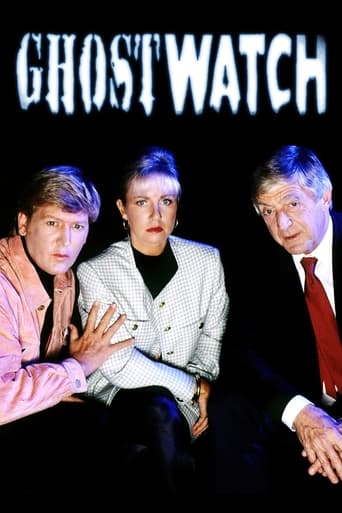
Ghostwatch
BBC · 1992 · Television
Shares restraint over gore.
87% shared signal
The Turn of the Screw
Henry James · 1898 · Book
Shares slow-burn dread.
87% shared signal
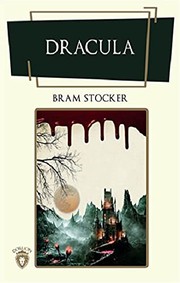
Dracula
Bram Stoker · 1897 · Book
Shares a bleak, unforgiving tone.
85% shared signal

The Fog (OST)
John Carpenter · 1980 · Record
Shares analog-era texture.
84% shared signal

Frankenstein
Mary Shelley · 1818 · Book
Shares slow-burn dread.
84% shared signal
The Blair Witch Project
D. Myrick & E. Sánchez · 1999 · Film
Shares restraint over gore.
83% shared signal
The Elementals
Michael McDowell · 1981 · Book
Shares a bleak, unforgiving tone.
82% shared signal
See the full list of movies like Rosemary's Baby →
Questions about Rosemary's Baby
The things people actually ask about this film, answered.
What happens at the end of Rosemary's Baby?
Rosemary finds the coven gathered around her baby's bassinet and is told that the child's father is Satan. She is horrified, then offered the chance to care for him, and the last image is her taking the rocker and beginning to soothe him. The baby is never shown.
Does Rosemary accept the baby?
The film ends on the gesture rather than a statement, but it is unambiguous — she stops recoiling and rocks the cradle. Levin's novel says plainly that she accepts. The horror is that the coven correctly predicted what a mother would do.
Is the coven in Rosemary's Baby real?
Yes. The film keeps every supernatural element deniable for ninety minutes and then shows the gathering, the bassinet and Roman's announcement plainly. Nothing in the final scene can be read as delusion, which is what makes the long withholding work.
What does Guy get in return?
An acting career. His main rival goes suddenly blind and Guy inherits the role, and the film makes clear this was the exchange for giving the coven access to his wife. He never admits it outright; the closest is an apology he cannot finish.
What is wrong with the baby's eyes?
The film does not say and never shows him. Rosemary asks what is wrong with his eyes and Roman replies that he has his father's. That refusal to reveal the child is the film's best decision and the thing almost every imitator gets wrong.
Is Rosemary's Baby scary?
Not in the startle sense — there are no jump scares and we score it 010 on viscera, close to the floor of our index. It frightens through social helplessness: a woman in pain whose husband, doctor and neighbours all calmly explain that nothing is wrong.
These are ranked against Rosemary's Baby, not against you.
Build your own tape →