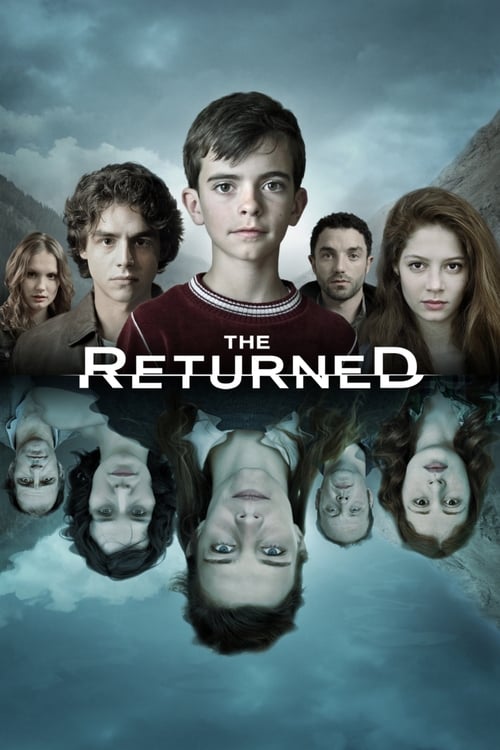
On VHSCREAM’s six-axis scale, Les Revenants (2012) is most extreme on the pace-of-fear axis: 12 out of 100, where 0 is slow-burn dread and 100 is relentless shock. 9% of the 105 horror works we have scored come in lower on that axis. How we score →
Les Revenants is a French series created by Fabrice Gobert for Canal+, first broadcast in 2012 and running to two seasons. In an Alpine village below a dam, dead people start coming home — intact, unaware they died, and expecting things to continue. We score it 012 on pace — only 9 works are slower — and 014 on tone.
Scored and reviewed by VHSCREAM on · how we score
Les Revenants: the review
Les Revenants is the best thing ever made about bereavement and it achieves that by refusing almost everything the premise invites.
The returned are not zombies, not ghosts and not monsters. Camille Séguret walks down a mountain road and into her parents' kitchen four years after a coach crash killed her and most of her class, and she is fifteen and hungry and annoyed that nobody will tell her what is going on. Simon turns up at the church where his fiancée is about to marry somebody else, ten years after he died on their wedding day. They do not decay, they do not remember dying, they eat enormously, and they are exactly who they were — which is the cruelty, because everybody else has spent years becoming somebody who could live without them.
Gobert shoots it with total patience: long takes, flat Alpine light, a village that is mostly empty, and almost no score except Mogwai's, which is one of the great pieces of television music — droning, patient, melancholy, and used sparingly enough that it means something when it arrives.
Camille and Léna are the series
Camille is fifteen forever and her twin sister Léna is nineteen, and the show understands immediately what that does. Léna has four years of grief, guilt, a scar she did not have, a boyfriend who was Camille's, and a sister who has not aged a day and wants her life back. Yara Pilartz and Jenna Thiam play it as a genuine sibling relationship with a horror situation on top rather than the reverse, and the family's slow disintegration — a mother who has moved on, a father who never did, a church group forming around the returned — is written with no villains in it.
Where season two loses it
Season one is close to perfect and season two is not. Gobert expands the mythology, introduces a larger population of the returned, adds a community and a timeline that the first season deliberately withheld, and starts answering questions. The answers are not as good as the questions, the pacing becomes uneven, and several of season one's best ambiguities are resolved into something smaller. The series was not renewed, which means the back half of its own expansion goes unused.
Where it is difficult
At 012 on pace this is among the slowest things we hold and the slowness is the method. Subtitles, two seasons, and a show that will spend ten minutes on a woman cooking too much food for a daughter who died. There is also an American remake, which is not worth your time.
For the same small community and the same unresolved metaphysics, Midnight Mass; for the same grief that will not accept the outcome, Pet Sematary; for the same unhurried Alpine and village dread, The Wicker Man.
The ending of Les Revenants explained
Total spoilers from here. Everything above this line is spoiler-free.
The short answer: the series' explanation, when it finally comes, is Victor. Victor — the small mute boy who died in the 1970s and who has been attached to Julie — is the cause: terrified of being left alone when the man who had been hiding him collapsed, he wished him back, and brought the village's other dead with him. He has been one of the returned himself for thirty-five years, which recasts everything about him. The reservoir, which has been dropping all series, uncovers the old church of the village the dam drowned, and the connection between the flooded settlement and the returned is made without being spelled out. The final episode is about letting go rather than winning. Camille is shot at by Frédéric; Claire shoots him; Jérôme drives Camille away and the road itself gives out, turning to dirt and then to nothing, and the Ségurets are left in the woods with Camille no longer breathing. They accept it, which is the series' whole argument — the dead can come back and it still has to end. The returned leave. And then the last beat undercuts the relief: Adèle and Simon's infant son is the same as Victor, Lucy leaves the baby on a doorstep, and Victor hears it cry and looks frightened. The series was cancelled after that, so nothing beyond it exists.
Why do the dead come back in Les Revenants?
Because Victor wanted someone to stay. Season two establishes that he is the origin: already one of the returned himself, hidden for thirty-five years, he was faced with losing the only person who knew he was there and wished him back — and the wish was not precise, so the village's other dead came with him. Season one deliberately offers no explanation at all, and a substantial number of viewers prefer it that way.
What are the returned?
Physically identical, undecayed versions of the dead, who wake near where they died, walk home, and have no memory of dying. They eat compulsively, they do not age, they bruise and heal, and they can be killed again. They are not aware of being dead unless told, and the series is specific that they are the same people rather than copies — which is what makes the families' situation impossible rather than merely strange.
What is the significance of the dam and the lake?
The village was flooded to build the reservoir, and the old settlement — including its church — is under the water. Across both seasons the water level drops without explanation as more of the dead return, eventually exposing the church. The series never states the mechanism. What it establishes is that the drowning of the old village and the return of the dead are the same event seen from two ends, and that the water going down is a measure of how much is coming back.
Does Camille die again?
Yes. In the final episode she is shot at, driven away by her father, and the road out of the valley simply ceases to exist; she stops breathing in the car in the woods. Her parents' acceptance of it is the emotional resolution of the entire series, and the show deliberately gives her a second death that nobody caused and nobody could have prevented.
What does the last scene of Les Revenants mean?
That it is starting again. Adèle and Simon's baby is established as being like Victor — a returned child with whatever ability Victor has — and Lucy leaves the infant on a doorstep. Victor hears it crying and is visibly afraid. It is a cliffhanger for a third season that was never made, and read as an ending it says the thing the whole series has said: this is a condition of the valley, not an incident in it.
Is the American remake worth watching?
No. A&E's 2015 version remakes season one closely, was cancelled after ten episodes, and reproduces the plot without the pace, the light or the Mogwai score — which is to say without the only things that made it work. Watch the French original with subtitles.
How scary is Les Revenants, actually?
Scored against the published rubric, here is what the numbers mean.
Pace 012 is extremely slow — only 9 works are slower. Scenes run to their natural length and well past it, and that duration is the entire mechanism.
Tone 014 is bleak — 30 works score lower. Every family in the series is given back what it lost and then has to lose it again, and the last beat is the cycle restarting.
Reality anchor 058 leans towards dream logic — 59 works score lower. The road out of the valley stops existing, the water level tracks the dead, and no mechanism is ever stated.
Viscera 018 is very low — 11 works score lower. A serial killer's attacks, a self-inflicted injury and a shooting, almost all of it off-frame or in brief glimpses.
Era bias 072 leans modern — 63 works score lower. Digital capture, a 2012 French village with mobile phones, and a contemporary television grade.
The threat at 030 is on the supernatural side — 35 works score lower, although the series' only murderer is a living man and the returned mostly want their beds back.
On jump scares: two in two seasons, and the series is not remotely interested in them.
Les Revenants on six axes of fear
Every work in the index is scored on six continuous axes of fear. This is what Les Revenants looks like as a vector.
Disagree with a number? Say so on the axis itself. Nobody has confirmed this vector yet, and a score you challenge goes to the top of the queue to be re-scored by a human. Votes do not move the numbers — they decide what gets looked at first. How the scoring works →
Scored against the published rubric. This vector is a draft awaiting review — the method is public so you can argue with it.
Who should skip Les Revenants
Skip it if slowness is the problem. At 012 on pace this is among the slowest things we hold, across sixteen episodes, in French.
Skip it if a child's death is a hard limit. A coach crash killing a class of schoolchildren is the premise, and Camille dies twice.
Skip it if an unresolved ending will frustrate you. The series was cancelled on a cliffhanger, and season one's best ambiguities are the ones season two tries hardest to answer.
Content notes: the deaths of children in a coach crash, a child's second death, a serial killer's attacks on women, a suicide, a self-inflicted injury, a stillbirth and a pregnancy loss, animal death, and sustained depictions of grief and of families being broken twice.
Watch it if you want the best television ever made about bereavement, you can take sixteen hours of a village where very little happens slowly, and you want to hear what Mogwai do with a horror series.
Where to find it
Streaming on Amazon Prime Video ↗Physical copies on eBay ↗Availability from JustWatch via TMDB. We earn nothing from these links.
Nothing loads from YouTube until you press play.
If Les Revenants is your kind of fear
The eight works closest to Les Revenants in the index, ranked by distance across all six axes — not by genre label, and not by what other people watched.
The Witch
Robert Eggers · 2015 · Film
Shares a bleak, unforgiving tone.
87% shared signal
The Babadook
Jennifer Kent · 2014 · Film
Shares restraint over gore.
87% shared signal
It Follows
David Robert Mitchell · 2014 · Film
Shares slow-burn dread.
86% shared signal
A Dark Song
Liam Gavin · 2016 · Film
Shares modern craft.
84% shared signal
The Haunting of Hill House
Mike Flanagan · 2018 · Television
Shares a supernatural threat.
84% shared signal
The Fisherman
John Langan · 2016 · Book
Shares slow-burn dread.
84% shared signal

Abyss
Chelsea Wolfe · 2015 · Record
Shares a bleak, unforgiving tone.
84% shared signal
House of Leaves
Mark Z. Danielewski · 2000 · Book
Shares restraint over gore.
82% shared signal
Questions about Les Revenants
The things people actually ask about this series, answered.
What happens at the end of Les Revenants?
Victor is revealed as the cause of the returns. The reservoir drops to expose the drowned village's church, Camille is shot at and dies again when the road out of the valley ceases to exist, and her parents accept it. The returned leave — and the final beat is Simon and Adèle's baby being like Victor.
Why do the dead come back in Les Revenants?
Because Victor, a boy who died in the 1970s and had been one of the returned for thirty-five years, wished back the man who was hiding him and brought the village's other dead along with him. Season one offers no explanation at all, which many viewers prefer.
What are the returned in Les Revenants?
Undecayed, physically identical versions of the dead who wake near where they died and walk home with no memory of dying. They eat compulsively, do not age, heal, and can be killed again. The series treats them as the same people, not copies.
Does Camille die again in Les Revenants?
Yes, in the final episode. After being shot at she is driven away by her father and the road out of the valley stops existing; she stops breathing in the car. Her parents' acceptance of that second loss is the series' real resolution.
What does the lake and the dam mean in Les Revenants?
The reservoir drowned the old village, church included, and the water level falls as more of the dead come back — eventually uncovering the church. The series never explains it, and treats the flooding and the returns as the same event from two directions.
Is the American remake of The Returned any good?
No. A&E's 2015 version follows season one closely, was cancelled after ten episodes, and keeps the plot while losing the pace, the light and the Mogwai score — which were the show. Watch the French original.
These are ranked against Les Revenants, not against you.
Build your own tape →