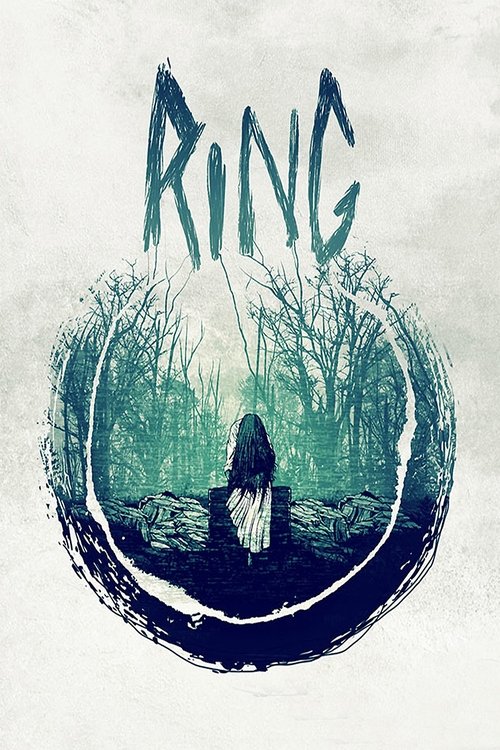
Film · 1998
Ringu
Hideo Nakata
A curse that spreads like media, because it is media.
Most extreme on TONE — a bleak, unforgiving tone at 012
On VHSCREAM’s six-axis scale, Ringu (1998) is most extreme on the tone axis: 12 out of 100, where 0 is a bleak, unforgiving tone and 100 is gleeful black comedy. 21% of the 105 horror works we have scored come in lower on that axis. How we score →
Ringu is a 1998 Japanese horror film directed by Hideo Nakata, adapted from Koji Suzuki's novel. A videotape kills whoever watches it within seven days. We score it 012 on tone — 22 works in an index of 105 score lower — and 022 on viscera, which makes it one of the least explicit films we hold.
Scored and reviewed by VHSCREAM on · how we score
Ringu: the review
Ringu frightens people who are not frightened by anything because it does almost nothing.
The film is quiet, flatly lit, procedural and cold. Reiko is a journalist and the structure is an investigation: a dead niece, a group of teenagers, a holiday cabin, a tape, a deadline. There are no stings and the score is sparse to the point of absence — mostly a low hum, water, and silence where a cue should be. The famous apparition appears for a handful of seconds in total.
What it has instead is the tape itself, which is one of the great sequences in horror. A minute of disconnected black-and-white images — a woman brushing her hair in a mirror, crawling figures, an eye, a well, text that is not quite readable — presented without explanation or commentary. It is frightening because it is formally wrong: it looks like something recorded rather than filmed, and it does not resolve into meaning.
The mechanism is the innovation
The curse spreads as media. It is not a haunting attached to a place or a bloodline; it is a copyable file with a propagation rule, and the only way to survive is to copy it and show it to somebody else. That makes the viewer complicit by design — the film's logic is that you pass it on or you die, and everyone who survives has condemned somebody.
In 1998, with a VHS deck in every home, that was a nearly perfect delivery system for dread. It is also why the premise has aged in an interesting direction rather than badly: the medium changed and the mechanism did not.
Sadako and the restraint
Nakata shows her in fragments: hair, a hand, a single eye, a jerky movement achieved by filming an actor walking backwards and reversing it. There is no makeup reveal and no monologue. Her history arrives as a newsreel and an interview rather than a flashback with music.
Where it is slow
It is genuinely slow and the middle act is two people reading archives. The child is written thinly. And the ending's final twist is delivered in dialogue rather than image, which is the one place the film takes the easy route.
For the American remake's different strengths, The Ring is scored separately; for the novel's colder, more procedural version, Ring.
The ending of Ringu explained
Total spoilers from here. Everything above this line is spoiler-free.
The short answer: finding and burying Sadako's body does not lift the curse. Ryuji dies on schedule. Reiko works out what actually saved her: she had copied the tape and shown it to somebody. The film ends with her driving to her father's house to show the tape to him, so that her son will live. She survives by sentencing her own father.
How does the curse in Ringu work?
Watch the tape and you die in seven days. The telephone rings immediately after viewing as confirmation. The only known escape is to make a copy and show it to another person within the week — which does not destroy the original curse, it extends the chain. Nothing about the mechanism is ever explained; it is simply observed and tested.
Who is Sadako Yamamura?
A girl with psychic abilities, daughter of a woman who was publicly discredited as a fraud. She was murdered by her father and thrown into a well, where she did not die immediately. The cabin where the teenagers watched the tape was built over that well. Her ability imprinted onto the tape, which is the film's only concession to explaining anything.
Why doesn't recovering the body stop it?
Because the curse was never about an unquiet burial, which is the assumption Reiko and Ryuji bring from every ghost story they know. The film lets them act on it, grants them a moment of relief, and then kills Ryuji on the deadline anyway. It is the film's best structural move: it defeats the genre's standard solution on screen.
What does Reiko do at the end?
She drives to her father's house with the tape, intending to show it to him so that her son Yoichi — who has now seen it — can be saved by passing it on. The film does not show the act. It ends on her driving, which is worse than showing it, because the audience has to complete the thought.
Is Ringu different from The Ring?
Substantially. Gore Verbinski's 2002 remake is more explicit, more explained and visually far more designed, with a decayed-corpse reveal and a detailed backstory. Ringu is colder, quieter and withholds almost everything. Both work; they are not the same film.
How scary is Ringu, actually?
Scored against the published rubric, here is what the numbers mean.
Tone 012 is bleak — 22 works score lower. The only way to live is to doom somebody else, and the protagonist takes it.
Viscera 022 is very low — 21 works score lower. There is one distorted face and almost nothing else. No blood, no injury, no body.
Pace 024 is slow — 29 works are slower. The middle is an archive search and the film never raises its voice.
The threat at 018 is near the floor — only 14 works score lower. The curse has no motive you can appeal to and no rules it will bend.
Era bias 034 reads analog — 44 works score lower, and the film is entirely dependent on it. A curse that spreads on physical cassettes could not be told any other way.
Reality anchor 064 is on the dream-logic side — 73 works score lower, almost entirely because of the tape's imagery.
On jump scares: two, and the film could have had twenty.
Ringu on six axes of fear
Every work in the index is scored on six continuous axes of fear. This is what Ringu looks like as a vector.
Where that puts it: #11 without gore · #11 slow burn · #11 surreal · #12 bleakest · #13 supernatural
Disagree with a number? Say so on the axis itself. Nobody has confirmed this vector yet, and a score you challenge goes to the top of the queue to be re-scored by a human. Votes do not move the numbers — they decide what gets looked at first. How the scoring works →
Scored against the published rubric. This vector is a draft awaiting review — the method is public so you can argue with it.
Who should skip Ringu
Skip it if slow procedural horror bores you. Large sections are two journalists reading documents, and the film offers no incident to carry you through them.
Skip it if you need a resolution. The curse is not broken, and the ending is the protagonist choosing to pass it on.
Skip it if a child in danger is a hard limit. The son watches the tape and is under sentence when the film ends.
Content notes: the murder of a child by a parent, a child placed under a death sentence, a body recovered from a well, a death from fright, and a protagonist knowingly condemning a family member.
Watch it if you want the most influential horror film of the last thirty years, you can take a slow investigation, and you want to see a curse designed as a propagation rule rather than a haunting.
Where to find it
Streaming on Philo · AMC+ · Criterion +4 ↗Physical copies on eBay ↗Availability from JustWatch via TMDB. We earn nothing from these links.
Nothing loads from YouTube until you press play.
If Ringu is your kind of fear
The eight works closest to Ringu in the index, ranked by distance across all six axes — not by genre label, and not by what other people watched.
Ring
Koji Suzuki · 1991 · Book
Shares a bleak, unforgiving tone.
91% shared signal
The Ring
Gore Verbinski · 2002 · Film
Shares a supernatural threat.
90% shared signal
The Elementals
Michael McDowell · 1981 · Book
Shares slow-burn dread.
84% shared signal

The Fog (OST)
John Carpenter · 1980 · Record
Shares restraint over gore.
83% shared signal

Heresy
Lustmord · 1990 · Record
Shares a bleak, unforgiving tone.
83% shared signal
Ghost Story
Peter Straub · 1979 · Book
Shares slow-burn dread.
81% shared signal
House of Leaves
Mark Z. Danielewski · 2000 · Book
Shares restraint over gore.
79% shared signal
Les Revenants
Canal+ · 2012 · Television
Shares a supernatural threat.
79% shared signal
Questions about Ringu
The things people actually ask about this film, answered.
What happens at the end of Ringu?
Burying Sadako's body does not break the curse and Ryuji dies on schedule. Reiko realises she survived because she had copied the tape and shown it to someone, so she drives to her father's house to show it to him and save her son. The film ends before she does it.
How does the curse work in Ringu?
Watching the tape kills you in seven days, confirmed by a phone call straight afterwards. The only escape is to copy it and show it to another person within the week, which extends the chain rather than ending it. The film never explains the mechanism, only tests it.
Who is Sadako in Ringu?
A psychic girl, daughter of a woman publicly branded a fraud, who was murdered by her father and thrown down a well where she did not die at once. Her ability imprinted onto videotape. The cabin where the teenagers watched it stands over that well.
Why doesn't finding the body stop the curse?
Because the curse was never about an improper burial — that is the assumption the characters import from every ghost story they know. The film lets them act on it, gives them a moment of relief, and then kills Ryuji on schedule anyway.
Is Ringu scarier than The Ring?
Quieter and colder. We score Ringu 022 on viscera with almost nothing shown; the 2002 American version is more explicit, more explained and far more designed. Viewers who respond to withholding usually prefer Ringu, and viewers who want a reveal usually prefer The Ring.
Is Ringu based on a true story?
No. Koji Suzuki's 1991 novel is fiction, though it draws on the real case of Chizuko Mifune, a Meiji-era woman tested for clairvoyance and publicly discredited, who is the model for Sadako's mother. The curse and the tape are invented.
These are ranked against Ringu, not against you.
Build your own tape →