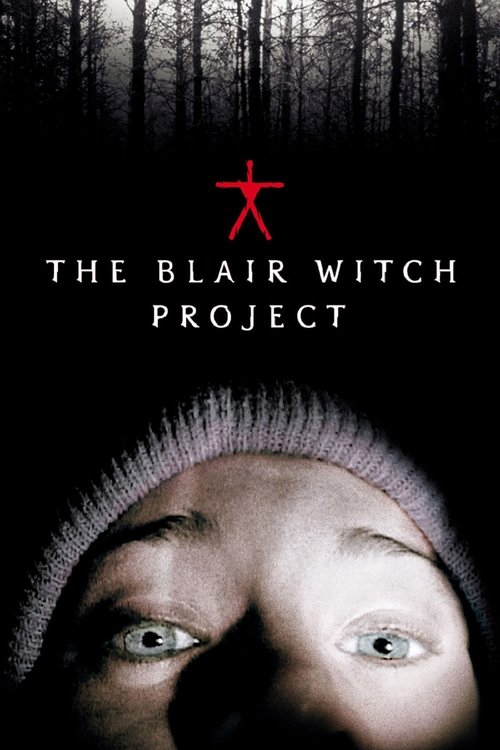
Film · 1999
The Blair Witch Project
D. Myrick & E. Sánchez
Three people get lost and the woods do the rest. Almost nothing is shown.
Most extreme on VISCERA — restraint over gore at 006
On VHSCREAM’s six-axis scale, The Blair Witch Project (1999) is most extreme on the viscera axis: 6 out of 100, where 0 is restraint over gore and 100 is explicit viscera. 1% of the 105 horror works we have scored come in lower on that axis. How we score →
The Blair Witch Project is a 1999 found-footage film directed by Daniel Myrick and Eduardo Sánchez, in which three student film-makers go into the Maryland woods to document a local legend and do not come out. We score it 006 on viscera — only 1 work scores lower, which makes it the joint-second-least-explicit film we have scored — and 014 on tone.
Scored and reviewed by VHSCREAM on · how we score
The Blair Witch Project: the review
The Blair Witch Project is a film about being lost, and almost nothing else, and it is still the most frightening thing anyone has done with that.
The first act is a mockumentary and plays as one: interviews in Burkittsville with people who half-believe, a fisherman at Coffin Rock, a woman with a baby who talks about Rustin Parr. Then the three of them walk into the woods and the film quietly stops being about a witch. The map goes into a creek. The compass does not help. They walk south all day and arrive back at the same log. The tent gets surrounded at night by something that makes children's noises and does not come in. Nothing is ever seen.
That absence is the whole method and it is a harder trick than it looks. The directors gave the three actors a rough map, a GPS, dwindling food and a set of daily note-drops, and then genuinely harassed them at night without warning — the shaking tent, the voices, the piles of stones left outside. What is on screen is three real people getting hungry, cold, frightened and unpleasant to each other. Heather's insistence on filming is a character flaw the film actually prosecutes: Mike's "I see why you like this camera so much — it's not quite reality" is the best line in nineties horror.
The folklore is doing real work
The film's three legends layer deliberately: Elly Kedward, banished for witchcraft in 1785; the 1940s hermit Rustin Parr, who killed seven children in a house in these woods, taking them in pairs and making one face a corner while he worked on the other; and a modern disappearance. None of it is confirmed. All of it supplies the final shot.
Where it is hard going
It is genuinely slow and a large part of the running time is three people arguing while walking. The handheld footage is punishing and the 1999 theatrical experience made people physically sick. And the film's reputation was built on a marketing campaign — missing-person posters, a website presenting the three actors as dead, an IMDb listing — which no longer exists, so a modern viewer has to supply the uncertainty themselves.
For the found-footage grammar it created, applied with a static camera, Paranormal Activity; for the best film ever made in this form, Lake Mungo; for the same unseen-folklore dread, The Wicker Man.
The ending of The Blair Witch Project explained
Total spoilers from here. Everything above this line is spoiler-free.
The short answer: Josh disappears in the night. The next morning Heather finds a bundle of sticks and cloth outside the tent containing what appear to be teeth, hair and a piece of tongue. That night she and Mike hear Josh screaming somewhere below them and follow the sound to a derelict house in the woods. Inside, the walls are covered in children's handprints. Mike runs to the basement, shouts, and his camera falls. Heather follows, screaming his name; in her camera's light Mike is standing facing the corner of the basement, motionless. Something strikes her, her camera drops, and it films the floor. Nothing is explained, nothing is seen, and the film ends.
What does the ending of The Blair Witch Project mean?
It is the Rustin Parr legend being completed. The film established, in a first-act interview, that Parr took children in pairs and made one stand facing a corner so it could not see what he was doing to the other. The last thing Heather's camera records is Mike standing in a corner. The implication is that whatever Parr was obeying is still operating, and that Heather is the one being worked on.
What is in the bundle of sticks?
A parcel of sticks bound with scraps of Josh's shirt, containing something wet that Heather unwraps off camera and reacts to with total horror. She says it contains teeth, and the fragments are generally read as teeth, hair and a piece of tongue. The film deliberately never shows it clearly. Whatever it is, it arrives the morning after Josh vanishes and it is left where she will find it.
What happens to Josh?
He is taken on the fifth or sixth night, out of the tent, while Heather and Mike hear him shouting and cannot find him. His screams are heard again the following night from inside or beneath the house, which is what leads Heather and Mike inside. He is never found, and the film's audio is ambiguous about whether what they are following is Josh at all.
Is the Blair Witch legend real?
No. Elly Kedward, Rustin Parr, Coffin Rock and the town of Blair are all invented for the film. Burkittsville, Maryland is a real town and was not previously associated with any such legend; it was renamed from nothing and became a minor pilgrimage site, to the considerable annoyance of the people who live there. The Black Hills Forest and the Parr murders do not exist.
Why does nobody see the witch?
Because the directors' rule was that there would be nothing to see. No creature was ever designed or shot. What produces the fear is a set of signs — stick figures hanging in the trees, three cairns outside the tent, the sound of a child, footsteps circling at night — and the fact that the woods are a closed system the characters cannot navigate out of. The film's position is that an unseen cause is worse than any possible reveal, and three sequels have since proved it right by trying.
Why is the handheld camera so rough?
Because the actors shot it. Heather Donahue, Joshua Leonard and Michael Williams operated the 16mm camera and the Hi8 video camera themselves, with no crew present, while hiking and while frightened. The two formats are a plot device as well: the black-and-white film stock is Heather's documentary and the colour video is her behind-the-scenes record, which is why the film cuts between them.
How scary is The Blair Witch Project, actually?
Scored against the published rubric, here is what the numbers mean.
Viscera 006 is at the floor — only 1 work scores lower. There is no injury, no blood and no body anywhere in the film. The most explicit thing in it is a bundle Heather does not show you.
Tone 014 is bleak — 30 works score lower. All three die, nothing is learned, and the footage exists only because it was recovered.
Pace 018 is very slow — only 18 works are slower. The film is a walk, and the dread comes from repetition rather than incident.
Era bias 030 reads analog — 42 works score lower. 16mm black-and-white and Hi8 video, both degraded, with no digital correction anywhere.
Reality anchor 026 is grounded — 14 works score lower. One forest, consistent geography that the characters cannot read, and no image that cannot be explained by something walking around outside a tent.
The threat at 035 leans supernatural — 47 works score lower, though the film is careful to leave a human reading available: three people could in principle be being stalked by a person.
On jump scares: almost none. There are perhaps two, and both are sounds.
The Blair Witch Project on six axes of fear
Every work in the index is scored on six continuous axes of fear. This is what The Blair Witch Project looks like as a vector.
Where that puts it: #3 without gore · #8 slow burn · #12 grounded
Disagree with a number? Say so on the axis itself. Nobody has confirmed this vector yet, and a score you challenge goes to the top of the queue to be re-scored by a human. Votes do not move the numbers — they decide what gets looked at first. How the scoring works →
Scored against the published rubric. This vector is a draft awaiting review — the method is public so you can argue with it.
Who should skip The Blair Witch Project
Skip it if handheld camerawork makes you ill. This is the film that put sick bags in cinema lobbies, and it has not been stabilised since.
Skip it if you need to see the monster. Nothing is ever shown. A substantial number of viewers finish it feeling cheated, and the film does not care.
Skip it if people arguing while lost will bore rather than frighten you. That is most of the running time.
Content notes: three deaths understood but never shown, the historical murder of seven children described in detail, human remains implied in a parcel, sustained fear and exhaustion filmed on non-actors, and a protracted depiction of being lost.
Watch it if you want the film that reinvented horror's economics, you can take a slow walk with no payoff, and you want to understand why an empty frame has frightened more people than any creature design.
Where to find it
Streaming on HBO Max ↗Physical copies on eBay ↗Availability from JustWatch via TMDB. We earn nothing from these links.
Nothing loads from YouTube until you press play.
If The Blair Witch Project is your kind of fear
The eight works closest to The Blair Witch Project in the index, ranked by distance across all six axes — not by genre label, and not by what other people watched.
Ghostwatch
BBC · 1992 · Television
Shares restraint over gore.
85% shared signal
Rosemary's Baby
Roman Polanski · 1968 · Film
Shares slow-burn dread.
83% shared signal

The Haunting of Hill House
Shirley Jackson · 1959 · Book
Shares a bleak, unforgiving tone.
81% shared signal
Ring
Koji Suzuki · 1991 · Book
Shares analog-era texture.
80% shared signal

The Fog (OST)
John Carpenter · 1980 · Record
Shares restraint over gore.
78% shared signal
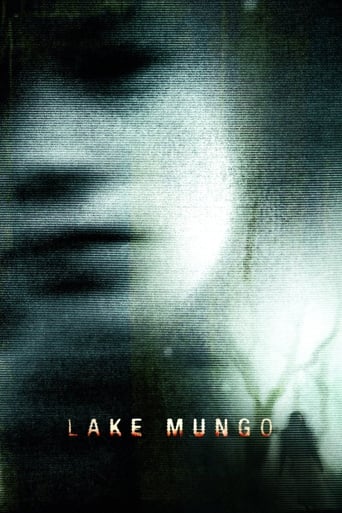
Lake Mungo
Joel Anderson · 2008 · Film
Shares grounded realism.
77% shared signal
Dracula
Bram Stoker · 1897 · Book
Shares slow-burn dread.
76% shared signal
Ringu
Hideo Nakata · 1998 · Film
Shares a bleak, unforgiving tone.
76% shared signal
See the full list of movies like The Blair Witch Project →
Questions about The Blair Witch Project
The things people actually ask about this film, answered.
What happens at the end of The Blair Witch Project?
Josh vanishes, Heather finds a bundle of sticks containing teeth and hair, and that night she and Mike follow his screams to a derelict house. Mike's camera falls in the basement; Heather finds him standing facing the corner, something hits her, and her camera lands on the floor.
What does the corner mean in The Blair Witch Project?
It completes the Rustin Parr legend set up in the first act. Parr took children in pairs and made one face a corner so it could not see what was happening to the other. Mike standing in the corner means Heather is the one being worked on.
Is the Blair Witch a real legend?
No. Elly Kedward, Rustin Parr, Coffin Rock, the Black Hills Forest and the town of Blair were all invented for the film. Burkittsville, Maryland is real and had no such folklore before 1999, and its residents did not welcome the attention.
What is in the bundle of sticks in The Blair Witch Project?
Sticks bound with scraps of Josh's shirt around something Heather unwraps off camera. She identifies teeth, and it is usually read as teeth, hair and a piece of tongue. The film never shows it, and it appears the morning after Josh is taken.
Is The Blair Witch Project gory?
Not at all. We score it 006 on viscera, at the floor of our index. There is no blood, no injury and no body on screen. Everything violent is inferred from sound, from a parcel and from an absence.
Why is The Blair Witch Project considered scary if nothing happens?
Because the fear is navigational rather than visual. The characters walk south all day and return to the same log, their map is gone, and something circles the tent every night without entering. We score it 018 on pace and 026 on reality anchor: it is slow, literal, and the dread is that the woods will not let them out.
These are ranked against The Blair Witch Project, not against you.
Build your own tape →