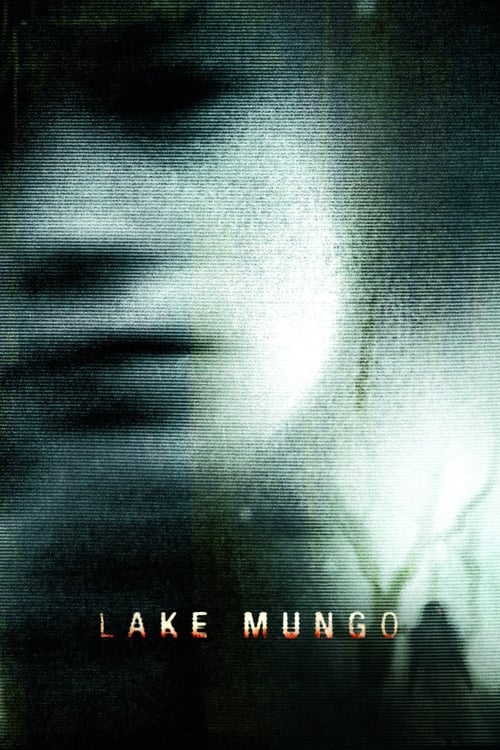
Film · 2008
Lake Mungo
Joel Anderson
A mock-documentary about grief that hides its worst image in plain sight.
Most extreme on VISCERA — restraint over gore at 004
On VHSCREAM’s six-axis scale, Lake Mungo (2008) is most extreme on the viscera axis: 4 out of 100, where 0 is restraint over gore and 100 is explicit viscera. 0% of the 105 horror works we have scored come in lower on that axis. How we score →
Lake Mungo is a 2008 Australian mock-documentary written and directed by Joel Anderson. A family whose teenage daughter drowns begins finding her in photographs. We score it 004 on viscera and 008 on reality anchor — the single least explicit and the single most grounded work in an index of 105. It shows you almost nothing and almost everything in it could happen.
Scored and reviewed by VHSCREAM on · how we score
Lake Mungo: the review
Everything that makes Lake Mungo work is a refusal. There is no score to speak of, no jump, no monster, no scene in which anybody runs. It is assembled entirely out of the furniture of Australian regional television: talking heads in good light, a measured narrator, archive photographs, a reconstructed timeline. The form is so convincing that the film's few supernatural events arrive without any of the signalling that normally tells an audience to be frightened, which is why they are frightening.
The subject is a drowning. Alice Palmer, sixteen, goes under at a dam on a family trip and her body is recovered. What follows is the Palmers failing to accept it in four different directions at once — a mother who cannot stop going into her daughter's room, a father who identified a body he now doubts was hers, a brother who starts photographing the house at night, and a psychic who may be the only honest person in the film.
It is a grief film with a horror film inside it
The ghost story is a decoy, and a deliberate one. Every apparition in the first hour has a mundane explanation, and the film supplies each one — a faked image, a misread shape, a sleepwalking brother. What the film is actually doing is tracking a family's search for a version of events that hurts less, and watching each candidate close off.
And then it produces one image that no explanation covers.
That image is the reason the film has a reputation out of all proportion to its budget, and the reason it is almost impossible to discuss without ruining. Anderson withholds it for seventy minutes, delivers it in a degraded phone video on a small screen inside a larger frame, and declines to repeat it. There is no music cue. Somebody simply describes what they are looking at.
Why it never found an audience
It had no stars, no distributor of consequence, a title that sounds like a geography documentary, and the misfortune to arrive during the found-footage boom it is quietly better than. Anderson has not made another feature in eighteen years, which is its own small horror.
If you want a film that frightens you in the cinema, this is the wrong one. If you want a film that you will think about in a specific moment years later — scrolling back through your own photographs, looking at a face in a window — nothing in the index does that better. The one to watch next is Skinamarink for the same refusal applied to a dark house, or The Babadook for the same grief handled as a monster.
The ending of Lake Mungo explained
Total spoilers from here. Everything above this line is spoiler-free.
The short answer: Alice had filmed herself at Lake Mungo months before she died, and the footage shows her own drowned body walking towards her. She saw her death in advance, told nobody, and buried the phone at the site. The haunting the family has been chasing was never Alice coming back — it was Alice having already seen what was coming.
What is on the phone footage?
A short, badly lit clip Alice shot on a school trip to Lake Mungo, recovered after her family finds what she buried there. On it, a figure approaches her across the ground in the dark: bloated, wrong, unmistakably a drowned body, and unmistakably hers. The film shows it once, small and degraded, with somebody narrating what they can make out. It is the only thing in the film with no alternative explanation, and the film does not offer one.
Why did Alice bury the phone?
Because she had seen it and had no way to say so. The film has been laying this in all along — her withdrawal, the secrecy her parents read as ordinary teenage distance, the relationship with a neighbouring family that she concealed. The last act reframes every one of those as a girl managing something alone. The horror is not the ghost. It is a sixteen-year-old who knew and could not tell anybody.
What happens to the Palmers?
They stop. Having found the footage, June finally accepts that her daughter is dead and that the figure in the house was never Alice looking for her. The family has Alice's grave reopened to confirm the body, buries her properly, and sells the house. It is as close to a resolution as the film allows, and it is a resolution about the living.
What is in the credits?
This is the part that gets people. Over the end credits, the film replays photographs you have already seen — family snaps, the reconstruction stills, images presented earlier as unremarkable. Alice is in them. She has been in them the whole time, at the edge of the frame, in a window, behind someone. Nothing is zoomed and nothing is pointed out.
It is the best possible last move for this film, because it retroactively makes the audience the one who failed to look properly. Everybody in the Palmer family spent ninety minutes searching photographs for their daughter. So did you, and she was there.
How scary is Lake Mungo, actually?
Scored against the published rubric, here is what the numbers mean.
Viscera 004 is the lowest score in the index. Nothing scores lower and 104 works score higher. There is no blood, no injury, and no body on screen except in description and in one degraded video. This is the proof that explicitness and fear are independent measurements.
Reality anchor 008 is also the lowest in the index, with 104 works above it. The film obeys every rule: people behave like people, the geography is real, the institutions are plausible, and the documentary form means even the supernatural arrives as testimony rather than as spectacle. That combination — nothing shown, nothing impossible — is unique in everything we have scored.
Pace 006 means this is one of the slowest things we hold. Only 4 works are slower. There is no act break you will notice and no sequence that accelerates.
Tone 012 is bleak but not punishing — 22 works score lower. The film is sad rather than cruel, and it is kind to its characters in a way most grief horror is not.
On jump scares: zero. There is not one in the film. The single most frightening moment is a man calmly describing a photograph.
Lake Mungo on six axes of fear
Every work in the index is scored on six continuous axes of fear. This is what Lake Mungo looks like as a vector.
Where that puts it: #1 without gore · #1 grounded · #2 slow burn · #10 bleakest
Disagree with a number? Say so on the axis itself. Nobody has confirmed this vector yet, and a score you challenge goes to the top of the queue to be re-scored by a human. Votes do not move the numbers — they decide what gets looked at first. How the scoring works →
Scored against the published rubric. This vector is a draft awaiting review — the method is public so you can argue with it.
Who should skip Lake Mungo
Skip it if you are grieving, particularly a child. The film is an accurate and sustained depiction of a family failing to absorb a death, and its final move is to confirm that the dead girl was alone with her knowledge. It is gentle and it is devastating.
Skip it if you need something to happen. This is a fake documentary that moves at the speed of one. Viewers who want incident find it inert, and that is a reasonable description of the first hour.
Skip it if degraded, hard-to-read images frustrate you. The film's central effect depends on squinting at a small, dark video. If you need to see clearly, the payoff will not land.
Content notes: the drowning death of a teenager, the exhumation of a body, a description of a corpse, an adult's sexual relationship with a minor discussed obliquely, and sustained parental grief.
Watch it if you want the most effective use of the mock-documentary ever filmed, you can take a slow one, and you want to be frightened by something you have to look for rather than something that arrives.
Where to find it
Streaming on MovieSphere+ ↗Physical copies on eBay ↗Availability from JustWatch via TMDB. We earn nothing from these links.
Nothing loads from YouTube until you press play.
If Lake Mungo is your kind of fear
The eight works closest to Lake Mungo in the index, ranked by distance across all six axes — not by genre label, and not by what other people watched.
The Blair Witch Project
D. Myrick & E. Sánchez · 1999 · Film
Shares restraint over gore.
77% shared signal
The Haunting of Hill House
Mike Flanagan · 2018 · Television
Shares a bleak, unforgiving tone.
73% shared signal
Les Revenants
Canal+ · 2012 · Television
Shares slow-burn dread.
72% shared signal
Let the Right One In
Tomas Alfredson · 2008 · Film
Shares a bleak, unforgiving tone.
72% shared signal
A Dark Song
Liam Gavin · 2016 · Film
Shares modern craft.
71% shared signal
Paranormal Activity
Oren Peli · 2007 · Film
Shares restraint over gore.
69% shared signal
It Follows
David Robert Mitchell · 2014 · Film
Shares slow-burn dread.
68% shared signal
The Witch
Robert Eggers · 2015 · Film
Shares modern craft.
68% shared signal
See the full list of movies like Lake Mungo →
Questions about Lake Mungo
The things people actually ask about this film, answered.
What happens at the end of Lake Mungo?
The family recovers a phone Alice buried at Lake Mungo months before she died. The footage on it shows her own drowned body approaching her — she had seen her death in advance. The Palmers confirm her remains, bury her properly and sell the house, and the credits reveal Alice visible in photographs shown earlier.
What is in the Lake Mungo phone video?
A short, dark clip Alice filmed on a school trip, in which a bloated drowned figure walks towards her across the ground. It is her. The film shows it once, small and degraded, with a character describing what they can see, and offers no alternative explanation — the only event in the film it does not explain away.
Is Lake Mungo a real documentary?
No. It is a scripted film using documentary form — actors, invented family, invented town. Joel Anderson built it to be indistinguishable from Australian regional television of the period, which is why it is often mistaken for a real case. Lake Mungo itself is a real place in New South Wales.
Is Lake Mungo scary?
It depends entirely on what frightens you. It has no jump scares, no gore and no monster, and we score it 004 on viscera — the least explicit work in our index. What it has is one image people remember for years. Viewers who need incident find it slow; viewers who respond to dread rate it among the best ever made.
Why is Lake Mungo so obscure?
No stars, almost no distribution, a title that sounds like a geography programme, and a release during the found-footage boom it was quietly better than. Joel Anderson has not directed another feature since. Its reputation has been built almost entirely by word of mouth.
These are ranked against Lake Mungo, not against you.
Build your own tape →