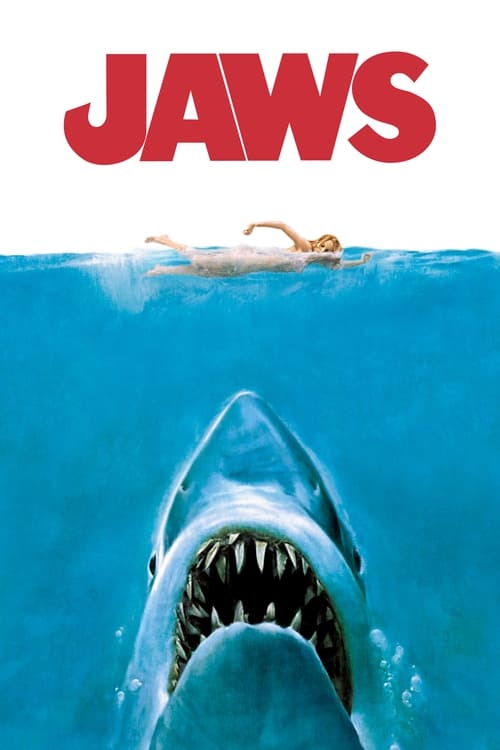
Film · 1975
Jaws
Steven Spielberg
Attacks you on a clock and shows you almost nothing, because the shark did not work.
Most extreme on REALITY ANCHOR — grounded realism at 012
On VHSCREAM’s six-axis scale, Jaws (1975) is most extreme on the reality-anchor axis: 12 out of 100, where 0 is grounded realism and 100 is dream logic. 2% of the 105 horror works we have scored come in lower on that axis. How we score →
Jaws is a 1975 horror film directed by Steven Spielberg, adapting Peter Benchley's novel. A great white shark begins killing swimmers at a New England beach resort a week before the Fourth of July. We score it 012 on reality anchor — only 2 works score lower, which makes it the joint-second-most grounded film we have scored — and 046 on tone.
Scored and reviewed by VHSCREAM on · how we score
Jaws: the review
Jaws is a horror film that people remember as an adventure film, and the reason it still works is that the shark is broken.
Bruce — the three pneumatic sharks built for the production — did not function in salt water. Spielberg, twenty-seven and over schedule on Martha's Vineyard, was forced to shoot around the thing the film was named after, and the solution he improvised became the film's grammar: a yellow barrel, a dorsal fin, a point-of-view shot looking up at kicking legs, a severed head drifting out of a hull, and two notes on a double bass. The shark is fully visible for perhaps four minutes of a two-hour film. Every horror director who has held something back since is working from the accident.
The first hour is also a very good film about municipal government. Brody knows what is in the water; the mayor knows what closing the beaches on Independence Day weekend costs; the film is specific that the deaths are procurement decisions. Mrs Kintner slapping Brody in front of the harbour is the moral centre of the picture, and the beach sequence that follows — a crowded shore, a dog named Pippet, a boy on a yellow raft, and Spielberg's dolly-zoom onto Brody's face — is one of the great constructions in American cinema.
The second hour is a three-hander and the best of it is a scar
Once the Orca leaves the dock, Jaws becomes three men in a small boat: a policeman afraid of water, a rich young oceanographer, and a professional who has decided this is personal. The scar-comparing scene is where Robert Shaw's Quint tells the story of the USS Indianapolis, and it is four minutes of a man talking in near-darkness that is more frightening than any attack in the film.
Where it shows its seams
The shark itself, when fully lit in the final twenty minutes, is a rubber prop and looks like one. Hooper's diving-cage sequence was reshot with live footage and does not quite cut together. And the film's last act is a different genre from the first, which is the price of the structure.
For the same monster-in-a-closed-space escalation, Alien; for the same creature hunting by sense rather than motive, A Quiet Place; for the same descent into an environment that does not want you, The Descent.
The ending of Jaws explained
Total spoilers from here. Everything above this line is spoiler-free.
The short answer: the shark destroys the Orca over the course of a day, swallowing the barrels, ramming the hull and finally coming aboard the sinking stern, where it kills Quint. Brody, alone on a boat going down by the bow, retreats up the mast to the masthead with Quint's rifle and a tank of compressed air. He forces the scuba tank into the shark's mouth as it comes at him and then shoots the tank from the mast — "smile, you son of a bitch" — and the shark explodes. Hooper, who escaped the crushed diving cage and has been hiding under the reef, surfaces alive. The two of them paddle back to Amity on the Orca's floating debris.
How does Brody kill the shark in Jaws?
By detonating a compressed-air cylinder in its mouth. The film sets the mechanism up twice — Hooper warns about the tanks rolling loose early on, and Quint's rifle is established as the only long gun aboard. Brody jams a tank between the shark's jaws, climbs the mast of the sinking boat, and hits the valve with the rifle on the fourth or fifth shot. In Benchley's novel the shark simply dies of its injuries and sinks; the explosion is the film's invention.
What is the Indianapolis speech in Jaws?
Quint's account of the sinking of the USS Indianapolis in July 1945, after it had delivered components of the Hiroshima bomb. Around nine hundred men went into the water and, in Quint's telling, the sharks took most of them over four days before a rescue arrived. It explains his obsession in one monologue and does it without any flashback or score. The speech was rewritten on location — Howard Sackler, John Milius and Shaw himself all worked on it — and Shaw delivered it in close to a single take.
Does Hooper die in Jaws?
Not in the film. The diving cage is destroyed and the shark passes him, and he hides on the sea floor until the fight is over; he surfaces at the end and swims back with Brody. He does die in Benchley's novel, and the film's live-shark footage was shot in Australia with a scale double, which is why the cage sequence had to be rebuilt in the edit to let him survive.
Is Jaws based on a true story?
Only distantly. Benchley cited the 1916 Jersey Shore attacks — five victims over twelve days, including two in a tidal creek — and the 1964 capture of a very large great white off Long Island as the two sources for his novel. Amity, the Orca, Quint, Brody and the Fourth of July are inventions, and the behaviour the film attributes to the shark is not how great whites behave.
Why is the shark barely shown in Jaws?
Because it did not work. The three mechanical sharks corroded, sank, failed to hold their skin and would not operate in sea water, and Spielberg rewrote the film around their absence — the barrels, the fin, the submerged point of view, the hull creaking, the Williams cue. The effect is that the audience assembles the shark itself, and it is larger in every viewer's head than the prop that finally appears.
How scary is Jaws, actually?
Scored against the published rubric, here is what the numbers mean.
Reality anchor 012 is near the floor — only 2 works score lower. There is no supernatural element of any kind, no dream sequence and no unreliable perspective. A town, a boat and an animal.
Tone 046 is close to the midpoint — 97 works score lower, and that is high for a film with this body count: two of the three leads come home, the shark dies, and the last line is a joke.
Era bias 014 is deep analog — only 25 works score lower. 1975 Panavision, in-camera dolly zoom, pneumatic effects and an orchestral score recorded to tape.
Viscera 034 is low — 40 works score lower. A severed leg sinking, a head in a hull, a bitten arm in the shallows, and Quint's death, which is explicit for about three seconds.
Pace 058 is on the shock side, with 77 works slower. The attacks are short, sudden and widely spaced, and the film is otherwise unhurried.
The threat at 036 leans away from the human — 52 works score lower. The shark has no motive; the mayor does, and the film holds him responsible for at least one death.
On jump scares: three, and the head in the hull is the most effective in cinema.
Jaws on six axes of fear
Every work in the index is scored on six continuous axes of fear. This is what Jaws looks like as a vector.
Where that puts it: #2 grounded
Disagree with a number? Say so on the axis itself. Nobody has confirmed this vector yet, and a score you challenge goes to the top of the queue to be re-scored by a human. Votes do not move the numbers — they decide what gets looked at first. How the scoring works →
Scored against the published rubric. This vector is a draft awaiting review — the method is public so you can argue with it.
Who should skip Jaws
Skip it if you swim in the sea and would like to continue. This is the film's documented effect and it has not worn off in fifty years.
Skip it if a child's death is a hard limit. Alex Kintner is killed on a crowded beach in daylight and his mother gets a scene about it.
Skip it if animal cruelty will trouble you. The production used real shark footage and a dead tiger shark hung on the dock, and a dog is strongly implied to be taken.
Content notes: a child killed on screen, a swimmer dismembered in the opening, a severed human head and leg shown, a man eaten alive at close range, an animal death implied, and a sustained depiction of officials suppressing a public-safety warning.
Watch it if you want the film that invented the summer blockbuster and is also a genuinely frightening horror film, you can take a rubber shark in the last reel, and you want to hear four minutes about the Indianapolis.
Where to find it
Streaming on YouTube TV ↗Physical copies on eBay ↗Availability from JustWatch via TMDB. We earn nothing from these links.
Nothing loads from YouTube until you press play.
If Jaws is your kind of fear
The eight works closest to Jaws in the index, ranked by distance across all six axes — not by genre label, and not by what other people watched.
Halloween
John Carpenter · 1978 · Film
Shares analog-era texture.
81% shared signal

Halloween (OST)
John Carpenter · 1978 · Record
Shares grounded realism.
81% shared signal
Night of the Living Dead
George A. Romero · 1968 · Film
Shares analog-era texture.
80% shared signal
Ghostwatch
BBC · 1992 · Television
Shares grounded realism.
76% shared signal
Dracula
Bram Stoker · 1897 · Book
72% shared signal
Dawn of the Dead
George A. Romero · 1978 · Film
71% shared signal
Poltergeist
Tobe Hooper · 1982 · Film
69% shared signal

The Fog (OST)
John Carpenter · 1980 · Record
69% shared signal
See the full list of movies like Jaws →
Questions about Jaws
The things people actually ask about this film, answered.
What happens at the end of Jaws?
The shark sinks the Orca and kills Quint. Brody climbs the mast of the foundering boat, jams a compressed-air tank in the shark's mouth and shoots the tank with Quint's rifle, destroying it. Hooper surfaces alive from under the reef and the two of them paddle back to Amity.
How does Brody kill the shark in Jaws?
He forces a scuba tank between its jaws and then shoots the tank from the masthead, detonating it. The film plants both the loose tanks and the rifle earlier. In the novel the shark simply dies of its wounds — the explosion is the film's addition.
What is Quint's Indianapolis speech about?
The sinking of the USS Indianapolis in July 1945, after it delivered parts of the Hiroshima bomb. Quint describes around nine hundred men in the water and the sharks taking most of them over several days. It explains his obsession in a single scene, with no flashback and no music.
Does Hooper die in Jaws?
No. The shark wrecks his cage and he hides on the sea floor, surfacing once the fight is over. He dies in Peter Benchley's novel; the film spared him partly because the live-shark footage shot in Australia gave the editors a way to.
Is Jaws based on a true story?
Loosely. Benchley pointed to the 1916 Jersey Shore attacks and a very large great white caught off Long Island in 1964. Amity, Quint, Brody and everything else are invented, and the film's shark behaves nothing like a real great white.
How gory is Jaws?
Less than you remember. We score it 034 on viscera, low for our index. There is a severed leg, a head, a bitten arm and about three seconds of Quint's death; almost everything else happens below the surface or outside the frame.
These are ranked against Jaws, not against you.
Build your own tape →