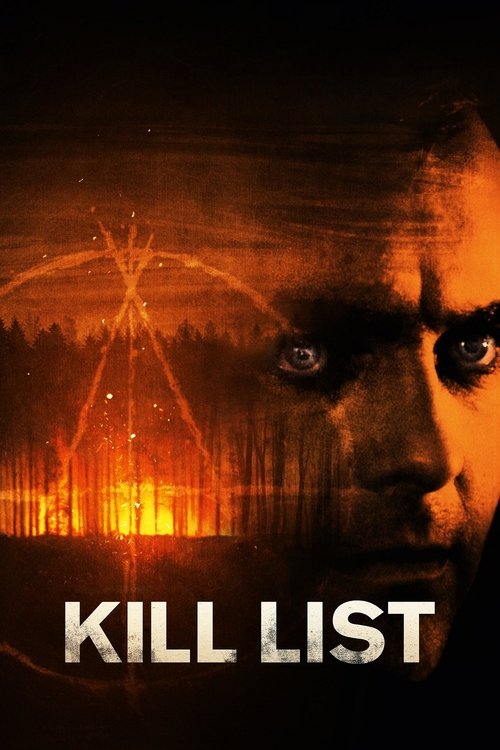
Film · 2011
Kill List
Ben Wheatley
A hitman film that walks into the wrong field and never walks out.
Most extreme on TONE — a bleak, unforgiving tone at 016
On VHSCREAM’s six-axis scale, Kill List (2011) is most extreme on the tone axis: 16 out of 100, where 0 is a bleak, unforgiving tone and 100 is gleeful black comedy. 38% of the 105 horror works we have scored come in lower on that axis. How we score →
Kill List is a 2011 British film directed by Ben Wheatley and co-written with Amy Jump. An ex-soldier takes a contract-killing job that turns into something else entirely. We score it 080 on viscera — 93 works in an index of 105 score lower — and 072 on the threat axis, because for most of its runtime the people doing the harm are entirely ordinary.
Scored and reviewed by VHSCREAM on · how we score
Kill List: the review
Kill List spends forty minutes convincing you it is a different film, and the reason it works is that the different film is good.
What you get first is a British domestic drama with the volume up: Jay, eight months out of work since something went wrong in Kiev, and Shel, who is funding the house and is finished pretending that is fine. Their dinner party with Gal and Fiona is one of the best-written scenes in British cinema of the decade — overlapping, cruel, specific, entirely improvised in feel, with a marriage coming apart at one end of the table and a new girlfriend quietly taking an interest in the bathroom mirror at the other.
Then the job starts, and Wheatley lets the register slide a degree at a time. The client cuts Jay's hand and his own and presses them together, which nobody in the film treats as odd. The first target, a priest, thanks them. The second, a librarian, has a hard drive that makes Jay lose his composure in a way that reframes the whole film's attitude to violence. The third is an MP.
The horror is in the edit, not the plot
Wheatley's method here is withholding and juxtaposition. Scenes end a beat early. A cut arrives before the information does. Jim Williams's score lands on moments that do not obviously deserve it, so that dread accumulates in places you cannot point to. Long before anything supernatural happens, the film has made you distrust its own surface — which is why the final act's shift does not feel like a betrayal.
It also has, in the hammer sequence, the single most difficult scene of violence in the index that is not in Martyrs. It is not stylised, it goes on, and Jay is enjoying it.
Where it frustrates
Deliberately, and some of it is still frustration. The film withholds so much — Kiev, the client, the cult's purpose, the reason for the list — that a viewer can finish it without enough to build a reading on, and "work it out yourself" is only satisfying when there is a solution. The sound mix buries dialogue in the domestic scenes, which is an aesthetic choice that costs comprehension.
For the same cult logic with a clearer argument, The Wicker Man; for the same British unease, A Dark Song is the patient, procedural cousin.
The ending of Kill List explained
Total spoilers from here. Everything above this line is spoiler-free.
The short answer: Jay and Shel are taken to a nighttime gathering of masked, torch-carrying cultists, where Jay is forced into a knife fight with a figure in a hunchbacked sack. He kills it. The sack is removed: it is Shel, with their son Sam strapped to her back. The cult cheers, crowns Jay, and bows to him.
What is the hunchback?
Shel, carrying Sam. The hump is their child. Jay has killed his wife and, it is strongly implied, his son, with a knife, in front of an audience that arranged it.
Did the cult plan all of it?
The film's strongest implication is yes, from the beginning. The evidence it offers, all of it circumstantial by design: Fiona is at the dinner party before any of this starts, she is found scratching a symbol into the back of their bathroom mirror, and she takes a tissue from the bin. The client's blood pact at the contract meeting is a ritual, not an eccentricity. The targets thank them. The list leads them geographically toward the gathering. And the final ceremony requires a specific outcome that only Jay could produce.
What the film never provides is a reason. There is no exposition scene, no professor on a webcam, no explanation of what the cult believes or what Jay has been made into. Whether that is the film's great strength or its one real failure is the argument the film exists to start.
What happened in Kiev?
Never stated, and it is the film's most disciplined omission. We know a job went wrong, that Jay has not worked in eight months, that Gal was there, and that somebody died who should not have. Everything about Jay's instability is downstream of it and the film refuses to cash the cheque.
Is any of it supernatural?
Possibly none of it. Nothing in Kill List requires a supernatural explanation — a cult can arrange a gathering, recruit a girlfriend, hire a killer and manipulate a man with a known breaking point. The film sits on the human end of our threat axis for exactly this reason. What is left is far worse than a demon: a group of people, several of them well-dressed and polite, who wanted this specific thing to happen and made it happen.
How scary is Kill List, actually?
Scored against the published rubric, here is what the numbers mean.
Viscera 080 is high and the film earns it in two scenes — 93 works score lower. Most of the runtime is bloodless. The hammer sequence is among the hardest in the index, and it is hard because it is slow, badly lit and relished.
Threat 072 is the human end, with 87 works lower. Even granting the cult, every injury in the film is inflicted by a person with a tool. The scoring reflects the film's actual mechanics rather than its atmosphere.
Tone 016 is bleak — 40 works score lower. There is no survivor who matters, no explanation offered as consolation, and the last sound in the film is applause.
Pace 042 sits just on the dread side, with 59 works slower. The structure is deceptive: a slow domestic first act, a procedural middle, and a final twenty minutes that run.
Reality anchor 052 is almost exactly the midpoint. That is the right number for a film that could be read as entirely mundane or as entirely occult and does not help you choose.
On jump scares: very few. The dread is editorial — cuts that arrive early, a score that lands on nothing.
Kill List on six axes of fear
Every work in the index is scored on six continuous axes of fear. This is what Kill List looks like as a vector.
Where that puts it: #10 goriest · #13 human monsters
Disagree with a number? Say so on the axis itself. Nobody has confirmed this vector yet, and a score you challenge goes to the top of the queue to be re-scored by a human. Votes do not move the numbers — they decide what gets looked at first. How the scoring works →
Scored against the published rubric. This vector is a draft awaiting review — the method is public so you can argue with it.
Who should skip Kill List
Skip it if extreme, unstylised violence is a problem. The hammer scene is the reason this film has the reputation it has, and there is no way to watch Kill List and avoid it.
Skip it if ambiguity reads as evasion to you. The film withholds Kiev, the client, the cult and the purpose. People who need a key leave angry, and the film has given them grounds.
Skip it if child harm is a hard limit. The ending involves a child, directly.
Content notes: the killing of a wife and child by the protagonist, a prolonged hammer beating, torture, a hanging, suicide, animal death, child sexual abuse referenced as motive, and sustained domestic conflict with a child present.
Watch it if you want the best British horror film of its decade, you can take a register shift that most films would botch, and you prefer a film that implies a structure to one that explains it.
Where to find it
Streaming on Philo · AMC Plus · AMC+ +3 ↗Physical copies on eBay ↗Availability from JustWatch via TMDB. We earn nothing from these links.
Nothing loads from YouTube until you press play.
If Kill List is your kind of fear
The eight works closest to Kill List in the index, ranked by distance across all six axes — not by genre label, and not by what other people watched.
Audition
Takashi Miike · 1999 · Film
Shares a bleak, unforgiving tone.
82% shared signal

Midsommar
Ari Aster · 2019 · Film
Shares human monsters.
80% shared signal
The Only Good Indians
Stephen Graham Jones · 2020 · Book
Shares explicit viscera.
79% shared signal
Martyrs
Pascal Laugier · 2008 · Film
Shares a bleak, unforgiving tone.
78% shared signal
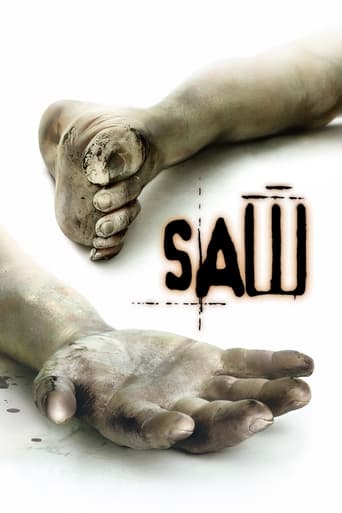
Saw
James Wan · 2004 · Film
Shares explicit viscera.
77% shared signal
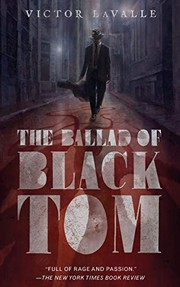
The Ballad of Black Tom
Victor Lavalle · 2016 · Book
77% shared signal
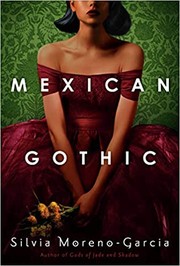
Mexican Gothic
Silvia Moreno-Garcia · 2020 · Book
77% shared signal
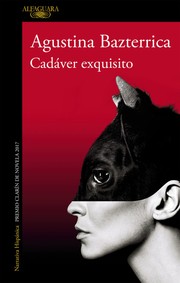
Tender Is the Flesh
Agustina Bazterrica · 2017 · Book
76% shared signal
Questions about Kill List
The things people actually ask about this film, answered.
What happens at the end of Kill List?
Jay and Shel are brought to a masked nighttime gathering where Jay is made to knife-fight a figure in a hunchbacked sack. He kills it, and the sack is removed to reveal Shel with their son Sam strapped to her back. The cult cheers, crowns Jay and bows to him.
What is the hunchback in Kill List?
Shel, Jay's wife, carrying their son Sam on her back — the hump is the child. Jay kills them both with a knife in front of an audience that arranged the fight specifically so that he would.
Did the cult plan everything in Kill List?
The film implies it strongly and never confirms it. Fiona is present before the job begins and is caught scratching a symbol into their bathroom mirror; the client seals the contract with a blood ritual; the targets thank their killers; and the list leads geographically to the gathering. No reason is ever given.
What happened in Kiev in Kill List?
The film never says. All it establishes is that a job went wrong, that Gal was there, that somebody died, and that Jay has not worked in the eight months since. Every bit of his instability traces back to it, and the omission is deliberate.
Is Kill List supernatural?
Possibly not at all. Nothing in it requires a supernatural explanation — a cult can recruit, hire and manipulate without anything occult, which is why we score it 072 on the threat axis, toward human monsters. The film declines to resolve it either way.
Why is Kill List so hard to watch?
One scene, mostly. We score it 080 on viscera, but the runtime is largely bloodless; the hammer sequence is slow, poorly lit, lengthy and performed with evident enjoyment, which makes it considerably worse than a more explicit scene shot conventionally.
These are ranked against Kill List, not against you.
Build your own tape →