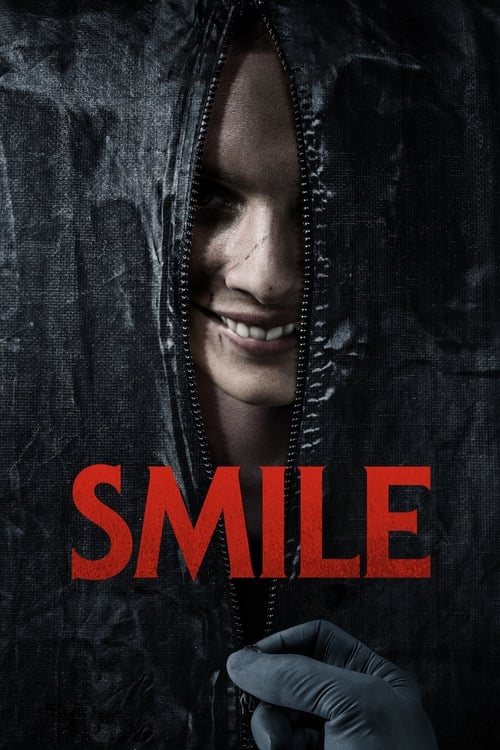
Film · 2022
Smile
Parker Finn
A curse that spreads by witness. Meaner than the marketing let on.
Most extreme on ERA BIAS — modern craft at 092
On VHSCREAM’s six-axis scale, Smile (2022) is most extreme on the era-bias axis: 92 out of 100, where 0 is analog-era texture and 100 is modern craft. 97% of the 105 horror works we have scored come in lower on that axis. How we score →
Smile is a 2022 horror film written and directed by Parker Finn, expanded from his own short. A psychiatrist witnesses a patient's suicide and inherits an entity that wears the faces of the people around her and smiles. We score it 092 on era bias — joint-second most contemporary-feeling of the 105 works we score, behind only Skinamarink — and 072 on pace, one of the fastest things we hold.
Scored and reviewed by VHSCREAM on · how we score
Smile: the review
Smile is a very well-built machine wrapped around a borrowed idea, and it is worth being clear about both halves of that.
The machine is excellent. Finn's camera is the most disciplined thing in the film: inverted shots, slow dollies that put the horizon in the wrong place, a willingness to hold a wide and let something stand in it. He shoots suicide and self-harm with a coldness that makes the set pieces genuinely difficult rather than merely loud, and Sosie Bacon carries the whole thing on a performance of escalating exhaustion that nobody was expecting from a September release.
The idea is It Follows with a jump scare budget, and Ringu before that. A transmissible curse, a clock, a rule about passing it on, a protagonist nobody believes. Finn adds one good variation — the entity performs as the people you trust, so the threat arrives wearing a therapist, a sister, a fiancé — and one excellent image, which is the smile itself: a full-face human grin held slightly too wide for slightly too long, which turns out to be more upsetting than any creature design.
Its real subject is being disbelieved
The best scenes are not the scares. They are Rose explaining what is happening to people professionally obliged to interpret it as illness, and watching her own vocabulary used against her. The film understands that the specific horror of a curse nobody else can see is indistinguishable from the horror of a psychiatric episode, and that a psychiatrist is the one person who cannot win that argument.
Where it is thinner is the trauma backstory. Rose's mother's death is deployed as explanation at exactly the moment the film would be scarier without one, and the final act's decision to literalise it costs the entity some of its menace.
Is it too loud?
Yes, in places, and knowingly. There are at least three stings the film does not need, including one in the first ten minutes that is pure contract-fulfilment. If you want dread without percussion, It Follows is the same premise at a quarter of the volume.
But it works. It made close to two hundred million dollars from a reported seventeen, and the reason is not marketing. It is that the smile is a genuinely new scare and the camera knows what to do with it.
The ending of Smile explained
Total spoilers from here. Everything above this line is spoiler-free.
The short answer: Rose fails. She believes she can break the curse by confronting her trauma at her childhood home, burns it down, and returns to Joel apparently free. That sequence is a hallucination — she never left the house. The entity emerges from her mother's body, forces its way into her, and the film ends with Rose, possessed, setting herself on fire and smiling in front of Joel, which passes the curse to him.
How does the curse in Smile work?
You inherit it by witnessing the death of the current holder. From that moment the entity has roughly four to seven days, during which it appears as people you know, escalates, and isolates you. At the end it takes you, and it kills you in front of a witness — which transmits it. The one apparent exception is somebody who killed in front of a witness deliberately and survived, which is the loophole Rose investigates and the film ultimately denies her.
Can the curse be broken?
The film says no. Rose's research finds one man who broke the chain by murdering a stranger in front of a witness, which passes it on rather than ending it — so the only known escape is making it somebody else's problem. Her attempt to break it by facing her trauma instead is presented as the final act of a plan that the entity has been encouraging.
Why does Joel get the curse?
Because Rose dies in front of him. He drives to the house looking for her, and the ending is constructed so that his arrival is the thing that completes the transmission. His kindness is the mechanism, which is the cruellest structural choice in the film.
What does the ending mean?
That the entity feeds on isolation and wins by making its victim believe that healing is an escape route. Rose's final sequence — therapy language, confronting the past, burning the house — is the shape of a recovery narrative, and the film reveals it as the hallucination the entity needed her to have in order to be alone with her. It is a bleak thing to argue and the film argues it clearly.
How scary is Smile, actually?
Scored against the published rubric, here is what the numbers mean.
Era bias 092 is the signature. Only 1 work in the index scores higher, and only Talk to Me ties it. Clean digital photography, a modern sound mix, phones, and a scare vocabulary that did not exist twenty years ago.
Pace 072 makes it fast — 95 works are slower. There is a scare roughly every four minutes and the film does not sit still.
Viscera 052 is just above the median film — 59 works score lower. There is no sustained gore, but there are three or four explicit images of self-inflicted injury and they are the hardest part of the film by a distance.
Tone 014 is genuinely bleak — 30 works score lower. Nobody is saved, the protagonist loses, and the mechanism guarantees it happens again.
Threat 030 leans supernatural, with 35 works lower. The entity is never explained, named or bargained with.
On jump scares: many, and more than it needs. This is the index's clearest example of a film that earns its scares and then adds a few anyway.
Smile on six axes of fear
Every work in the index is scored on six continuous axes of fear. This is what Smile looks like as a vector.
Where that puts it: #2 modern · #8 relentless
Disagree with a number? Say so on the axis itself. Nobody has confirmed this vector yet, and a score you challenge goes to the top of the queue to be re-scored by a human. Votes do not move the numbers — they decide what gets looked at first. How the scoring works →
Scored against the published rubric. This vector is a draft awaiting review — the method is public so you can argue with it.
Who should skip Smile
Skip it if suicide or self-harm is something you need to avoid. This is not a borderline case. The film opens with a graphic suicide, returns to self-inflicted injury repeatedly, and ends with self-immolation. It is the subject, not an element.
Skip it if jump scares annoy rather than frighten you. There are a lot, some unearned.
Skip it if you have seen It Follows and want something new. The premise is largely the same machine with a different engine note.
Content notes: multiple graphic suicides, sustained self-harm, self-immolation, the death of a pet, a graphic facial injury, and the disbelief of a mentally distressed person by medical professionals.
Watch it if you want the best-directed mainstream horror of its year, you can take the self-harm content, and you want to see one genuinely original image — a human smile held too long — do an enormous amount of work.
Where to find it
Streaming on Paramount Plus Premium · Paramount Plus Essential · Paramount+ +1 ↗Physical copies on eBay ↗Availability from JustWatch via TMDB. We earn nothing from these links.
Nothing loads from YouTube until you press play.
If Smile is your kind of fear
The eight works closest to Smile in the index, ranked by distance across all six axes — not by genre label, and not by what other people watched.
Talk to Me
Danny & Michael Philippou · 2022 · Film
Shares modern craft.
86% shared signal
Sinister
Scott Derrickson · 2012 · Film
Shares a bleak, unforgiving tone.
85% shared signal
Oculus
Mike Flanagan · 2013 · Film
Shares a supernatural threat.
83% shared signal

It Follows (OST)
Disasterpeace · 2014 · Record
Shares modern craft.
82% shared signal
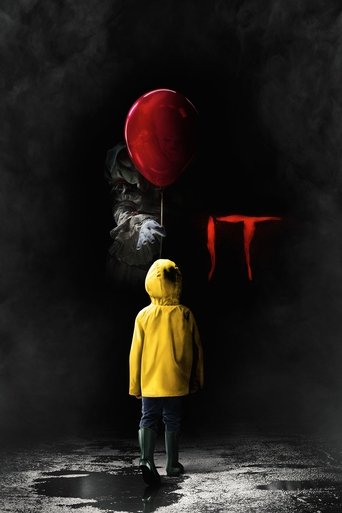
It
Andy Muschietti · 2017 · Film
Shares a supernatural threat.
82% shared signal

Lights Out
David F. Sandberg · 2016 · Film
Shares relentless shock.
79% shared signal
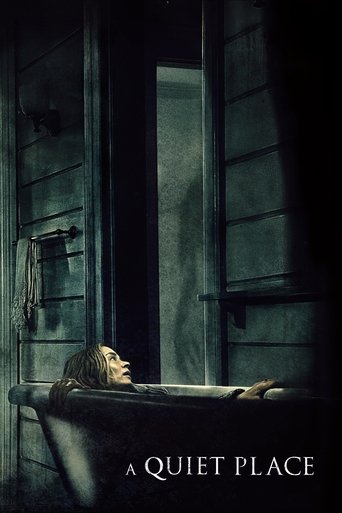
A Quiet Place
John Krasinski · 2018 · Film
Shares a bleak, unforgiving tone.
79% shared signal

Annabelle
John R. Leonetti · 2014 · Film
Shares relentless shock.
79% shared signal
See the full list of movies like Smile →
Questions about Smile
The things people actually ask about this film, answered.
What happens at the end of Smile?
Rose appears to break the curse by burning down her childhood home and returning to Joel, but that sequence is a hallucination — she never left. The entity emerges from her mother's body and takes her, and the film ends with Rose setting herself on fire in front of Joel, which passes the curse to him.
How does the curse in Smile work?
You inherit it by witnessing the current holder's death. You then have roughly four to seven days while the entity impersonates people you know and isolates you, before it kills you in front of a witness and transmits itself to them. The chain only breaks by passing it on.
Can the curse in Smile be broken?
Not according to the film. The one man who escaped did so by murdering a stranger in front of a witness, which transfers the curse rather than ending it. Rose's attempt to break it by confronting her trauma is revealed as something the entity wanted her to try.
Why does Joel get the curse at the end of Smile?
Because Rose dies in front of him. He drives to the house looking for her out of concern, and the film is built so that his arrival completes the transmission — his kindness is the mechanism, which is the bleakest structural choice in it.
Is Smile just a copy of It Follows?
It shares the transmissible-curse structure with It Follows and, before that, Ringu. What it adds is the entity performing as people you trust and the smile itself, and it is a much faster, louder film — 072 on our pace axis against It Follows at 026.
Is Smile too scary?
It is the most jump-scare-dense film in our index and the self-harm content is genuinely hard, so for some viewers yes. The scares are well constructed rather than cheap, but there are more of them than the film needs, including one in the first ten minutes that exists purely to open the account.
These are ranked against Smile, not against you.
Build your own tape →