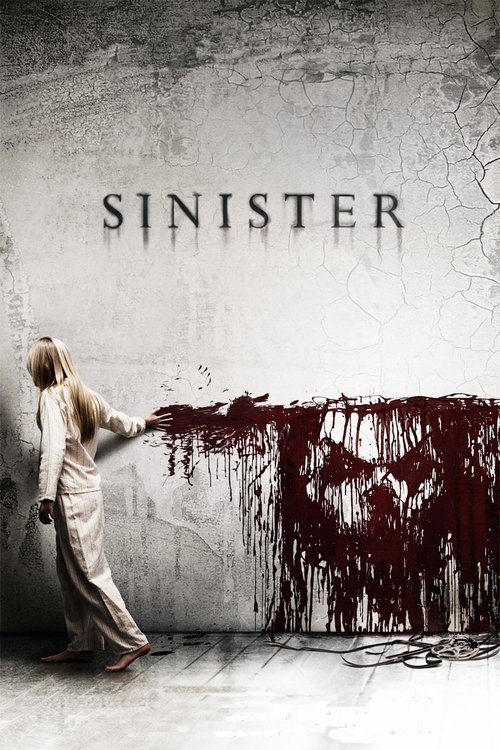
Film · 2012
Sinister
Scott Derrickson
The found super-8 reels are the whole film. Bleaker than its box office suggests.
Most extreme on TONE — a bleak, unforgiving tone at 012
On VHSCREAM’s six-axis scale, Sinister (2012) is most extreme on the tone axis: 12 out of 100, where 0 is a bleak, unforgiving tone and 100 is gleeful black comedy. 21% of the 105 horror works we have scored come in lower on that axis. How we score →
Sinister is a 2012 horror film directed by Scott Derrickson and co-written with C. Robert Cargill. A true-crime writer moves his family into a murder house and finds a box of Super 8 films in the attic. We score it 018 on the threat axis — only 14 works in an index of 105 score lower, making it one of the most purely supernatural films we hold.
Scored and reviewed by VHSCREAM on · how we score
Sinister: the review
Sinister has a better premise than almost anything else from the 2010s mainstream, and it is the only one of its wave that still frightens people on a rewatch.
The premise is a box of home movies. Each reel is labelled with a cheerful domestic title — Pool Party '66, BBQ '79, Sleepy Time '98 — and each shows a family being killed, filmed by one of their own children. The reels are the film, and Derrickson's single best decision is to let them play almost uninterrupted on a projector with no score, just sprocket noise and the hum of a fan, while Ethan Hawke sits in the dark and watches. There is nothing edited into those sequences to tell you how to feel. They are just footage, and they are extremely hard to sit through.
The second-best decision is Christopher Young's score, which is less music than a set of sounds — processed voices, metal, a lurching industrial clatter that arrives when the reels do. It is the most effective horror score of its decade and a large part of why the film works on people who are otherwise immune.
It is a film about a man who will not stop looking
Ellison Oswalt is a genuinely unpleasant protagonist, and the film is clear-eyed about it: a writer whose career peaked a decade ago, who has moved his wife and two children into a crime scene without telling them, and who keeps watching because a bestseller is worth more to him than their safety. Hawke plays him as vain rather than brave. Every bad thing that happens is downstream of his ambition.
Where it loosens
The mythology arrives via a convenient professor on a webcam, which is the laziest scene in the film. There are two or three jump scares that cheat — a face in the frame accompanied by a bang — and the film does not need them, given what the reels are doing for free. And the final act's logic is clean but delivered in a rush.
For the same found-footage-inside-a-film trick done with more restraint, Lake Mungo; for the same curse mechanics with better rules, It Follows.
The ending of Sinister explained
Total spoilers from here. Everything above this line is spoiler-free.
The short answer: Ellison burns the films and moves the family back to their old house, believing he has escaped. That is the mistake. The curse requires a family to move into a murder house and then leave it — moving out is the trigger. His daughter Ashley, already taken by Bughuul, drugs the family, axe-murders all four of them while filming it, paints the walls in their blood, and is led into a photograph by Bughuul to join the other children.
Who or what is Bughuul?
A Babylonian deity, introduced in the film as Bagul or "Mr Boogie", who consumes the souls of children. He works through images: he can only reach into the world through a recording or a depiction of himself, which is why the Super 8 reels matter and why the film treats a photograph as dangerous. In each case across decades, he has induced one child of a family to murder the rest, film it, and then taken that child.
Why does moving house kill them?
This is the rule the film saves until the end and it is a good one. The pattern across every case is identical: a family moves into the house where the previous family died, lives there, then moves away — and the murders happen at the new address. The house is where Bughuul gets his hook into a child; the move is what completes the cycle. Ellison's decision to flee is therefore the single thing that dooms them, and he makes it believing he is protecting them.
Why did Ashley do it?
Because she had already been taken. The film seeds it carefully: she is the one painting on the walls, she is the one who talks about the children in the house, and she is the one who has been in the attic. By the time the family packs, the daughter leaving with them is not entirely their daughter.
Is Bughuul in the photographs?
Yes, and the film makes you find him. He is present in the background of the reels and in family photographs, usually badly lit and at the edge of frame, and Derrickson refuses to zoom or point. The final image is Ashley being led by the hand into one — which is also how the previous children appear in it.
How scary is Sinister, actually?
Scored against the published rubric, here is what the numbers mean.
Threat 018 is the signature and it is near the floor. Only 14 works in the index score lower, which makes this about as purely supernatural as horror gets. There is no human antagonist — the children are instruments and Bughuul is not negotiable.
Pace 058 puts it on the shock side, with 77 works slower. It is not a dread film. The reels function as set pieces and arrive on a schedule.
Viscera 040 is just below the median film — 45 works score lower. The reels contain some of the most upsetting images in the index, and almost none of them are gory. The lawnmower reel is the exception.
Tone 012 is genuinely bleak — 22 works score lower. Every single family in the film dies, including the protagonist's, and the cycle continues.
Era bias 078 is modern craft, with 70 works lower — but note that the film's most effective material is a digital reconstruction of degraded Super 8, which is doing the opposite of what the score suggests.
On jump scares: many, and several are cheap. The film is on a lot of "scariest ever" lists — including the Science of Scare study, which measured viewers' heart rates — and some of that is the stings rather than the craft.
Sinister on six axes of fear
Every work in the index is scored on six continuous axes of fear. This is what Sinister looks like as a vector.
Where that puts it: #14 bleakest · #14 supernatural
Disagree with a number? Say so on the axis itself. Nobody has confirmed this vector yet, and a score you challenge goes to the top of the queue to be re-scored by a human. Votes do not move the numbers — they decide what gets looked at first. How the scoring works →
Scored against the published rubric. This vector is a draft awaiting review — the method is public so you can argue with it.
Who should skip Sinister
Skip it if images of real-seeming domestic murder are a problem. The reels are the film and they are presented as documentary footage of families being killed, including children, with no score and no cutting away.
Skip it if children in danger is a hard limit. Every case in the film turns on a child murdering their family, and the protagonist's two children are in jeopardy throughout.
Skip it if cheap scares annoy you. There are a handful of bang-and-a-face moments in a film that absolutely did not need them.
Content notes: the hanging of an entire family including children, a family burned alive in a car, a drowning, a throat-cutting, death by lawnmower, an axe murder of a family by a child, and extensive footage framed as real.
Watch it if you want the best premise of the 2010s mainstream, the best horror score of its decade, and a film whose central idea — watching footage you should not be watching — is still the most frightening thing anybody has done with a projector.
Where to find it
Streaming on MovieSphere+ ↗Physical copies on eBay ↗Availability from JustWatch via TMDB. We earn nothing from these links.
Nothing loads from YouTube until you press play.
If Sinister is your kind of fear
The eight works closest to Sinister in the index, ranked by distance across all six axes — not by genre label, and not by what other people watched.
Oculus
Mike Flanagan · 2013 · Film
Shares a bleak, unforgiving tone.
90% shared signal
Smile
Parker Finn · 2022 · Film
Shares modern craft.
85% shared signal
The Conjuring
James Wan · 2013 · Film
Shares a supernatural threat.
85% shared signal

Annabelle
John R. Leonetti · 2014 · Film
Shares a supernatural threat.
85% shared signal

It Follows (OST)
Disasterpeace · 2014 · Record
Shares modern craft.
84% shared signal
A Quiet Place
John Krasinski · 2018 · Film
Shares a bleak, unforgiving tone.
84% shared signal

Lights Out
David F. Sandberg · 2016 · Film
83% shared signal
Talk to Me
Danny & Michael Philippou · 2022 · Film
82% shared signal
See the full list of movies like Sinister →
Questions about Sinister
The things people actually ask about this film, answered.
What happens at the end of Sinister?
Ellison burns the films and moves his family back to their old house, which is the trigger rather than the escape. His daughter Ashley, already taken by Bughuul, drugs the family and axe-murders all four while filming it, then is led by Bughuul into a photograph to join the other children.
Who is Bughuul in Sinister?
A Babylonian deity introduced as Bagul or "Mr Boogie" who consumes children's souls and can only reach the world through images of himself. Across decades he induces one child in each family to murder the rest, film it, and then takes that child. He appears at the edges of the reels and of photographs.
Why does moving house cause the murders in Sinister?
Because the cycle requires it. Every family in the pattern moves into the previous victims' house, lives there, and then moves away — and the killings happen at the new address. The house is where Bughuul reaches a child; the move completes it. Ellison dooms his family by fleeing.
Why did Ashley kill her family?
Because Bughuul had already taken her before they left. The film seeds it throughout — she paints on the walls, talks about the other children, and has been in the attic. The daughter who moves house with them is no longer entirely theirs.
Is Sinister the scariest movie ever made?
It regularly tops lists built on measured heart rate, including the Science of Scare study, and the home-movie reels genuinely are among the hardest things in our index to sit through. Some of that ranking is jump scares rather than craft — the film has several it does not need.
How gory is Sinister?
Less than its reputation. We score it 040 on viscera, just below the median film in our index. The reels are devastating because of what they depict and how plainly they are shot, not because of blood. The lawnmower sequence is the one genuine exception.
These are ranked against Sinister, not against you.
Build your own tape →