Film · 2013
Oculus
Two timelines braided until neither is trustworthy. Cleverer than its poster.
Most extreme on TONE — a bleak, unforgiving tone at 016
On VHSCREAM’s six-axis scale, Oculus (2013) is most extreme on the tone axis: 16 out of 100, where 0 is a bleak, unforgiving tone and 100 is gleeful black comedy. 38% of the 105 horror works we have scored come in lower on that axis. How we score →
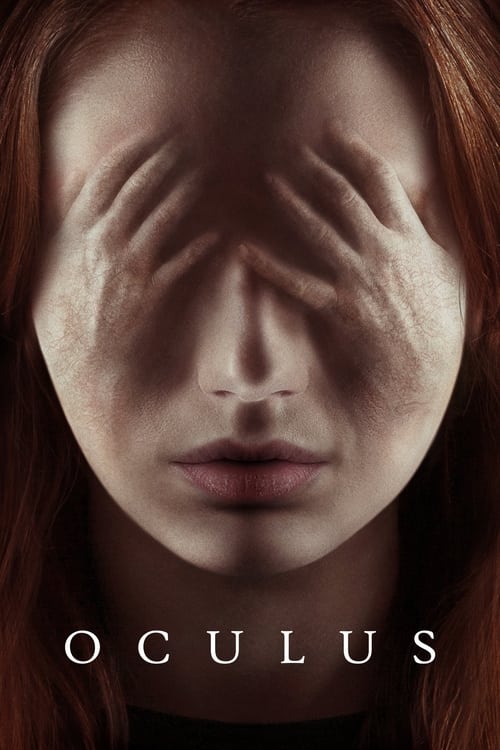
Oculus is a 2013 horror film directed by Mike Flanagan and co-written with Jeff Howard, expanded from his own short. Two adult siblings return to the mirror that destroyed their family, intending to prove it. We score it 068 on reality anchor — 77 works in an index of 105 score lower — and 016 on tone.
Scored and reviewed by VHSCREAM on · how we score
Oculus: the review
Oculus is the film where Flanagan worked out what he was for, and its central device is still the best thing he has done.
The device is editorial. The film runs two timelines — the siblings as children while their parents come apart, and the same siblings as adults in the same house eleven years later — and it does not cut between them so much as let them bleed. A door opens in 2002 and closes in 2013. Adult Kaylie walks down a corridor and passes her child self. By the last half hour the film has stopped signalling which period you are in, and the effect is not confusion but something much better: you lose the ability to trust a shot, which is precisely the condition the characters are in.
That is a genuinely difficult thing to pull off and almost nobody has tried it since.
The mirror is a brilliant antagonist because it cheats
The Lasser Glass does not chase anybody. It alters perception. You reach for a glass of water and drink from a light bulb; you bandage a wound and find you have stapled your own hand; you watch a camera for proof and the camera shows you what the mirror wants. Kaylie's entire plan — timers, alarms, cameras, plants to check whether it is draining life, a dog, an anchor rigged to swing and smash it on a delay — is an attempt to defeat an unreliable narrator with instruments, and the film's cruelty is in how patiently each instrument is turned around.
Karen Gillan is very good as a woman whose competence is itself the trap: she has spent eleven years preparing, and the preparation is what gets her killed.
Where it is weaker
The parents' timeline is the stronger half and the film knows it, which leaves the adult sections occasionally feeling like a delivery system for exposition. The mirror's history arrives as a list of previous owners read aloud. And Flanagan's later work is better at making you care about the people — the siblings here are a thesis and a doubter rather than characters with much interior life.
For the same family-grief-as-haunting handled with more warmth, The Haunting of Hill House is where he took this next; for the same unreliable-image trick in a colder film, Lake Mungo.
The ending of Oculus explained
Total spoilers from here. Everything above this line is spoiler-free.
The short answer: the plan fails completely. The mirror makes Kaylie see Tim standing where the anchor's kill-switch is, and when she calls him over she is in fact standing in its path herself. The anchor swings and kills her. Tim, holding her body, is found by police and institutionalised again, and the mirror — undamaged — is taken away to be sold on. The last shot is their parents' reflections watching from inside the glass.
What does the Lasser Glass actually do?
It controls what the people near it perceive, and it feeds on them. It has no physical form of attack: everything it does is a substitution. Food becomes something else, a wound becomes self-inflicted, a person is somewhere they are not. It also drains the life around it — plants die, the dog dies, people stop eating without noticing — and the film's best unsettling detail is that Kaylie and Tim keep forgetting to eat while explaining that it makes you forget to eat.
Why does Kaylie's plan fail?
Because every element of it relies on perception, and perception is what the mirror owns. The cameras record what it wants recorded. The timers are heard when it permits. The anchor — the one purely mechanical safeguard, rigged to swing on a delay whether or not anybody is conscious — is the only part that works, and it works by killing her, because she has been moved without knowing it.
It is a very clean piece of plotting. The plan does not fail from a mistake. It fails because it was designed by somebody inside the thing she was trying to measure.
What happens to Tim?
He is arrested beside his sister's body, with nothing in the record except that a man released from a psychiatric institution eleven years after killing his father is found with a second corpse. He is institutionalised again, and this time there is no version of events he can offer that anybody will believe. The mirror has repeated itself exactly: one dead parent figure, one child blamed, one survivor with a story.
What is the final shot?
Their mother and father appear in the glass behind them, eyes clouded, watching. It confirms what the film has implied — that the mirror keeps what it takes — and it establishes that the Lasser Glass is going back onto the market with two more people inside it.
How scary is Oculus, actually?
Scored against the published rubric, here is what the numbers mean.
Reality anchor 068 is the signature. 77 works score lower. The film sits on the dream-logic side because its central mechanic is that nothing you are shown can be verified, and its structure makes the audience share that.
Tone 016 is bleak — 40 works score lower. Both siblings lose, both parents are still trapped, and the object survives intact to do it again.
Era bias 080 is modern craft, with 72 works lower. Clean 2013 digital photography and a conventional contemporary mix; nothing analog is being imitated.
Viscera 034 is low — 40 works score lower. There are two genuinely hard moments, one involving a light bulb and one involving a staple gun, and they work because almost nothing else in the film is explicit.
Pace 054 sits just on the shock side, with 73 works slower. The dual timeline keeps something happening almost continuously.
Threat 025 leans supernatural — the mirror is never explained, never bargained with, and has no motive beyond appetite.
On jump scares: a handful, and the best ones are substitutions rather than stings — you realise what someone is actually holding a beat before they do.
Oculus on six axes of fear
Every work in the index is scored on six continuous axes of fear. This is what Oculus looks like as a vector.
Where that puts it: #10 surreal
Disagree with a number? Say so on the axis itself. Nobody has confirmed this vector yet, and a score you challenge goes to the top of the queue to be re-scored by a human. Votes do not move the numbers — they decide what gets looked at first. How the scoring works →
Scored against the published rubric. This vector is a draft awaiting review — the method is public so you can argue with it.
Who should skip Oculus
Skip it if you need to be able to trust what you are watching. The last third deliberately stops distinguishing between timelines. Viewers who find that disorienting rather than effective are describing the film accurately.
Skip it if self-inflicted injury is a problem. The light bulb and the staple gun are both brief and both very hard, and the film's whole method is making a character harm themselves while believing they are doing something ordinary.
Skip it if you came for Flanagan's warmth. This is his coldest film and his most mechanical. The emotion came later.
Content notes: a child witnessing a parent's murder, a mother restrained and starved, two children in sustained danger, self-inflicted injury by light bulb and staple gun, the death of a dog, and a parricide.
Watch it if you want the smartest structural experiment in mainstream 2010s horror, you like a plot where the plan is the trap, and you want to see the film that Mike Flanagan's whole television career grew out of.
Where to find it
Streaming on Amazon Prime Video ↗Physical copies on eBay ↗Availability from JustWatch via TMDB. We earn nothing from these links.
Nothing loads from YouTube until you press play.
If Oculus is your kind of fear
The eight works closest to Oculus in the index, ranked by distance across all six axes — not by genre label, and not by what other people watched.
Sinister
Scott Derrickson · 2012 · Film
Shares a bleak, unforgiving tone.
90% shared signal

It Follows (OST)
Disasterpeace · 2014 · Record
Shares modern craft.
88% shared signal

Lights Out
David F. Sandberg · 2016 · Film
Shares a supernatural threat.
83% shared signal
Smile
Parker Finn · 2022 · Film
Shares a bleak, unforgiving tone.
83% shared signal
Insidious
James Wan · 2010 · Film
Shares dream logic.
83% shared signal

Hereditary (OST)
Colin Stetson · 2018 · Record
Shares modern craft.
83% shared signal
The Babadook
Jennifer Kent · 2014 · Film
83% shared signal
The Nun
Corin Hardy · 2018 · Film
Shares a supernatural threat.
82% shared signal
Questions about Oculus
The things people actually ask about this film, answered.
What happens at the end of Oculus?
The mirror makes Kaylie believe Tim is standing where her anchor's kill-switch is; in reality she is in the anchor's path. It swings and kills her. Tim is found with her body and institutionalised again, the undamaged mirror is taken away to be sold, and their parents' faces appear watching from inside the glass.
What does the mirror in Oculus do?
The Lasser Glass controls what people near it perceive and feeds on them. It never attacks physically — it substitutes. Food becomes something else, a wound becomes self-inflicted, a person appears where they are not. It also drains life from its surroundings, killing plants and animals and making people forget to eat.
Why does Kaylie's plan fail in Oculus?
Because every safeguard depends on perception, which is the one thing the mirror owns. The cameras record what it allows. The only purely mechanical element — an anchor rigged to swing on a timer regardless of who is conscious — works exactly as designed and kills her, because she has been moved without knowing it.
Is Oculus scary?
It is unsettling rather than startling. We score it 034 on viscera, well below the median film, with two genuinely hard moments. Its effect comes from the editing — the dual timelines stop being separable — which produces a loss of confidence in the image rather than fright.
How are the two timelines connected in Oculus?
They are deliberately merged rather than intercut. Doors open in one period and close in the other, adult characters pass their child selves, and by the final act the film stops indicating which period a shot belongs to. The audience loses the ability to trust a shot, which is the characters' exact condition.
Is Oculus connected to The Haunting of Hill House?
Not in story, only in authorship. Mike Flanagan directed both, and Oculus is where he developed the braided-timeline technique and the family-trauma-as-haunting approach that his later television work is built on.
These are ranked against Oculus, not against you.
Build your own tape →