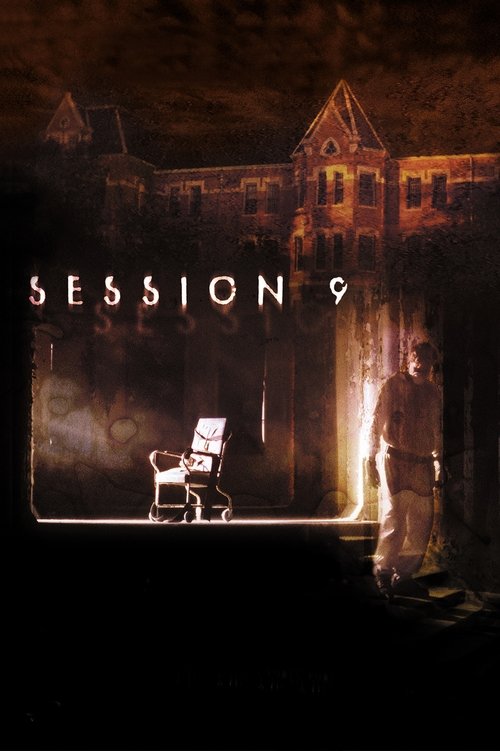
Film · 2001
Session 9
Brad Anderson
An asbestos crew in an empty asylum. The building wins on patience.
Most extreme on TONE — a bleak, unforgiving tone at 012
On VHSCREAM’s six-axis scale, Session 9 (2001) is most extreme on the tone axis: 12 out of 100, where 0 is a bleak, unforgiving tone and 100 is gleeful black comedy. 21% of the 105 horror works we have scored come in lower on that axis. How we score →
Session 9 is a 2001 horror film directed by Brad Anderson, shot inside the abandoned Danvers State Hospital in Massachusetts. An asbestos abatement crew is given a week to strip a derelict asylum and one of them finds a box of recorded therapy sessions. We score it 074 on the threat axis — 89 works score lower, the human end of the scale — and 012 on tone.
Scored and reviewed by VHSCREAM on · how we score
Session 9: the review
Session 9 is a film in which almost nothing happens, in a building that is doing all of the work, and it is one of the two or three most unnerving films of its decade.
Danvers State Hospital was real: a Kirkbride-plan asylum on a hill outside Boston, closed in 1992, enormous, rotting, and still full of furniture, files and bath fittings when Anderson's crew got inside. He shot the film there with a tiny cast on one of the first high-definition video cameras, and the format is essential — the image is cold, slightly cheap, over-detailed in the shadows, and it makes the corridors look like something recorded rather than lit. You can see damp. The building needs no haunting and the film has the discipline not to give it one.
Over that, Anderson puts five working men on a bid they cannot deliver. Gordon has underquoted the job by weeks because his business is failing; he also has a newborn daughter and a marriage he describes in the past tense within his first two scenes. Phil and Hank are not speaking because Hank is with Phil's ex. Mike is a law-school dropout. Jeff is afraid of the dark and has to run the generator. The crew dynamic is written and played with complete naturalism, and it is the reason the film's ending lands as grief rather than as a twist.
The tapes are the best device in the film
Mike finds nine reel-to-reel recordings of a patient called Mary Hobbes, and listens to them in an empty room across the week. Mary has dissociative identity disorder and three alters: Princess, who is sweet and refuses to speak about certain days; Billy, who is evasive and protective; and Simon, who will not come to the tape at all. The clinician's voice is patient and professional. The tapes advance in parallel with the crew's disintegration, and the film cuts between them with no scoring, which means the horror arrives in the form of a man asking careful questions in 1970.
Where it is weak
The hydrotherapy-room gold is a thin motivation for Hank. The film's final montage over-cuts, and the last ten minutes explain slightly more than the preceding eighty earned. And at 016 on pace it is genuinely slow — much of the running time is men walking down corridors talking about work.
For the same institutional dread and a man who was already broken, The Shining; for the same documentary-flat British-and-Irish register, Kill List; for the same found-recording structure, Lake Mungo.
The ending of Session 9 explained
Total spoilers from here. Everything above this line is spoiler-free.
The short answer: Gordon is the killer, and he has been since before the job started. The "accident" he described early on — spilled boiling water during an argument with his wife Wendy — was not an accident and was not an injury: he killed Wendy and their newborn daughter at home on the Saturday before the crew arrived, and has been going back to an empty house every night and reporting conversations that are not happening. Inside the asylum he kills Hank, then Phil, then Mike, and when Jeff finds him at the end he is sitting among them. The film intercuts his confession with the ninth tape, in which the clinician finally reaches Simon directly and asks him where he lives. Simon's answer is the film's last line: he lives in the weak and the wounded.
Who is Simon in Session 9?
The third and most dangerous of Mary Hobbes's alters, and the one that killed her family. On the tapes, Princess and Billy both circle a Thanksgiving in 1958; Simon is the one who took Mary's hands and did it. Whether Simon is purely a dissociative structure or something that moves between people is what the film refuses to settle — and the ending's intercutting makes the second reading available without ever stating it. Simon is given a voice, not a body.
Who killed the crew in Session 9?
Gordon. Hank disappears first, after finding coins and gold teeth in the hydrotherapy room, and is killed there; Phil is killed in the tunnels; Mike is killed in the room where he has been listening to the tapes. There is no supernatural agent, no additional character and no sixth man in the building. The film's horror is that the person holding the crew together was already past the point of being held together.
What is on tape nine?
The session the clinician has been trying to get for eight recordings. Simon finally speaks as himself, answers questions about Mary's family and about what happened on Thanksgiving, and then is asked where he lives. He says he lives in the weak and the wounded — not in Mary, not in the hospital, but in whoever is available. It is the only line in the film that could be read as supernatural, and it arrives over a shot of Gordon.
What does "I live in the weak and the wounded" mean?
Two things at once, deliberately. Clinically, it is a description of how dissociation forms: a personality that occupies the damage. Supernaturally, it is a claim of mobility — that Simon is not Mary's and did not stop when she did, and that a man who has underbid a job, lost his business and killed his family on a Saturday afternoon is exactly the kind of place he lives. The film ends on the line and offers no third reading.
Is Danvers State Hospital a real place?
Yes. It was a state asylum north of Boston, opened in 1878 on the Kirkbride plan, chronically overcrowded, closed in 1992 and left to rot with much of its contents inside. Anderson shot the film in the real buildings with no set dressing in most rooms. Most of the complex was demolished in 2006 and 2007 to build apartments, so the film is now a record of a building that no longer exists.
How scary is Session 9, actually?
Scored against the published rubric, here is what the numbers mean.
The threat at 074 leans human — 89 works score lower. Every death in the film is committed by a man with a tool, and the only supernatural claim in it is one sentence on a tape.
Tone 012 is bleak — 22 works score lower. A wife and an infant are dead before the film begins, four men die in it, and nothing is recovered.
Pace 016 is extremely slow — only 15 works are slower. Large sections are men surveying corridors and arguing about a schedule.
Viscera 026 is low — 27 works score lower. Three bodies, a severed tongue, and an injury described on tape. Almost nothing is shown.
Era bias 036 reads analog — 45 works score lower, which is the right reading despite the digital camera: a 1970s reel-to-reel archive, a 19th-century building, and no modern technology in the film beyond a mobile phone that cannot get a signal.
Reality anchor 040 is grounded — 26 works score lower. One building, one week, consistent geography, and no sequence that cannot be read literally.
On jump scares: two, and the film is otherwise completely uninterested in them.
Session 9 on six axes of fear
Every work in the index is scored on six continuous axes of fear. This is what Session 9 looks like as a vector.
Where that puts it: #7 slow burn · #11 human monsters · #13 bleakest · #14 without gore
Disagree with a number? Say so on the axis itself. Nobody has confirmed this vector yet, and a score you challenge goes to the top of the queue to be re-scored by a human. Votes do not move the numbers — they decide what gets looked at first. How the scoring works →
Scored against the published rubric. This vector is a draft awaiting review — the method is public so you can argue with it.
Who should skip Session 9
Skip it if filicide is a hard limit. The film's buried event is a man killing his wife and newborn daughter, and the final act describes it.
Skip it if you want incident. This is ninety minutes of men working in a derelict building, and the horror is almost entirely tonal until the last ten minutes.
Skip it if institutional abuse will be hard to sit with. The asylum's hydrotherapy rooms, restraints and files are real and the film lingers on them.
Content notes: the murder of an infant and a mother recounted in detail, three killings, a self-inflicted injury described on tape, the murder of a family by a child, extensive depiction of a real asylum's restraint and hydrotherapy apparatus, and a sustained portrait of a man's psychiatric collapse.
Watch it if you want the most unsettling use of a real location in modern horror, you can take an hour of men talking about asbestos, and you want a film whose only supernatural claim is a single sentence you can decline to believe.
Where to find it
Rent or buy from Amazon Video · Apple TV Store · Google Play Movies +2 ↗Physical copies on eBay ↗Availability from JustWatch via TMDB. We earn nothing from these links.
Nothing loads from YouTube until you press play.
If Session 9 is your kind of fear
The eight works closest to Session 9 in the index, ranked by distance across all six axes — not by genre label, and not by what other people watched.

Frankenstein
Mary Shelley · 1818 · Book
Shares a bleak, unforgiving tone.
80% shared signal
The Shining
Stanley Kubrick · 1980 · Film
Shares slow-burn dread.
79% shared signal
The Shining
Stephen King · 1977 · Book
Shares a bleak, unforgiving tone.
78% shared signal
Don't Look Now
Nicolas Roeg · 1973 · Film
Shares restraint over gore.
77% shared signal
We Have Always Lived in the Castle
Shirley Jackson · 1962 · Book
Shares human monsters.
76% shared signal
A Dark Song
Liam Gavin · 2016 · Film
Shares slow-burn dread.
76% shared signal

The Haunting of Hill House
Shirley Jackson · 1959 · Book
Shares restraint over gore.
76% shared signal
Ghostwatch
BBC · 1992 · Television
75% shared signal
See the full list of movies like Session 9 →
Questions about Session 9
The things people actually ask about this film, answered.
What happens at the end of Session 9?
Gordon is revealed as the killer. He murdered his wife and newborn daughter at home before the job began, and inside the asylum he kills Hank, Phil and Mike. The film intercuts his confession with the ninth tape, in which Simon says he lives in the weak and the wounded.
Who is Simon in Session 9?
The third alter of Mary Hobbes, the patient on the tapes, and the one who killed her family at Thanksgiving in 1958. The film never settles whether Simon is a dissociative structure or something that moves between people, and the ending makes both readings available.
Who killed the crew in Session 9?
Gordon, the foreman. There is no supernatural agent and no additional person in the building. Hank is killed in the hydrotherapy room, Phil in the tunnels, and Mike in the room where he had been listening to the recordings.
What does "I live in the weak and the wounded" mean?
It is Simon's answer when the clinician finally asks where he lives, and it works two ways: as a clinical description of a personality formed around damage, and as a claim that he is not confined to Mary. The line plays over a shot of Gordon.
Is Session 9 filmed in a real asylum?
Yes — Danvers State Hospital in Massachusetts, a Kirkbride-plan asylum opened in 1878 and closed in 1992, shot largely undressed. Most of the complex was demolished in 2006 and 2007, so the film is now a record of a building that is gone.
Is Session 9 gory?
No. We score it 026 on viscera, low for our index. There are three bodies and one severed tongue, and nearly all of the violence happens off screen or is described rather than shown.
These are ranked against Session 9, not against you.
Build your own tape →