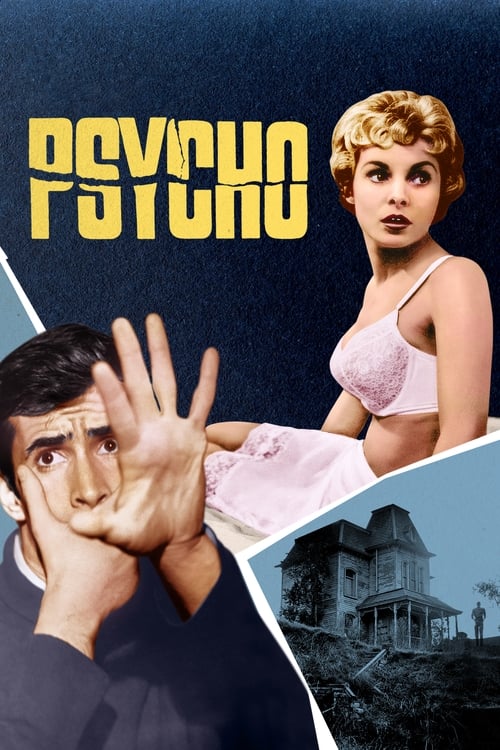
Film · 1960
Psycho
Alfred Hitchcock
The most famous murder in cinema and the knife never once touches skin.
Most extreme on ERA BIAS — analog-era texture at 002
On VHSCREAM’s six-axis scale, Psycho (1960) is most extreme on the era-bias axis: 2 out of 100, where 0 is analog-era texture and 100 is modern craft. 0% of the 105 horror works we have scored come in lower on that axis. How we score →
Psycho is a 1960 horror film directed by Alfred Hitchcock, adapted from Robert Bloch's novel. A woman steals forty thousand dollars, checks into a motel, and is murdered forty minutes in. We score it 002 on era bias — joint-first of 105 works, tied only with the oldest things we hold — and 096 on the threat axis.
Scored and reviewed by VHSCREAM on · how we score
Psycho: the review
Psycho invented the modern horror film by breaking a contract, and the break is still legible.
For forty minutes it is a crime picture. Marion Crane takes the money, drives, is spoken to by a traffic cop, trades her car, and keeps running a conversation in her own head about whether she can go back. Janet Leigh is the star, the camera is hers, and the film has established exactly the kind of story it is. Then she is killed in a bathroom by someone the audience has barely met, and the film continues for another seventy minutes without her.
Audiences in 1960 had no framework for that. Hitchcock bought up copies of Bloch's novel to keep the ending quiet, refused late admission, and the result was the first horror film whose marketing was a condition of its effect.
The shower scene is a montage, not a murder
Seventy-odd shots in under a minute, no blade ever shown entering a body, chocolate syrup for blood because it photographed better in black and white, and Bernard Herrmann's strings — which Hitchcock had wanted to play silent and which are the single most quoted cue in cinema. What makes it hold up is that it is edited rather than depicted. The violence is assembled in your head, which is also why it survives sixty-five years of escalation elsewhere.
Anthony Perkins is the film
Norman Bates works because Perkins plays him as likeable before anything else — awkward, funny, solicitous, eating sweets, talking about birds. The performance has to carry a reveal that would collapse under a sinister reading, and it does. Nothing in the subsequent fifty years of slasher cinema managed to make a killer this specific.
What has not aged well
The psychiatrist's speech. Ten minutes of a man in a room explaining Norman's psychology in terms that were shaky in 1960 and are embarrassing now. It exists because the studio and the audience needed an explanation, and it undoes some of what the film's images had achieved by implying that all of this is tidy and diagnosable.
For the same violence-in-the-edit without the explanation, Halloween is the direct descendant; for the same motel-and-highway dread, The Texas Chain Saw Massacre is the version with no apology in it.
The ending of Psycho explained
Total spoilers from here. Everything above this line is spoiler-free.
The short answer: Norman Bates killed his mother and her lover ten years earlier, preserved her body, and has been committing murders while in a dissociated state he believes to be her. Lila finds the corpse in the fruit cellar; Norman attacks dressed as his mother and is overpowered. A psychiatrist explains the diagnosis, and the final scene is Norman alone, his mother's voice narrating, her skull briefly superimposed on his face.
Who has been killing people in Psycho?
Norman, in every case. There is no mother. The woman whose silhouette appears at the window, whose voice carries down from the house and who refuses to come downstairs, is Norman performing her — and the film cheats carefully to sustain it, using a body double, a dressed corpse in a chair and dialogue recorded by three different performers.
Why does Norman keep his mother's body?
He poisoned her and her lover after she took one, and he could not accept having done it. Preserving the corpse and taking on her personality is the film's explanation for how a person continues after an act they cannot own. The psychiatrist calls the mother the dominant half, which is why Norman's own personality is losing ground by the final scene.
What is the last shot of Psycho?
Marion's car being winched out of the swamp, immediately after Norman — now entirely his mother — sits in a cell planning to stay silent. The film ends on the recovery of the stolen money, which nobody in the story cares about any more. It is a joke about what the audience thought the film was about, delivered ninety minutes after the film stopped being that.
Is Psycho based on a true story?
Loosely and at a distance. Robert Bloch's 1959 novel drew on the case of Ed Gein, a Wisconsin murderer arrested in 1957 who had kept his mother's room intact and exhumed bodies. Gein was neither a motel keeper nor a dissociated impersonator; what Bloch took was the mother, the farmhouse and the preserved remains.
How scary is Psycho, actually?
Scored against the published rubric, here is what the numbers mean.
Era bias 002 is the floor of the index. 102 of 105 works read more modern, and 2 tie it. Black and white, mono, rear projection, a title sequence of sliding bars. Nothing we score is more thoroughly of its moment.
The threat at 096 is near the ceiling — 1 work scores higher. There is nothing supernatural in Psycho. The danger is a polite young man with a knife, which is the whole reason the film reorganised the genre.
Viscera 018 is very low — 11 works score lower. Two murders, both cut to pieces, no wound ever shown. The reputation for brutality is entirely a reputation.
Pace 040 sits on the dread side, with 56 works slower. The first act is a slow crime film and the second is an investigation; the shocks are two and they are enormous.
Reality anchor 012 is almost the floor — only 2 works are more grounded. Nothing impossible happens at any point.
On jump scares: two, and they are the originals. The shower and the cellar. Everything since is a copy of one or the other.
Psycho on six axes of fear
Every work in the index is scored on six continuous axes of fear. This is what Psycho looks like as a vector.
Where that puts it: #1 human monsters · #1 analog era · #3 grounded · #7 without gore
Disagree with a number? Say so on the axis itself. Nobody has confirmed this vector yet, and a score you challenge goes to the top of the queue to be re-scored by a human. Votes do not move the numbers — they decide what gets looked at first. How the scoring works →
Scored against the published rubric. This vector is a draft awaiting review — the method is public so you can argue with it.
Who should skip Psycho
Skip it if you need a horror film to feel modern. At 002 on era bias this is the single most dated-feeling work we score, and for some viewers the mono sound and rear projection are an insurmountable distance.
Skip it if the psychiatric framing will annoy you. The explanation scene is long, wrong and central.
Skip it if you already know the twist and need suspense. Most of the film's original power was structural, and the structure has been spoiled for sixty years.
Content notes: two stabbing murders, a preserved corpse, voyeurism through a peephole, and a depiction of mental illness that is both central and inaccurate.
Watch it if you want to see the film every slasher is descended from, you can accept 1960 craft, and you want proof that an edit frightens people more reliably than an image.
Where to find it
Rent or buy from Amazon Video · Apple TV Store · Google Play Movies +2 ↗Physical copies on eBay ↗Availability from JustWatch via TMDB. We earn nothing from these links.
Nothing loads from YouTube until you press play.
If Psycho is your kind of fear
The eight works closest to Psycho in the index, ranked by distance across all six axes — not by genre label, and not by what other people watched.
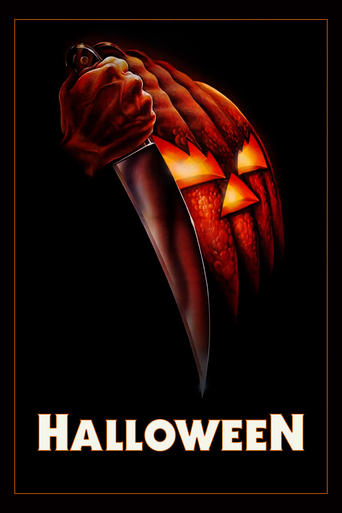
Halloween
John Carpenter · 1978 · Film
Shares analog-era texture.
79% shared signal

Halloween (OST)
John Carpenter · 1978 · Record
Shares restraint over gore.
79% shared signal
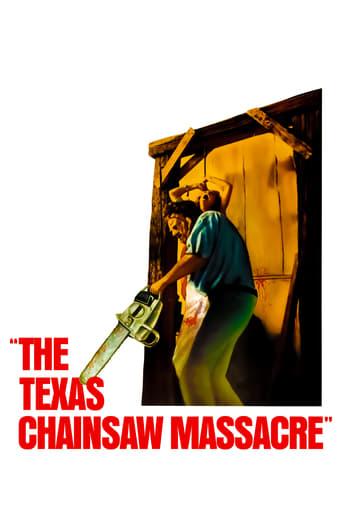
The Texas Chain Saw Massacre
Tobe Hooper · 1974 · Film
Shares human monsters.
78% shared signal
We Have Always Lived in the Castle
Shirley Jackson · 1962 · Book
Shares analog-era texture.
75% shared signal
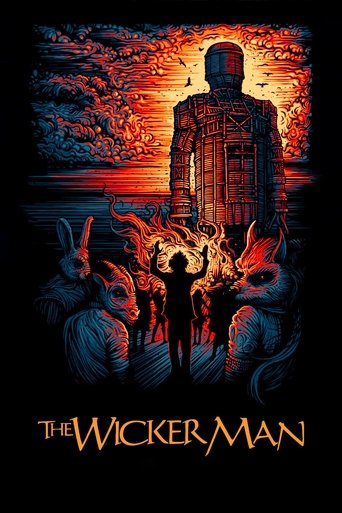
The Wicker Man
Robin Hardy · 1973 · Film
Shares human monsters.
74% shared signal
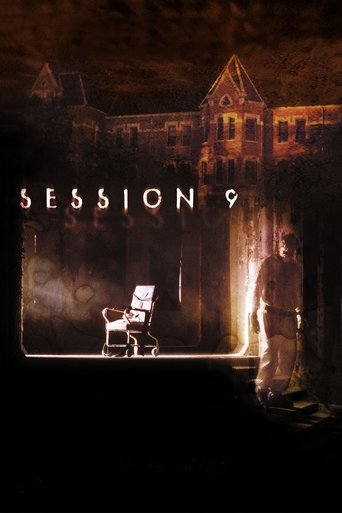
Session 9
Brad Anderson · 2001 · Film
Shares a bleak, unforgiving tone.
70% shared signal
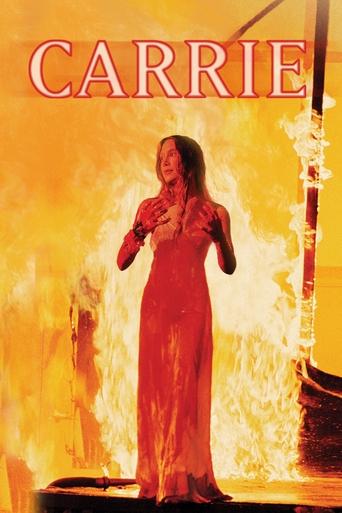
Carrie
Brian De Palma · 1976 · Film
Shares a bleak, unforgiving tone.
69% shared signal

Frankenstein
Mary Shelley · 1818 · Book
Shares restraint over gore.
68% shared signal
See the full list of movies like Psycho →
Questions about Psycho
The things people actually ask about this film, answered.
What happens at the end of Psycho?
Lila finds Norman's mother's preserved corpse in the fruit cellar, and Norman attacks her dressed as his mother before being overpowered. A psychiatrist explains that Norman killed his mother years earlier and now believes himself to be her. The last scene is Norman alone, narrated in her voice.
Who is the killer in Psycho?
Norman Bates, in every murder. There is no mother alive in the film — the figure at the window and the voice in the house are Norman in a dissociated state. Hitchcock sustains the deception with a body double, a dressed corpse and dialogue recorded by multiple performers.
Why does Norman dress as his mother?
He poisoned her and her lover and could not accept having done it, so he preserved her body and took on her personality. When he kills, he does so believing he is her, which the film presents as the mother's half of him gradually overwhelming his own.
Is Psycho gory?
Not at all. We score it 018 on viscera, lower than most of our index. There are two murders, both built from very short cuts, and no blade is ever shown entering a body. The blood was chocolate syrup, chosen because it photographed better in black and white.
Is Psycho based on a true story?
Indirectly. Robert Bloch's novel drew on Ed Gein, arrested in Wisconsin in 1957, who had preserved his mother's room and exhumed bodies. Gein ran no motel and had no second personality; the borrowed elements are the mother, the isolated house and the kept remains.
Is Psycho still scary?
Less frightening than important, for most viewers. The twist has been public for decades and the craft is unmistakably 1960. What still works is the shower sequence, which is assembled rather than depicted, and Anthony Perkins, whose Norman is more specific than any killer the genre has produced since.
These are ranked against Psycho, not against you.
Build your own tape →