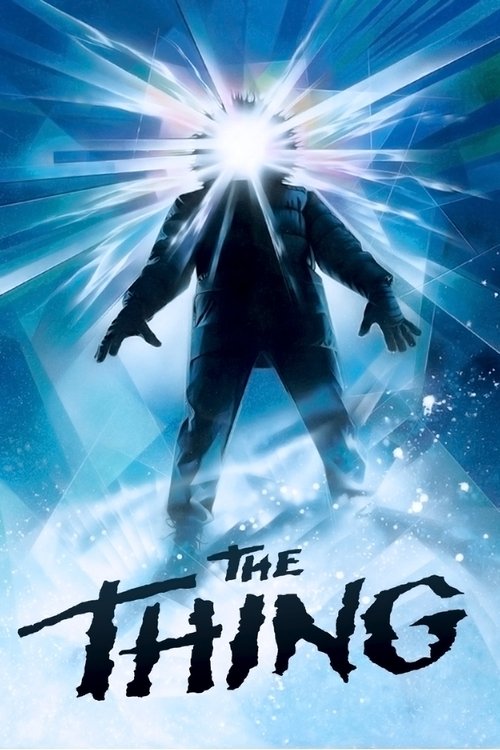
Film · 1982
The Thing
Practical-effects body horror and total paranoia. Nobody is who they say they are.
Most extreme on VISCERA — explicit viscera at 088
On VHSCREAM’s six-axis scale, The Thing (1982) is most extreme on the viscera axis: 88 out of 100, where 0 is restraint over gore and 100 is explicit viscera. 90% of the 105 horror works we have scored come in lower on that axis. How we score →
The Thing is a 1982 science fiction horror film directed by John Carpenter, adapted from John W. Campbell Jr.'s 1938 novella Who Goes There?. An American research station in Antarctica is infiltrated by an organism that perfectly imitates the people it kills. We score it 088 on viscera — more explicit than 95 of 105 works — and 020 on the threat axis, the alien end of the scale.
Scored and reviewed by VHSCREAM on · how we score
The Thing: the review
Paranoia with a budget
Most films about not knowing who to trust cheat: the audience is shown something the characters are not, and the tension becomes dramatic irony. The Thing refuses the cheat. You know exactly what the men at Outpost 31 know, which is nothing, and the film is edited so that even on a rewatch the arithmetic does not quite close. People have been arguing about who was infected when for forty years and the arguments are good arguments, because Carpenter and Bill Lancaster built a film that withholds the one thing a thriller normally gives away.
The result is a horror film that functions as a logic problem, and the blood test is the best scene of its kind ever shot — a sequence that is pure procedure, with a man tied to a bench, a hot wire, and petri dishes, and almost unbearable.
Rob Bottin's effects are not just technically good, they are conceptually correct
A shapeshifter in a lesser film becomes a monster. Bottin's Thing never settles into one, because it is not trying to be anything — it is a thing interrupted mid-imitation, which is why the dog-kennel transformation and the Norris chest sequence are still upsetting in a way that forty years of improvement has not touched. Limbs arrive in the wrong number. A head walks off on spider legs. Nothing in it is designed to be impressive; it is designed to be wrong.
Bottin was twenty-two and hospitalised by the end of the shoot. Stan Winston covered the kennel sequence. It remains the high-water mark of practical creature work and it has aged better than almost any digital equivalent, for the simple reason that it was photographed rather than rendered.
Why it failed and then didn't
It opened in June 1982, two weeks after E.T., into an audience that had just been told the visitor from space wanted to go home. Reviews were hostile, several of them specifically about its violence and its refusal to offer anyone comfort, and it lost money. Carpenter lost a studio deal over it.
What rescued it was the thing that sank it: there is no comfort in it anywhere. No romance, no child, no survivor you can be certain of, no score beyond Morricone's two-note heartbeat, which sounds so much like Carpenter that people routinely credit it to him. The film is twelve men, a dog, and an empty white horizon, and on video and then on disc it found the audience that wanted exactly that.
Kurt Russell's MacReady is the other reason. He is not a hero; he is the man most willing to point a flamethrower at a colleague, and the film is clear-eyed that this is why he is still alive.
The one real weakness
Nobody in it is a character in any depth. Blair gets a calculation, Childs gets a scowl, Palmer gets a joke, and that is roughly the allocation. It is deliberate — in a film about imitation, interiority would be a tell — but it means the deaths cost you less than they should, and the dread is intellectual rather than grief-shaped. Compare Hereditary, where the fear is attached to people. Here it is attached to a situation.
That situation is still, four decades on, the best one in the genre.
The ending of The Thing explained
Total spoilers from here. Everything above this line is spoiler-free.
The short answer: the outpost is burning, and MacReady and Childs sit in the snow watching it go, both wounded, neither able to prove anything about the other. MacReady passes a bottle, Childs drinks, MacReady laughs quietly, and the film ends. Whether either of them is human is never stated.
Does the Thing get out?
No, and this the film does settle. The Thing does not get out. Blair's computer projected that it would reach the rest of the world within hours of civilisation if it escaped, and the destruction of the camp — fuel, generator, shelter — means that whatever is left will freeze. MacReady says it plainly before the finale: he would rather nobody got out, including himself. On that reading the ending is unambiguous and it is a victory.
Is Childs a Thing?
This the film does not settle. Childs has been missing for the entire final act, having gone out into a whiteout after Blair. He returns with a story nobody can check. Both men are too hurt and too cold to fight about it.
What are the clues about Childs?
Childs' breath. The most cited clue: whether you can see it in the firelight. Watch it and you will see breath, which argues he is human — the Thing's assimilated tissue is shown to tolerate cold in other scenes, so the clue cuts weakly in both directions and the print quality you are watching changes what you see.
The earring. Childs is wearing one earring at the end and reportedly two earlier, which has been offered as proof of a replacement. It is thin.
The bottle. MacReady had been seen pouring whisky into a bottle of gasoline earlier. If the bottle he hands Childs is the gasoline, MacReady is testing him and laughing at the result. This is the most satisfying reading and the hardest to evidence from what is on screen.
MacReady's laugh. The last human sound in the film is a man who has worked it out, or a man who has stopped caring, or a thing enjoying itself. The performance is deliberately non-committal.
What has John Carpenter said about the ending?
Carpenter has consistently treated the ambiguity as the design, and has at various times given cheerful and contradictory answers about who is infected. The 1982 novelisation and the 2011 prequel both offer tidier readings; neither is the film.
The honest position is that The Thing ends on a question it has spent its whole runtime teaching you that you cannot answer, which is the most thematically consistent ending available to it. The horror is not that one of them is a Thing. It is that there is no longer any test left to run.
How scary is The Thing, actually?
Scored against the published rubric, here is what the numbers mean for a viewer.
Viscera 088 is the signature and it is not an exaggeration. 95 works score lower, which makes this one of the most explicit things in the index — above Midsommar at 062 and nearly three times The Shining at 030. The body horror is sustained, inventive and wet. If latex and corn syrup in large volumes is a problem for you, this is the wrong film.
Threat 020 is the alien end of the scale. Only 18 works score lower. The antagonist has no motive you can appeal to, no rules you can learn, and no form it keeps.
Pace 055 puts it on the shock side, just. 74 works are slower. The Thing is patient in its first half hour and then runs; the kennel sequence arrives early and resets the film's speed permanently.
Reality anchor 040 keeps it grounded, which matters. 26 works score lower. There is no dream logic here at all — the film is procedural, the men behave like workers, the science is treated as a job. That is precisely why the impossible thing in the middle of it lands.
Era bias 020 is deep analog. 34 works score lower. Anamorphic Panavision, practical effects, a synthesiser heartbeat, and the particular blue-black of a 1982 Universal negative.
Tone 022 is bleaker than most people register — 61 works score lower — because the film has jokes and a hero and still ends with everyone dead or unprovable.
On jump scares: several, and they are earned. This is the one film in our first rank that uses them properly, mostly by having something open that should have stayed shut.
The Thing on six axes of fear
Every work in the index is scored on six continuous axes of fear. This is what The Thing looks like as a vector.
Where that puts it: #8 goriest
Disagree with a number? Say so on the axis itself. Nobody has confirmed this vector yet, and a score you challenge goes to the top of the queue to be re-scored by a human. Votes do not move the numbers — they decide what gets looked at first. How the scoring works →
Scored against the published rubric. This vector is a draft awaiting review — the method is public so you can argue with it.
Who should skip The Thing
Skip it if practical gore is a hard limit. At 088 on viscera it is the joint-seventh most explicit film in the index, and the two big transformation sequences are long, lit and unflinching.
Skip it if you need a resolved ending. The film ends on a question and means it. Viewers who want to know go away angry.
Skip it if you need to care about someone. Characterisation is deliberately shallow because interiority would be a tell. If your way into horror is through people, this film does not offer one.
Content notes: extreme body horror and mutation, animal death including a prolonged sequence involving dogs, suicide, a character killed while restrained, severe burns, amputation, and an attempted blood transfusion scene played as interrogation.
Watch it if you want the best paranoia film ever made, the best practical effects ever shot, and an ending that has kept a genuinely good argument alive for forty years.
Where to find it
Rent or buy from Amazon Video · Apple TV Store · Google Play Movies +2 ↗Physical copies on eBay ↗Availability from JustWatch via TMDB. We earn nothing from these links.
Nothing loads from YouTube until you press play.
If The Thing is your kind of fear
The eight works closest to The Thing in the index, ranked by distance across all six axes — not by genre label, and not by what other people watched.
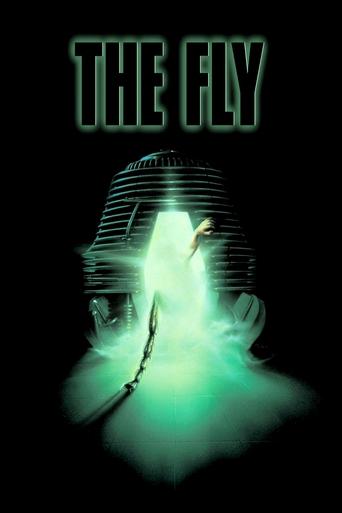
The Fly
David Cronenberg · 1986 · Film
Shares explicit viscera.
89% shared signal
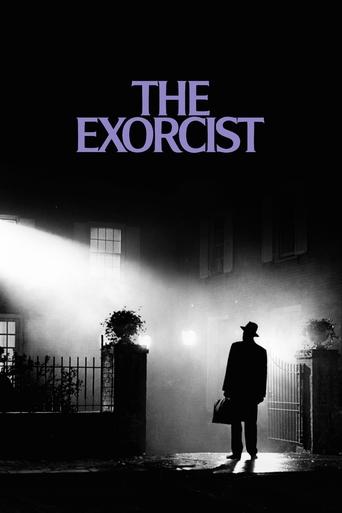
The Exorcist
William Friedkin · 1973 · Film
Shares a supernatural threat.
83% shared signal
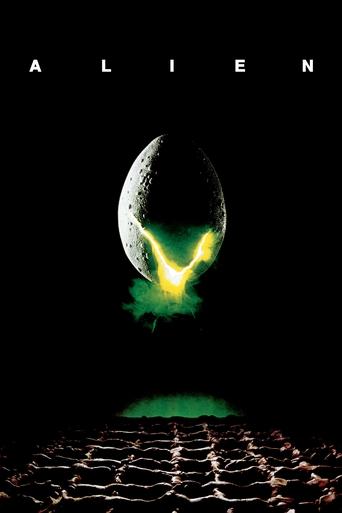
Alien
Ridley Scott · 1979 · Film
Shares analog-era texture.
83% shared signal

Books of Blood
Clive Barker · 1984 · Book
Shares explicit viscera.
79% shared signal
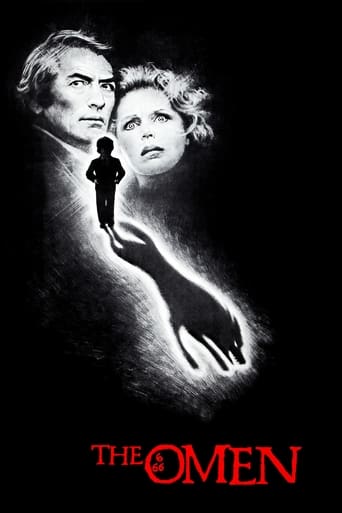
The Omen
Richard Donner · 1976 · Film
Shares a bleak, unforgiving tone.
79% shared signal
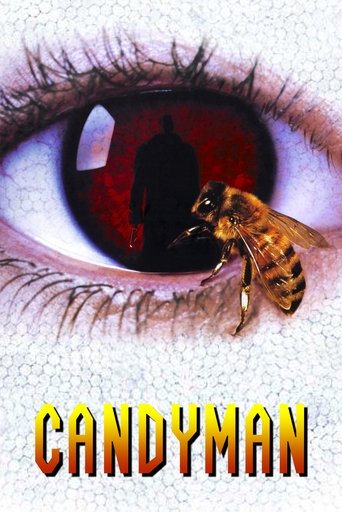
Candyman
Bernard Rose · 1992 · Film
Shares a bleak, unforgiving tone.
77% shared signal
Pet Sematary
Stephen King · 1983 · Book
Shares analog-era texture.
76% shared signal
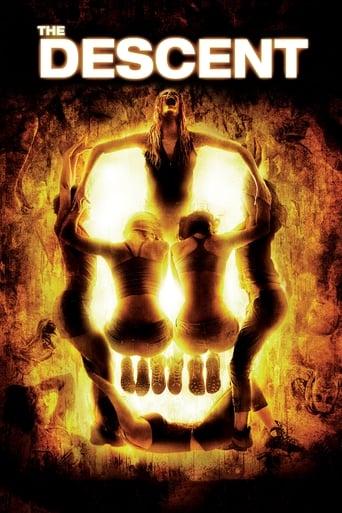
The Descent
Neil Marshall · 2005 · Film
Shares a supernatural threat.
76% shared signal
See the full list of movies like The Thing →
Questions about The Thing
The things people actually ask about this film, answered.
What happens at the end of The Thing?
MacReady destroys the station to make sure the organism cannot escape. He and Childs are left wounded in the snow watching it burn, each unable to prove the other is human. MacReady passes him a bottle, Childs drinks, MacReady laughs, and the film ends without resolving either man's status.
Is Childs the Thing at the end?
The film never says. The commonly cited clues — whether Childs' breath is visible, a missing earring, and whether MacReady's bottle holds whisky or gasoline — point both ways and none is conclusive. Carpenter has treated the ambiguity as deliberate and has given contradictory answers himself.
How gory is The Thing?
Very. We score it 088 on viscera, higher than 95 of the 105 works we score. The two major transformation sequences are long, well-lit and explicit, and the body horror is sustained rather than glimpsed. Rob Bottin's practical effects have not softened with age.
Why did The Thing flop in 1982?
It opened two weeks after E.T. into an audience primed for a friendly alien, and reviews were unusually hostile about its violence and nihilism. It lost money and cost Carpenter a studio relationship. Home video and later reappraisal rebuilt its reputation over the following decade.
Is The Thing a remake?
Both the 1982 film and 1951's The Thing from Another World adapt John W. Campbell Jr.'s 1938 novella Who Goes There?. Carpenter's version returns to the novella's shapeshifting premise, which the 1951 film had dropped in favour of a single humanoid creature, so it is closer to a fresh adaptation than a remake.
Do I need to watch the 2011 prequel?
No. The 2011 film dramatises the Norwegian camp whose aftermath the 1982 film discovers, and it resolves ambiguities the original left open. Watch it afterwards if at all; it works as a footnote and not as a companion.
These are ranked against The Thing, not against you.
Build your own tape →